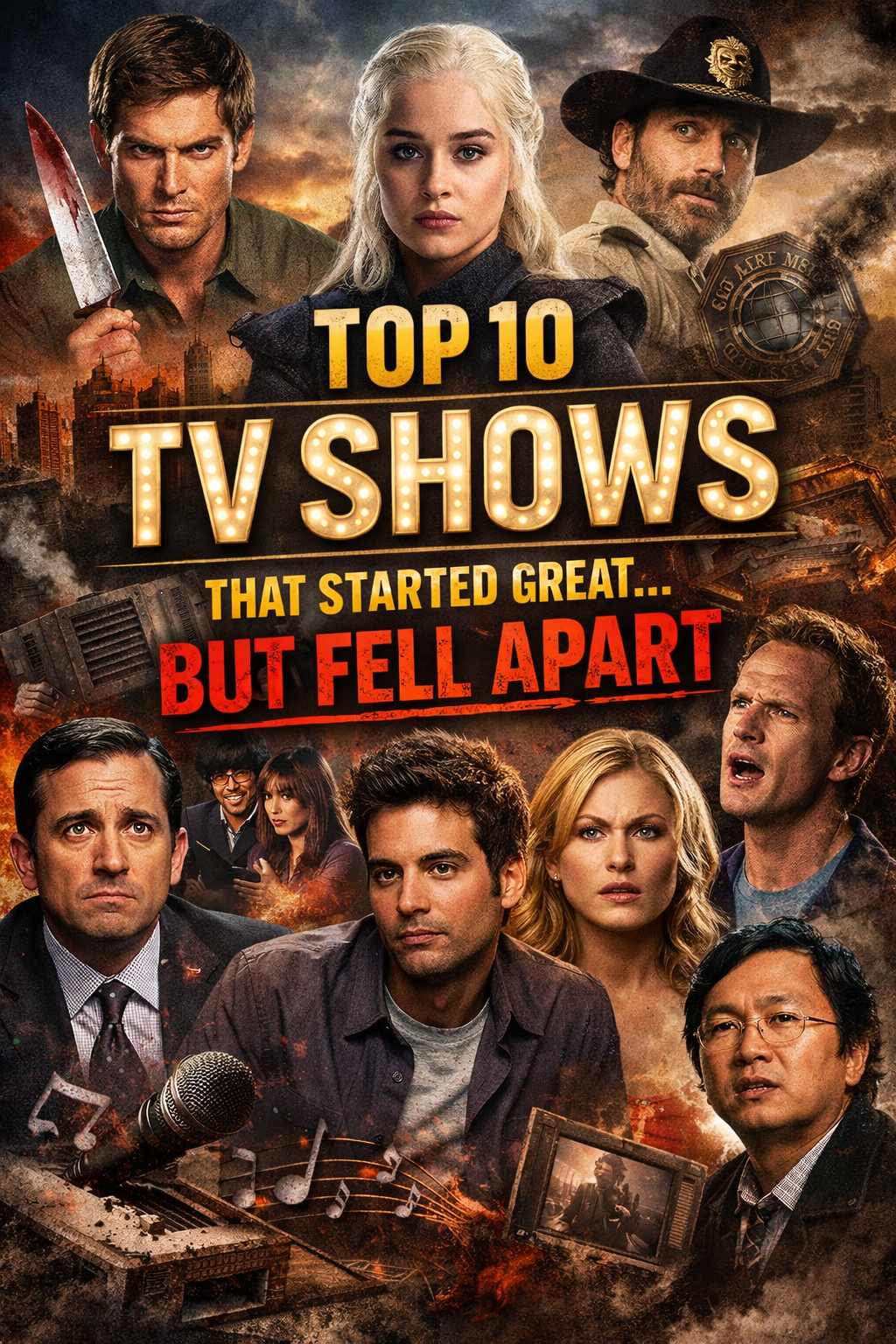
 Television has always been a long game. Unlike movies, which have two hours to tell a story and stick the landing, TV shows stretch narratives across seasons—sometimes years—building characters, deepening arcs, and earning audience trust along the way. When it works, it creates something timeless. But when it doesn’t? The fall can be brutal.
Some shows arrive with electric first seasons—tight writing, compelling characters, and a clear creative vision. They hook audiences instantly, generate buzz, and feel like the next big thing. But somewhere along the way, something changes. Maybe it’s network pressure. Maybe it’s cast departures, creative burnout, or simply a story that didn’t know how to end. Whatever the reason, these shows lost their footing—and never quite recovered.
This list looks at ten of the most notable examples: shows that didn’t just decline, but collapsed under their own weight. These are the series that had us obsessed early on… and scratching our heads by the end.
10. Heroes (2006–2010)
Why It Fell Apart: A victim of its own ambition and the writers’ strike
When Heroes debuted in 2006, it felt like lightning in a bottle. Before the Marvel Cinematic Universe dominated pop culture, this was a grounded, character-driven take on ordinary people discovering extraordinary powers. The first season was tightly constructed, weaving together multiple storylines into a satisfying and emotional climax. The tagline—“Save the cheerleader, save the world”—became instantly iconic.
But everything unraveled almost immediately afterward.
Season 2 was derailed by the 2007–2008 writers’ strike, resulting in a shortened, disjointed storyline that never fully landed. Instead of regrouping and simplifying, the show doubled down on complexity. New characters were introduced at a rapid pace, while established ones became inconsistent or unrecognizable. Time travel plots became convoluted, stakes became muddled, and the emotional core that made Season 1 work began to fade.
The biggest problem was that Heroes kept trying to recreate its original magic instead of evolving. Villains were recycled, arcs were reset, and the show seemed trapped in a loop of its own mythology. What started as a fresh, human take on superheroes slowly turned into a confusing mess of half-baked ideas.
By the time it ended, Heroes wasn’t just disappointing—it was a cautionary tale about how quickly a great premise can collapse without strong direction.
9. The Walking Dead (2010–2022)
Why It Fell Apart: Repetition, pacing issues, and creative fatigue
At its peak, The Walking Dead was a cultural phenomenon. The early seasons delivered a gripping mix of survival horror and human drama, anchored by strong performances and genuinely tense storytelling. The pilot episode alone remains one of the most effective introductions in television history.
But as the seasons dragged on, cracks began to show.
The show developed a formula that became impossible to ignore: find a safe haven, introduce a new villain, build tension, destroy the haven, repeat. While this worked for a while, it eventually led to narrative fatigue. Storylines stretched far longer than they should have, with entire seasons feeling like extended filler.
Character decisions also became increasingly frustrating. Fan-favorite characters were killed off in ways that felt more shocking than meaningful, while others lingered long past their narrative usefulness. The infamous Negan storyline, while initially compelling, was dragged out to the point of exhaustion.
Perhaps the biggest issue was pacing. Episodes that should have been tight and focused instead became slow and meandering, diluting the tension that once defined the series. As viewership declined, the show struggled to recapture its early intensity.
What began as a gripping survival epic slowly turned into a repetitive, bloated series that overstayed its welcome.
8. Dexter (2006–2013, 2021)
Why It Fell Apart: A once-brilliant character lost in weak storytelling
Dexter started with one of the most unique premises in television history: a forensic analyst who moonlights as a serial killer targeting other murderers. The early seasons were sharp, darkly funny, and morally complex, anchored by a career-defining performance from Michael C. Hall.
The Trinity Killer arc in Season 4 is widely considered the show’s peak—a perfect blend of suspense, character development, and emotional weight. Unfortunately, it was all downhill from there.
Subsequent seasons struggled to maintain the same level of tension and originality. Villains became less compelling, storylines grew increasingly far-fetched, and Dexter himself became less interesting as the show softened his darker edges. The writing leaned more into melodrama than psychological depth, losing the balance that made the early seasons so effective.
Then came the finale—widely regarded as one of the worst in TV history. Instead of delivering a meaningful conclusion to Dexter’s journey, the show opted for an ending that felt both rushed and unsatisfying.
The 2021 revival, Dexter: New Blood, attempted to course-correct, but even that ended in a divisive fashion.
Dexter didn’t just fall apart—it squandered one of the most compelling antiheroes ever created.
7. Lost (2004–2010)
Why It Fell Apart: Mystery without payoff
When Lost premiered, it redefined what television could be. It combined character-driven storytelling with intricate mysteries, creating a show that demanded audience engagement on a deeper level. The early seasons were thrilling, unpredictable, and emotionally rich.
But as the mysteries piled up, answers became harder to deliver.
The show introduced countless questions—about the island, the hatch, the numbers, the smoke monster—but struggled to provide satisfying resolutions. While some fans appreciated the philosophical and emotional focus of the later seasons, others felt that the show had abandoned its own mythology.
The introduction of flash-forwards and time travel added layers of complexity, but also confusion. Instead of clarifying the narrative, these elements often made it feel more disjointed.
The finale remains one of the most polarizing in TV history. While it offered emotional closure for the characters, many viewers were frustrated by the lack of concrete answers.
Lost didn’t completely collapse—it remained compelling throughout—but it ultimately failed to deliver on the promises it made early on.
6. Game of Thrones (2011–2019)
Why It Fell Apart: Rushed storytelling and a disastrous final season
For years, Game of Thrones was untouchable. Its early seasons combined political intrigue, complex characters, and shocking twists in a way that captivated audiences worldwide. It felt like prestige television at its absolute peak.
Then came the final seasons.
Once the show moved beyond George R.R. Martin’s source material, the writing began to falter. Character arcs that had been carefully built over years were rushed or abandoned entirely. Key developments happened at breakneck speed, stripping them of emotional impact.
The final season, in particular, was widely criticized for its pacing and narrative decisions. Major plot points—like Daenerys Targaryen’s sudden transformation—felt unearned, while the resolution of the Night King storyline was seen as anticlimactic.
What made the decline so frustrating was how great the show once was. Game of Thrones didn’t just stumble—it crashed in spectacular fashion, leaving a lasting stain on an otherwise legendary series.
5. How I Met Your Mother (2005–2014)
Why It Fell Apart: A finale that betrayed its entire premise
For most of its run, How I Met Your Mother was one of the most beloved sitcoms on television. Its nonlinear storytelling, running gags, and heartfelt moments made it stand out in a crowded genre.
The mystery of the mother’s identity kept viewers invested for years. And when she was finally introduced, she lived up to expectations—charming, funny, and perfectly suited for Ted.
Then the finale happened.
After spending nine seasons building toward a specific conclusion, the show abruptly reversed course. The mother’s story was cut short, and the ending shifted focus back to Ted’s relationship with Robin—undermining years of character development.
The decision felt like a betrayal to many fans. What should have been a satisfying conclusion instead left a sour taste, overshadowing everything that came before it.
4. Westworld (2016–2022)
Why It Fell Apart: Complexity over clarity
Season 1 of Westworld was a masterpiece—thought-provoking, visually stunning, and meticulously crafted. It explored themes of consciousness, free will, and identity in a way that felt both intelligent and emotionally engaging.
But instead of building on that foundation, the show became increasingly convoluted.
Later seasons leaned heavily into nonlinear storytelling and philosophical abstraction, often at the expense of coherence. Plotlines became difficult to follow, and the emotional connection to the characters weakened.
What once felt profound began to feel pretentious. The show seemed more interested in being clever than being compelling.
By the end, Westworld had lost much of its audience—and its sense of purpose.
3. True Blood (2008–2014)
Why It Fell Apart: From intriguing to absurd
True Blood started as a fresh take on vampire mythology, blending Southern Gothic atmosphere with sharp social commentary. The early seasons were sexy, strange, and genuinely engaging.
But as the show progressed, it became increasingly ridiculous.
New supernatural elements were introduced with little explanation, storylines became chaotic, and the tone shifted wildly. What began as a grounded (relatively speaking) drama turned into a campy, over-the-top spectacle.
By the final seasons, the show had lost its identity entirely.
2. Glee (2009–2015)
Why It Fell Apart: Inconsistent tone and behind-the-scenes turmoil
Glee was a cultural phenomenon in its early years, blending music, comedy, and drama in a way that felt fresh and exciting. The first season struck a perfect balance between humor and heart.
But maintaining that balance proved difficult.
Storylines became repetitive, character arcs stalled, and the tone fluctuated wildly between satire and melodrama. Behind-the-scenes issues, including cast changes and real-life tragedies, further complicated the show’s trajectory.
By the end, Glee felt like a shadow of its former self.
1. The Office (U.S.) (2005–2013)
Why It Fell Apart: Losing its central character
At its peak, The Office was one of the greatest sitcoms ever made. Its blend of awkward humor, heartfelt moments, and unforgettable characters made it a cultural staple.
But everything changed when Steve Carell left.
Michael Scott was the heart of the show, and without him, it struggled to find its footing. New characters were introduced, but none could replicate the dynamic that made the earlier seasons so special.
While there were still funny moments, the show never fully recovered. The final seasons felt like a prolonged farewell rather than a continuation of what once made the series great.
Conclusion: When Great Shows Lose Their Way
What makes these shows so fascinating isn’t just that they declined—it’s how high they started. Each one captured something special in its early days, whether it was a unique premise, unforgettable characters, or a bold creative vision.
But television is a marathon, not a sprint. Without careful planning, strong writing, and a clear endgame, even the best shows can lose their way.
And when they do, the fall is often just as memorable as the rise.