 There are plenty of movies that claim to capture what it feels like to grow up. Some lean into nostalgia, others exaggerate for comedy, and a few try so hard to be authentic that they forget to actually be entertaining. But every once in a while, a film comes along that doesn’t feel written at all—it feels remembered.
Dazed and Confused is one of those movies.
On paper, it shouldn’t hit as hard for someone who came of age in the late 1990s. It’s set in 1976, soaked in classic rock, muscle cars, and a cultural landscape that predates cell phones, the internet, and everything else that supposedly defines modern youth. And yet, somehow, it mirrors a completely different era with eerie precision.
Because when you strip away the clothes, the music, and the setting, what’s left is something universal: the rhythm of being young, restless, and out in the world with nowhere specific to go—but absolutely no desire to go home.
The Same Night, Just a Different Location
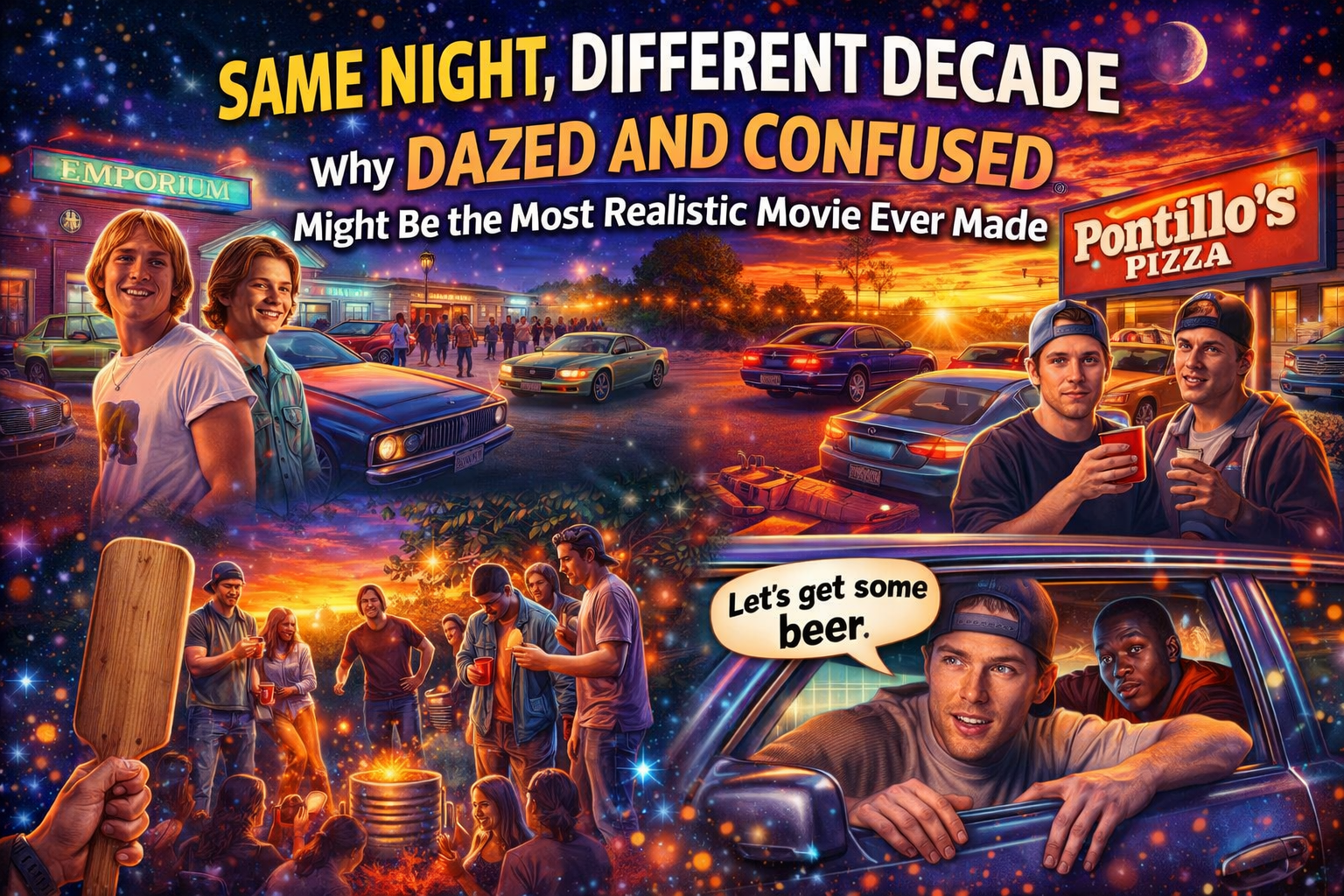
Every generation has its version of the Emporium.
In Dazed and Confused, it’s the pool hall—a central hub where people drift in and out, where plans are made, broken, and remade again. It’s not even about what happens there. It’s about the fact that it exists. A place to orbit around.
For us, it wasn’t the Emporium. It was the Pontillo’s Pizza parking lot.
That was the spot. That was where you went if you didn’t know what else was going on—which was most nights. You’d pull in, see who was there, lean on cars, talk about nothing, and wait for something to happen. Maybe someone knew about a party. Maybe someone was trying to get beer. Maybe it would just be another night of driving around aimlessly.
That’s the magic of Dazed and Confused. It understands that the place doesn’t matter. What matters is the function it serves—a gathering point for a loose, ever-changing community of teenagers trying to figure out what the night is going to become.
Keggers in the Woods and the Myth of “Something Better”
If there’s one thing the movie absolutely nails, it’s the constant search for something better.
There’s always another party. Always a rumor of a bigger kegger, a better crowd, a more exciting scene just a few miles away. And so you leave. You pile into cars, follow vague directions, and chase the idea of a better night.
Sometimes you find it.
Most of the time, you don’t.
Keggers in the woods were the peak. Or at least, they were supposed to be. In reality, they were a mix of chaos and disappointment—warm beer, questionable music, random people, and the constant low-level tension that something could go wrong at any moment.
And yet, they were everything.
Because it wasn’t about the quality of the party. It was about being there. About the freedom of being out, away from parents, away from rules, surrounded by people who were all chasing the same thing: a night that felt like it mattered.
Dazed and Confused captures that perfectly. The anticipation. The letdown. The decision to leave and try again. It’s a cycle that defined entire summers.
The Bullies, the Paddles, and the Things You Don’t Question at the Time
One of the more controversial aspects of Dazed and Confused is the hazing—the paddles, the intimidation, the borderline cruelty. Watching it now, it feels extreme. But for those who lived through similar environments, it feels uncomfortably familiar.
We had our own version of that.
And yeah, looking back on it, it wasn’t great. There was a line between tradition and bullying, and more often than not, we crossed it. At the time, though, it didn’t feel unusual. It was just part of the ecosystem. Something you endured, or something you participated in, depending on where you stood.
That’s another way the movie gets it right—it doesn’t try to moralize in the moment. It just shows it. The awkwardness, the fear, the weird sense of belonging that comes with being included in something that probably shouldn’t exist.
It’s not glorified. It’s just… there.
And that honesty is what makes it feel real.
The Endless Drift of the Night
There’s a certain point in every summer night where time stops making sense.
You’ve been out for hours. You’ve gone from one place to another, back again, then somewhere else entirely. Conversations blur together. Plans dissolve. The night just… stretches.
That’s the core of Dazed and Confused.
There’s no real plot. No major turning point. No single event that defines the night. It’s just a series of moments—some funny, some awkward, some completely forgettable.
And that’s exactly how it felt.
You’d start the night with a vague idea of what you were doing. By midnight, that plan was gone. By 2 a.m., you were just along for the ride. And by the time the sun started coming up, you weren’t even sure how you ended up where you were.
But you weren’t ready to go home.
Because going home meant the night was over. And the night—no matter how uneventful it might seem in hindsight—felt like everything.
Cliques That Weren’t Really Cliques
High school movies love to divide people into neat categories: jocks, nerds, stoners, popular kids. And while those labels exist, Dazed and Confused understands something deeper—they’re more fluid than we like to admit.
Sure, there were the cool kids. The stoners. The jocks. The outsiders.
But when it came to nights like these, those lines blurred.
You’d see people you never talked to at school. People who existed in completely different social circles suddenly standing next to you at a party, sharing a drink, laughing at the same dumb joke.
It was one of the few times those worlds collided.
And sometimes, it was surprising. The quiet kid you never noticed. The straight-A student who somehow ended up at the same kegger. The person you assumed wouldn’t be there—but was.
The movie captures that perfectly. It doesn’t isolate its characters—it lets them drift in and out of each other’s stories, just like real life.
The Hothead Everyone Knew
Every group had one.
The guy who was always on edge. Always looking for a reason. The one who could turn a normal night into something tense in seconds.
In Dazed and Confused, that energy is always simmering just beneath the surface. Not enough to dominate the story, but enough to remind you that things could go sideways at any moment.
That was real.
You could be having a perfectly good night, and then suddenly, something shifts. A look, a comment, a misunderstanding—and now everyone’s paying attention. Watching. Waiting to see what happens next.
Most of the time, it blew over.
But the possibility was always there.
And that added a layer of unpredictability to every night that you don’t really appreciate until it’s gone.
Driving Around for No Reason (and Every Reason)
If there’s one universal experience that transcends decades, it’s this: driving around with no destination.
Gas wasn’t cheap, but it didn’t matter. You piled into whatever car was available, rolled the windows down, turned up the music, and just… drove.
Looking for something.
Beer. A party. People. Anything.
The act of driving itself was part of the night. It was movement. It was freedom. It was the space between one moment and the next.
Dazed and Confused understands that completely. Some of its best scenes happen in cars—not because of where they’re going, but because of what’s happening inside them.
The conversations. The silence. The anticipation.
It’s all part of it.
The Sunrise Walk Home
There’s a very specific feeling that comes with the end of a long night.
The air is different. Cooler. Quieter. The world feels like it’s resetting, and you’re somehow still awake inside it.
Walking home as the sun comes up isn’t dramatic. It’s not cinematic in the traditional sense.
But it sticks with you.
Because it means the night is over. And for a few hours, you were part of something that felt bigger than it actually was.
Dazed and Confused doesn’t treat this moment as an ending. It just lets it happen.
And that’s exactly how it feels in real life.
Why It Still Feels True
The reason Dazed and Confused feels so real isn’t because of when it takes place—it’s because of what it understands.
It understands that being young isn’t about major events. It’s about small moments strung together over time. It’s about the in-between. The waiting. The wandering.
It’s about nights that don’t seem important until they’re over—and then you realize they were everything.
You can change the decade. Swap out the music. Replace the Emporium with a pizza parking lot.
It doesn’t matter.
Because the experience is the same.
Final Thoughts
There are bigger movies. More dramatic ones. More influential ones.
But there are very few that feel this honest.
Dazed and Confused isn’t just a movie about the 1970s. It’s a movie about a feeling—a very specific kind of freedom that exists for a brief window of time, usually before you even realize how much it matters.
For those of us who lived through our own version of it in the late ’90s, it’s not just relatable.
It’s almost identical.
Different decade. Same night.