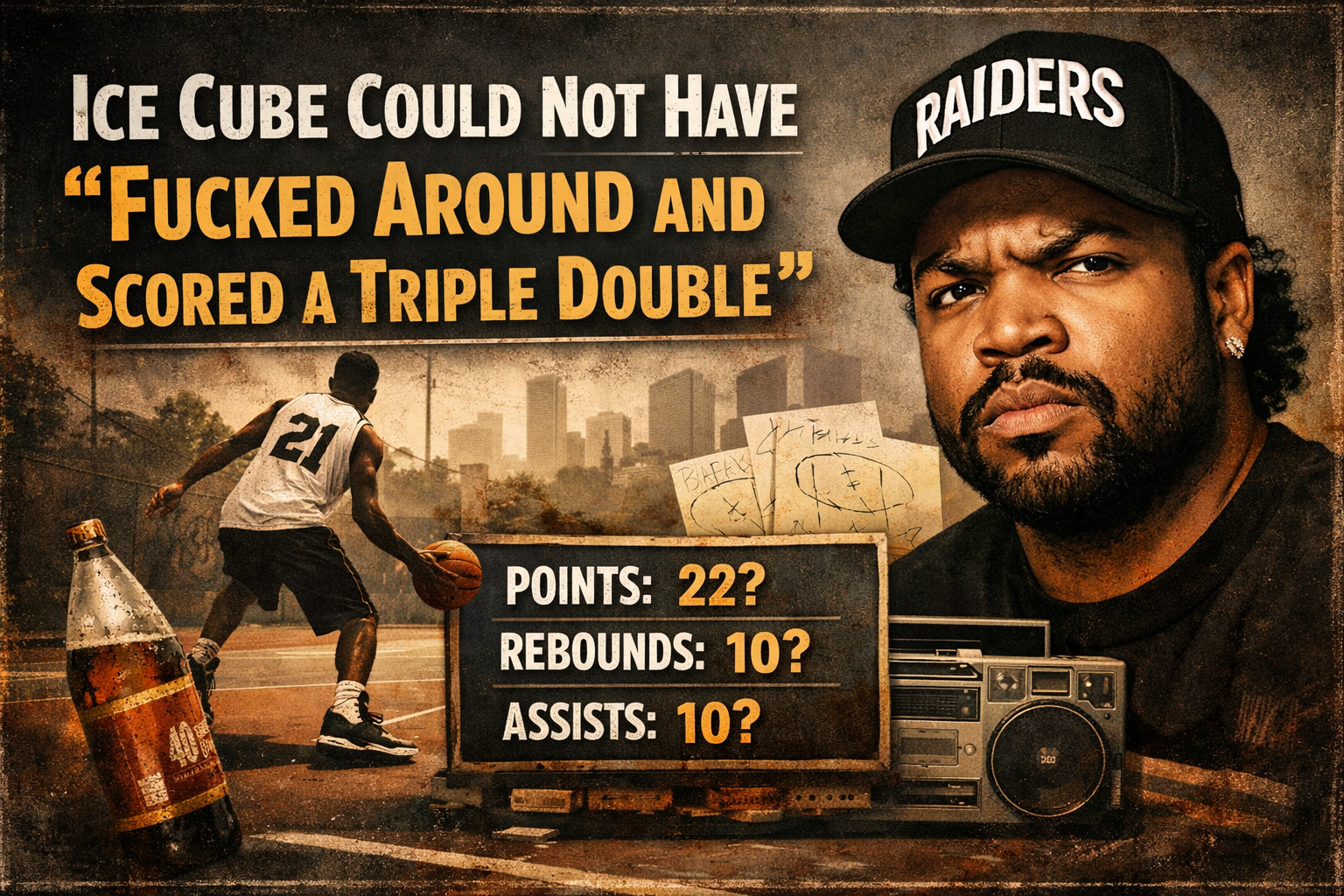
 In the landscape of 1990s hip-hop, few lines are as iconic as Ice Cube’s nonchalant boast in “It Was a Good Day”: “Messed around and got a triple-double.” It is the ultimate flex—an effortless display of dominance that suggests Cube was the Magic Johnson of the South Central blacktop. However, if we apply the cold, hard logic of basketball analytics to the typical structure of a playground pickup game, the claim begins to unravel. While the day may have been “good,” the “triple-double” was almost certainly a mathematical impossibility.
The most significant barrier is the scoring format. Most playground games are played to 21 points, scored by ones and twos (shots inside and outside the arc). In a game to 21, the total “statistical pie” is incredibly small. To achieve a triple-double, a player must reach double digits in three categories, typically points, rebounds, and assists. If Cube’s team won the game with 21 points, and he recorded 10 assists, those assists represent at least 10 points (if all were one-pointers) or up to 20 points (if all were two-pointers).
If we assume a mix, those 10 assists likely accounted for 12 to 15 of his team’s points. For Cube to then “mess around” and score 10 points himself, his team would have needed to score at least 22 to 25 points. In a game capped at 21, the math simply doesn’t square. He would have had to be directly responsible for nearly every single basket his team made, leaving zero room for teammates to score unassisted or for Cube to grab a bucket that wasn’t part of a perfectly choreographed offensive set.
The difficulty intensifies when you factor in the tenth rebound. In a professional 48-minute game, there are roughly 100 missed shots available to be caught. In a streetball game to 21, which usually lasts about 15 minutes, there are far fewer “reboundable” events. For Cube to snatch 10 rebounds while also spending enough time on the perimeter to rack up 10 assists and 10 points, he would have to be everywhere at once. He would need to be the primary ball-handler, the primary finisher, and the primary “big man” cleaning the glass.
Furthermore, playground basketball is notoriously “iso-heavy.” Assists are rarely tracked and even more rarely given; if a player dribbles more than twice before scoring, most streetball purists won’t credit the passer with an assist. For Cube to find teammates willing and able to convert 10 assisted baskets in a short game to 21 is perhaps the most mythical part of the entire story.
While Ice Cube’s lyric perfectly captures the feeling of an unstoppable afternoon, the “triple-double” remains a professional-grade achievement that requires more time and more possessions than a game to 21 can provide. He likely had a great game—perhaps a “five-by-five” or a very efficient 8-7-6—but the triple-double remains a glorious, lyrical exaggeration.