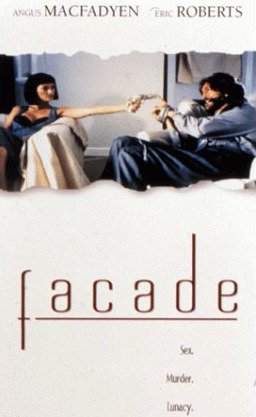
 There are movies that are confusing because they’re ambitious. There are movies that are confusing because they’re trying to tell a complicated story. Then there are movies like Facade (1999), which seem confusing because nobody involved stopped for five seconds and asked, “Does any of this actually make sense?”
If you actually want to try to watch this movie and understand it, you stream it for free on tubi right here
Starring Eric Roberts, Angus Macfadyen, Camilla Overbye Roos, Joe Viterelli, and—somehow—Brad Garrett, Facade is one of those late-1990s direct-to-video thrillers that looks like it should be a straightforward murder mystery but gradually transforms into a maze of double-crosses, secret agendas, hidden motives, hired killers, suspicious business deals, and enough plot twists to make your head hurt.
What’s fascinating about Facade isn’t that it’s bad. Plenty of movies are bad. What’s fascinating is that every time you think you’ve finally figured out what’s happening, the movie throws another layer of nonsense onto the pile.
By the end, you’re not trying to solve the mystery anymore.
You’re trying to figure out whether the writers were daring the audience to keep up.
The Movie Begins With a Perfectly Reasonable Premise
At first, Facade seems normal.
Caroline Kelner returns from a business trip to discover that her wealthy husband has been murdered alongside his mistress. Naturally, she’s terrified because it quickly becomes apparent that whoever ordered the hit may not be finished yet.
So far, so good.
This is Thriller Writing 101.
Dead husband.
Possible conspiracy.
Widow in danger.
Unknown enemies.
A mystery to solve.
You can practically hear the gears of a classic noir thriller starting to turn.
Unfortunately, this simple setup lasts approximately fifteen minutes before the movie decides simplicity is for cowards.
Everyone Is Suspicious
One of the biggest problems with Facade is that every single person seems suspicious.
Normally, a mystery introduces a few possible suspects.
Facade introduces what feels like an entire zip code of possible suspects.
The result is that nobody stands out.
Imagine playing a game of Clue where every character is carrying a bloody knife.
That’s basically Facade.
Every conversation feels loaded with hidden meaning.
Every character seems to know something.
Every person appears connected to somebody else.
The film becomes so obsessed with creating suspicion that it accidentally destroys suspense.
When everyone is suspicious, nobody is interesting.
Eric Roberts Is Trying Very Hard
Let’s talk about Eric Roberts.
Throughout his career, Roberts has appeared in everything from acclaimed dramas to wonderfully bizarre B-movies.
He’s one of those actors who always seems committed, regardless of what kind of movie he’s making.
That’s certainly true here.
The fascinating thing about Roberts’ performance is that he appears to believe he’s starring in a serious, sophisticated thriller.
He delivers his dialogue with conviction.
He reacts seriously to every twist.
He treats every revelation like it matters.
The problem is that the plot surrounding him often resembles something written on a napkin at three in the morning.
Watching him navigate the story is like watching a professional race-car driver attempt to win the Indianapolis 500 while driving through a carnival.
He’s doing his best.
The environment is the problem.
The Conspiracy Gets Needlessly Complicated
One of the golden rules of thrillers is that the villain’s plan should become clearer as the movie progresses.
Not in Facade.
In Facade, the conspiracy becomes increasingly ridiculous.
Instead of clarifying motivations, the movie keeps adding more.
Someone wants money.
Someone wants revenge.
Someone wants power.
Someone wants property.
Someone wants a giant hotel.
Wait.
A giant hotel?
Yes.
A giant hotel.
At some point, the movie essentially asks the audience to accept that a significant portion of the story revolves around a grand development project.
This is where things begin falling apart.
Because once you start examining the actual plan, you realize that murder, deception, manipulation, and an army of suspicious people are all being employed to achieve goals that seem wildly disproportionate to the effort involved.
The Villains Have the Most Complicated Plan in Human History
Imagine you wanted something.
Most people would pursue the simplest solution available.
Not the villains in Facade.
These people approach every obstacle as though they’re competing in the Olympic Games of Overcomplication.
Need information?
Don’t ask.
Create an elaborate deception.
Need money?
Don’t negotiate.
Launch a conspiracy.
Need somebody removed?
Don’t solve the problem directly.
Construct a maze of betrayals that requires twelve different participants.
The entire movie feels like a master class in making simple tasks impossibly difficult.
By the halfway point, you’re left wondering whether the villains actually want to succeed.
Or whether they simply enjoy creating unnecessarily complex situations.
Nobody Talks Like a Real Person
A common issue in thrillers is exposition.
Characters often need to explain things.
Facade solves this problem by having characters constantly speak in vague, cryptic dialogue.
Nobody says what they mean.
Nobody answers questions directly.
Everyone speaks as though they’re auditioning for a noir parody.
Simple conversations become bizarre verbal obstacle courses.
Instead of:
“Here’s what’s happening.”
You get:
“There are things you don’t understand.”
“Some truths are better left hidden.”
“You’ll know when the time comes.”
Will I?
Because I’m ninety minutes into this movie and I still don’t know what’s happening.
Caroline Makes Some Truly Amazing Decisions
Let’s discuss Caroline.
She’s supposed to be our emotional anchor.
The audience experiences the mystery through her perspective.
Unfortunately, she makes decisions that test the limits of human patience.
Again and again, she trusts people she shouldn’t trust.
Again and again, she ignores obvious warning signs.
Again and again, she walks directly into situations that scream danger.
At one point, it feels like the movie is operating under a special rule:
If Caroline can make the wrong decision, she absolutely will.
You want to root for her.
The movie makes that difficult.
Coincidences Save the Plot
The screenplay has another major problem.
Coincidences do most of the heavy lifting.
Characters run into exactly the right people.
Information appears at exactly the right time.
Clues magically surface when needed.
Events line up with astonishing convenience.
Instead of feeling like a carefully crafted mystery, the movie often feels like a collection of accidents.
Whenever the writers hit a dead end, coincidence arrives to save the day.
It’s less detective work and more cosmic luck.
Brad Garrett Randomly Appears
Now let’s discuss perhaps the strangest aspect of the movie.
Brad Garrett.
Yes.
That Brad Garrett.
The future Emmy-winning star of Everybody Loves Raymond.
His appearance in Facade feels like discovering your dentist in the middle of a James Bond movie.
You’re not necessarily upset.
You’re just confused.
Every time he appears, your brain briefly stops processing the plot because you’re busy wondering how this casting happened.
It’s not that Garrett is bad.
It’s that his presence somehow makes the movie even stranger.
The Tone Is Completely Unstable
One scene feels like a serious thriller.
The next feels like a soap opera.
The next feels like an action movie.
Then suddenly we’re back to mystery.
Then melodrama.
Then noir.
Then crime film.
Then something else entirely.
The movie never settles on an identity.
It’s like five different thrillers fighting for control of the same screenplay.
The result is tonal whiplash.
Just when you adjust to one style, the movie changes again.
The Mystery Isn’t Actually Fun to Solve
Here’s the biggest crime Facade commits.
The mystery isn’t enjoyable.
Great mysteries give viewers clues.
The audience can participate.
You can make predictions.
You can test theories.
Facade doesn’t really allow that.
Too much information is hidden.
Too many motivations are unclear.
Too many developments arrive without proper setup.
The movie mistakes secrecy for cleverness.
They’re not the same thing.
A mystery should make you feel smart.
Facade mostly makes you feel lost.
The Ending Doesn’t Fix Anything
Many confusing thrillers redeem themselves with a strong ending.
Everything clicks.
Questions get answered.
The pieces fall into place.
Not here.
The ending explains some things.
But explaining something isn’t the same as justifying it.
You may understand what happened.
That doesn’t mean it suddenly makes sense.
Several plot developments remain difficult to accept.
Certain character decisions remain baffling.
The conspiracy still feels absurd.
The giant hotel still feels ridiculous.
The movie reaches its conclusion without ever fully earning it.
Yet Somehow It’s Still Watchable
This is the weirdest part.
Despite everything I’ve criticized, Facade isn’t boring.
Confusing?
Absolutely.
Frustrating?
Constantly.
Illogical?
Without question.
Boring?
Not really.
The movie keeps moving.
New twists keep arriving.
Characters keep revealing secrets.
The story never stops throwing things at the audience.
Even when the plot stops making sense, curiosity takes over.
You keep watching because you genuinely want to see how much crazier things can get.
And trust me.
They get crazier.
A Perfect Example of Late-90s Direct-to-Video Madness
Movies like Facade don’t get made very often anymore.
It belongs to a very specific era.
The late 1990s were filled with direct-to-video thrillers featuring recognizable actors, ambitious plots, and limited budgets.
These films often aimed for the complexity of big studio mysteries without having the resources to pull them off.
Sometimes they succeeded.
Sometimes they failed spectacularly.
Facade lands somewhere in between.
Its ambitions are much larger than its execution.
But there’s something admirable about that.
The filmmakers clearly wanted to create an intricate thriller.
They just got a little carried away.
Actually, a lot carried away.
The Movie Feels Like Three Scripts Combined Into One
The best way to describe Facade is this:
It feels like three different movies merged together.
One movie is a murder mystery.
One movie is a business conspiracy thriller.
One movie is a noir crime drama.
Instead of choosing one direction, the film attempts all three simultaneously.
The result is fascinating chaos.
Every subplot competes for attention.
Every character carries baggage.
Every twist introduces more complications.
It’s ambitious.
It’s messy.
It’s occasionally entertaining.
And it rarely makes sense.
Final Verdict: A Fascinating Disaster
Facade isn’t the worst thriller ever made.
Far from it.
The cast is solid.
The cinematography is respectable.
The performances are generally committed.
The movie clearly had ambition.
The problem is that ambition alone isn’t enough.
A thriller needs logic.
It needs clarity.
It needs motivations that hold together under scrutiny.
Facade frequently lacks all three.
The film creates a giant web of conspiracies, betrayals, murders, secrets, and business schemes that ultimately collapse under their own weight. Every twist makes the story more confusing. Every revelation creates new questions. Every attempt to explain things somehow makes them harder to understand.
And yet, there’s something strangely lovable about it.
Maybe it’s Eric Roberts giving 110 percent.
Maybe it’s Brad Garrett’s unexpected appearance.
Maybe it’s the sheer audacity of the plot.
Or maybe it’s because the movie is so committed to its nonsense that you can’t help but admire it.
Twenty-five years later, Facade remains one of those forgotten thrillers that leaves viewers asking the same question:
“What exactly did I just watch?”
And honestly, that’s probably the most memorable thing about it.
After all, there are plenty of bad movies you’ve forgotten.
But a movie this confusing?
That sticks with you forever.