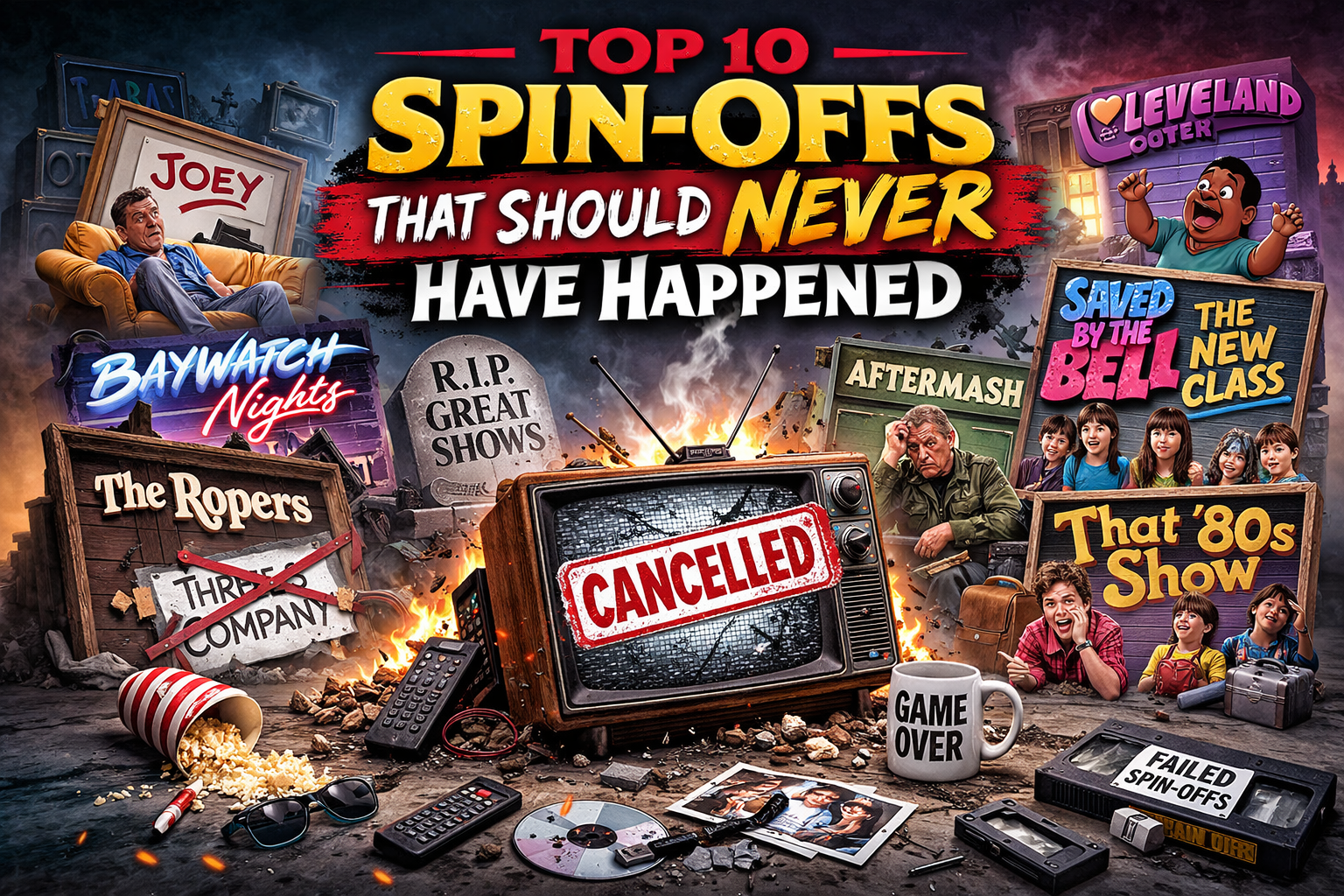
 Television history is filled with bold ideas, risky experiments, and occasionally, baffling misfires. The spin-off—one of TV’s most reliable formulas—can either expand a beloved universe or dilute it beyond recognition. For every success story like Frasier or Better Call Saul, there are far more cautionary tales where networks tried to bottle lightning twice and ended up with something awkward, unnecessary, or outright painful to watch.
Spin-offs often fail for predictable reasons: stripping away the chemistry that made the original work, overestimating a side character’s appeal, or forcing a premise that simply doesn’t have the depth to sustain a full series. Sometimes, the concept itself feels like a desperate attempt to keep a franchise alive long after its natural expiration date.
What follows is a look at ten spin-offs that, in hindsight, should have stayed in the writers’ room. These shows didn’t just miss the mark—they serve as reminders that not every supporting character deserves the spotlight, and not every world needs expanding.
10. Joey (Friends)
Why It Didn’t Work: Charm without chemistry is just empty space.
When Friends ended in 2004, NBC faced the daunting reality of losing one of the biggest sitcoms of all time. The solution? Keep the party going with Joey, centered around Matt LeBlanc’s lovable but dim-witted actor. On paper, it made sense—Joey Tribbiani was one of the most popular characters on the show. In practice, it exposed a harsh truth: Joey worked because of the ensemble, not despite it.
Removed from the tight-knit dynamic of Ross, Rachel, Chandler, Monica, and Phoebe, Joey suddenly felt one-dimensional. His womanizing antics and naive charm, once balanced by sharper personalities, became repetitive and, frankly, tiring. The supporting cast in Los Angeles never came close to replicating the magic of the original group, and attempts to deepen Joey’s character often fell flat.
The show struggled with tone as well. It wasn’t as witty as Friends, nor did it fully commit to reinventing Joey in a meaningful way. Instead, it lingered in an awkward middle ground—familiar but hollow.
Ultimately, Joey serves as a textbook example of why spin-offs need more than a familiar face. They need a reason to exist. Without the chemistry that made him shine, Joey Tribbiani was left stranded in a show that quickly lost its way.
9. AfterMASH (MAS*H)
Why It Didn’t Work: Continuing a perfect ending is a losing battle.
MASH* ended in 1983 with one of the most-watched television finales in history—a near-perfect conclusion that wrapped up its characters’ journeys with emotional precision. So naturally, someone decided to keep it going.
AfterMASH followed Colonel Potter, Klinger, and Father Mulcahy as they transitioned to civilian life at a veterans’ hospital. While the premise had potential, it lacked the tension and urgency that defined the original series. The Korean War setting wasn’t just a backdrop—it was the emotional engine of MASH*. Without it, the show felt directionless.
The tone shift was also jarring. MASH* balanced humor with profound commentary on war, trauma, and humanity. AfterMASH, by contrast, leaned heavily into lighter storytelling, losing the depth that made its predecessor resonate.
Viewers weren’t interested in seeing these characters in a watered-down environment. The stakes were lower, the conflicts less compelling, and the emotional impact diminished.
In trying to extend the legacy of a masterpiece, AfterMASH only highlighted why some stories are better left finished.
8. The Cleveland Show (Family Guy)
Why It Didn’t Work: A side character isn’t always leading material.
Cleveland Brown was a steady, understated presence on Family Guy, often serving as a calm counterbalance to Peter Griffin’s chaos. But giving him his own show revealed the limitations of that character dynamic.
The Cleveland Show relocated Cleveland to Stoolbend, Virginia, where he reunited with a high school flame and formed a new family. The problem? Cleveland’s low-key personality, which worked as a supporting role, struggled to carry a series. The show attempted to compensate by surrounding him with louder, more eccentric characters, but the result felt like a diluted version of Family Guy rather than something unique.
Humor that once felt sharp and unpredictable became formulaic. Storylines lacked the edge and irreverence that defined Seth MacFarlane’s flagship series. Even crossover appearances couldn’t sustain long-term interest.
Despite a respectable run, The Cleveland Show never justified its existence creatively. It wasn’t terrible—it was worse than that. It was forgettable.
7. Joanie Loves Chachi (Happy Days)
Why It Didn’t Work: Popularity doesn’t equal depth.
During its peak, Happy Days was a cultural juggernaut, and Joanie and Chachi were among its most beloved young characters. ABC saw an opportunity and spun them off into their own show, relocating them to Chicago to pursue music careers.
The problem was immediately apparent: their appeal on Happy Days was rooted in their relationship with the larger cast. Removed from that environment, their characters lacked the substance needed to anchor a series.
The show leaned heavily on their romance, but without compelling supporting characters or meaningful conflict, it quickly became repetitive. Musical elements added little, often feeling like filler rather than storytelling.
Audience interest faded rapidly, and the series was canceled after just one season. In hindsight, Joanie Loves Chachi feels like a classic case of mistaking audience affection for narrative potential.
6. Baywatch Nights (Baywatch)
Why It Didn’t Work: A bizarre identity crisis.
Baywatch was known for sun-soaked beaches, slow-motion runs, and melodramatic rescues. So naturally, someone thought, “What if we turned this into a detective show… with supernatural elements?”
Baywatch Nights began as a straightforward crime drama starring David Hasselhoff’s Mitch Buchannon as a private investigator. But when ratings lagged, the show pivoted wildly in its second season, introducing paranormal storylines involving ghosts, aliens, and monsters.
The tonal whiplash was staggering. Fans of the original series had little interest in watching lifeguards battle the occult, and new viewers weren’t drawn in either. The show felt like two incompatible concepts awkwardly stitched together.
Instead of expanding the Baywatch universe, it distorted it beyond recognition. The result was a spin-off that became infamous for its sheer absurdity.
5. The Lone Gunmen (The X-Files)
Why It Didn’t Work: Side characters lose their mystique in the spotlight.
The Lone Gunmen were a quirky highlight of The X-Files, offering comic relief and conspiracy-laden intrigue. But as a standalone series, their charm quickly wore thin.
The show leaned heavily into humor, abandoning much of the eerie atmosphere that made The X-Files compelling. Without Mulder and Scully anchoring the narrative, the stakes felt significantly lower.
While the series had its moments, it struggled to balance comedy and conspiracy effectively. What worked in small doses became overexposed.
Ironically, the show’s pilot episode—featuring a plot about hijacking an airplane—gained notoriety after real-world events, but even that couldn’t save it from cancellation.
The Lone Gunmen were best left in the shadows, where their mystery could thrive.
4. Saved by the Bell: The New Class
Why It Didn’t Work: Replacing magic isn’t the same as recreating it.
When the original Saved by the Bell ended, NBC attempted to keep the formula alive with The New Class. The show recycled the same setting, structure, and even some character archetypes, but swapped in a new cast of students.
The result felt like a pale imitation. Without the charisma of Zack Morris and his friends, the show struggled to establish its own identity. Storylines often mirrored those of the original series, creating a sense of déjà vu rather than nostalgia.
Even the return of Mr. Belding couldn’t bridge the gap. The chemistry that made the original series memorable simply wasn’t there.
Running for several seasons, The New Class wasn’t a total failure—but it lacked the cultural impact and charm of its predecessor. It existed more as a placeholder than a worthy continuation.
3. The Brady Brides (The Brady Bunch)
Why It Didn’t Work: Nostalgia can’t carry a weak premise.
Following the success of The Brady Bunch, producers attempted to extend the story with The Brady Brides, focusing on Marcia and Jan as newlyweds sharing a house with their husbands.
The concept was thin from the start. Much of the original show’s appeal came from the large, blended family dynamic. Reducing the cast stripped away the complexity and humor that defined the series.
Storylines often revolved around domestic squabbles and sitcom clichés, lacking the charm and innocence of the original.
Despite its familiar characters, The Brady Brides failed to capture the spirit of The Brady Bunch. It quickly faded, leaving little lasting impression.
2. That ’80s Show (That ’70s Show)
Why It Didn’t Work: A name isn’t enough.
Hoping to replicate the success of That ’70s Show, Fox launched That ’80s Show with a completely new cast and setting. The only real connection was the decade in the title.
Without shared characters or narrative continuity, the show felt more like a marketing gimmick than a true spin-off. It leaned heavily on 1980s nostalgia—fashion, music, and pop culture references—but lacked the heart and character-driven storytelling of its predecessor.
The characters were less defined, the humor less sharp, and the emotional core almost nonexistent.
Audiences quickly saw through the superficial similarities, and the show was canceled after just one season. It stands as a reminder that nostalgia alone isn’t enough to build a lasting series.
1. The Ropers (Three’s Company)
Why It Didn’t Work: Removing the conflict removes the show.
Three’s Company thrived on misunderstandings, double entendres, and the constant tension between Jack Tripper and his landlords, Stanley and Helen Roper. So what happens when you remove that dynamic and give the landlords their own show?
You get The Ropers, a spin-off that struggled to justify its existence from the start.
Without Jack and the roommates to play off, Stanley’s gruff demeanor and Helen’s sarcasm had little to bounce against. The show attempted to build new scenarios around their marriage, but the central conflict that made them entertaining was gone.
The humor felt forced, and the pacing sluggish compared to the original series. Even fans of Three’s Company found little reason to tune in.
Canceled after two seasons, The Ropers is often cited as one of the clearest examples of why not every character should be spun off. Sometimes, a character works because of their environment—and once that’s gone, so is the magic.
Final Thoughts
Spin-offs are a gamble. When they work, they can expand a universe in meaningful ways, offering new perspectives and deeper storytelling. But when they fail, they expose the delicate balance that made the original successful in the first place.
The shows on this list share a common flaw: they misunderstood what made their parent series special. Whether it was chemistry, tone, or narrative depth, something essential was lost in translation.
In the end, these spin-offs serve as a reminder that not every idea needs to be extended. Sometimes, the best thing a show can do is end—and leave its legacy intact.