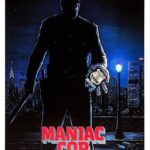
 Horror movies often prey on familiar fears, transforming everyday places and trusted figures into sources of terror. Few films embraced that concept more effectively than Maniac Cop, the 1988 cult classic that asked a chilling question: What if the person sworn to protect you became the one you feared most? Blending slasher horror, action, police drama, and supernatural mystery, Maniac Cop delivered a fresh twist on the genre while introducing one of horror’s most memorable villains.
Directed by William Lustig and written by legendary horror filmmaker Larry Cohen, Maniac Cop arrived during the height of the slasher boom. Audiences had already met masked killers stalking summer camps and suburban neighborhoods, but the idea of a murderous police officer represented something entirely different. Instead of hiding in the shadows, the killer wore a uniform that inspired trust, making every encounter with law enforcement feel uncertain.
Although it wasn’t a major box office hit upon release, Maniac Cop steadily built a devoted following through home video, cable television, and horror conventions. Today, it stands as one of the defining cult horror films of the late 1980s and the beginning of a franchise that continues to attract new fans.
A Killer Wearing a Badge
The film opens with a series of brutal murders across New York City. Witnesses consistently describe the attacker as a towering police officer in full uniform, leaving the public terrified and law enforcement scrambling to explain the impossible.
The police department insists that one of its own could never be responsible.
Unfortunately, the evidence keeps pointing in that direction.
As panic spreads throughout the city, honest officers find themselves facing growing hostility from the public. Citizens become afraid to approach police officers, unsure whether they’re encountering someone there to help or someone preparing to kill.
The investigation eventually focuses on Officer Jack Forrest, a respected policeman who finds himself accused after suspicious circumstances connect him to several murders. While Forrest struggles to clear his name, Lieutenant Frank McCrae begins uncovering a darker truth involving a former officer named Matt Cordell.
That revelation transforms the movie from a straightforward slasher into something much stranger.
Matt Cordell: A Different Kind of Horror Villain
Every memorable slasher needs an unforgettable antagonist, and Matt Cordell certainly qualifies.
Unlike many horror icons who wear elaborate masks or supernatural disguises, Cordell remains recognizable as a police officer throughout much of the film. His weathered face, emotionless stare, and imposing physical presence make him immediately intimidating without relying on excessive theatrics.
Cordell’s backstory adds unexpected depth.
Once a decorated police officer committed to fighting crime, he became the victim of corruption within the justice system. Wrongfully imprisoned after being framed by corrupt officials, Cordell suffered horrific abuse before eventually dying under mysterious circumstances.
Whether he returns as a ghost, zombie, or something in between remains intentionally ambiguous.
That uncertainty only enhances his mystique.
Rather than killing indiscriminately for pleasure, Cordell appears driven by vengeance against a society that betrayed him. Innocent victims become collateral damage in his relentless pursuit of justice twisted into obsession.
This tragic dimension separates him from many one-dimensional slasher villains.
Larry Cohen’s Clever Screenplay
Screenwriter Larry Cohen built his reputation by taking simple ideas and exploring their larger social implications.
Films like It’s Alive, The Stuff, and Q: The Winged Serpent often used horror concepts to comment on politics, media, consumer culture, or institutional failure.
Maniac Cop follows that tradition.
The movie isn’t simply about a killer in uniform. It also examines public trust in authority, police accountability, corruption, and how quickly fear can undermine confidence in institutions.
Once rumors spread about a murderous officer, ordinary citizens begin questioning every badge they encounter.
This erosion of trust creates almost as much tension as the murders themselves.
Cohen’s screenplay balances horror with police procedural elements, allowing the mystery to develop gradually rather than relying solely on violent set pieces.
William Lustig’s Direction
Director William Lustig was already familiar with gritty urban horror after directing the controversial Maniac in 1980.
With Maniac Cop, he expanded his style while maintaining the raw energy that defined his earlier work.
New York City becomes a major character throughout the film.
Instead of glamorous tourist landmarks, Lustig presents dark streets, aging buildings, abandoned warehouses, and shadowy alleyways that reinforce the city’s dangerous reputation during the late 1980s.
The action scenes feel grounded and physical.
Car chases, fistfights, and shootouts unfold with a realism that complements the movie’s supernatural elements rather than overwhelming them.
Lustig understands that restraint often makes horror more effective.
Rather than constantly showing Cordell, he allows anticipation and uncertainty to build whenever a uniformed officer appears onscreen.
An Outstanding Cast
One reason Maniac Cop remains so entertaining is its surprisingly strong cast.
Bruce Campbell stars as Jack Forrest, bringing the same natural charisma that made him famous in The Evil Dead. Unlike his more comedic roles, Campbell plays Forrest largely as a serious protagonist determined to prove his innocence.
Tom Atkins delivers another memorable performance as Lieutenant Frank McCrae.
Already beloved by horror fans through films like Halloween III: Season of the Witch and Night of the Creeps, Atkins provides the weary determination of a veteran detective who refuses to accept convenient explanations.
Laurene Landon contributes emotional weight as Officer Theresa Mallory, while Richard Roundtree adds authority as Commissioner Pike.
Towering above everyone else is Robert Z’Dar as Matt Cordell.
Standing well over six feet tall with his unmistakably broad jawline and imposing physique, Z’Dar creates one of horror’s most physically intimidating villains. Despite speaking very little, his presence dominates every scene.
Practical Effects and Old-School Action
Released before digital effects became commonplace, Maniac Cop relies almost entirely on practical filmmaking techniques.
Gunshots use traditional squibs.
Vehicle crashes involve real stunt work.
Physical fights emphasize choreography instead of computer enhancement.
The makeup effects used for Cordell’s deteriorating appearance remain especially effective.
As the story progresses, his damaged face hints at both his violent past and his unnatural existence without requiring elaborate monster makeup.
These practical techniques continue to appeal to horror fans who appreciate handcrafted filmmaking.
Modern audiences often find genuine stunt work more exciting than digitally generated action because every collision, explosion, and chase carries tangible weight.
Blending Horror with Action
Unlike many slashers of its era, Maniac Cop refuses to stay confined within one genre.
Large portions of the movie play like a police thriller.
Investigations, interrogations, and departmental politics occupy nearly as much screen time as horror sequences.
When violence erupts, however, the movie shifts effortlessly into slasher territory.
Cordell’s seemingly unstoppable strength gives him an almost supernatural quality, while his relentless pursuit of victims recalls classic horror monsters.
The action elements become increasingly prominent during the film’s final act, culminating in spectacular chases and explosive confrontations that distinguish Maniac Cop from more traditional body-count movies.
This hybrid approach helps explain the film’s lasting popularity.
New York as the Perfect Setting
Few cities provide a better backdrop for urban horror than New York.
During the late 1970s and 1980s, countless movies portrayed the city as both exciting and dangerous.
Maniac Cop embraces that atmosphere completely.
Crowded sidewalks, subway stations, dimly lit parks, and aging neighborhoods create constant opportunities for unexpected encounters.
The sheer size of the city also reinforces one of the movie’s central ideas.
If a killer truly wore a police uniform, hiding in plain sight would become frighteningly easy.
The setting makes the story feel surprisingly plausible despite its increasingly supernatural direction.
Building a Franchise
The success of Maniac Cop on home video led to two sequels.
Maniac Cop 2, released in 1990, expanded Cordell’s mythology while increasing both the action and body count. Many fans actually consider it the strongest entry in the series thanks to its larger scale and spectacular stunt work.
Maniac Cop 3: Badge of Silence followed in 1993, taking the supernatural aspects even further.
Although the third film received mixed reactions, the trilogy secured Matt Cordell’s place among cult horror’s recognizable villains.
For years, rumors circulated about remakes, television adaptations, and franchise revivals.
Those ongoing discussions demonstrate the character’s enduring appeal decades after his first appearance.
Why Maniac Cop Endures
Watching Maniac Cop today reveals why it has remained popular while many late-1980s slashers have faded from memory.
The premise remains immediately compelling.
Most people instinctively trust police officers during emergencies. Transforming that trusted figure into a relentless killer creates psychological horror that extends beyond simple jump scares.
The movie also avoids becoming repetitive.
By blending mystery, action, supernatural horror, and police drama, it constantly introduces new developments rather than relying solely on increasingly elaborate murder scenes.
Its practical effects continue to age gracefully.
The performances remain consistently engaging.
Most importantly, Matt Cordell stands apart from countless masked slashers because his tragedy makes him strangely sympathetic despite his horrifying actions.
A Lasting Legacy in Cult Horror
Maniac Cop occupies a unique position within horror history. It emerged during the crowded slasher era yet successfully distinguished itself through an original concept, memorable villain, and clever mixture of genres. Larry Cohen’s intelligent screenplay and William Lustig’s energetic direction combined to create a film that works equally well as a horror movie, action thriller, and mystery.
Matt Cordell has since become one of cult horror’s most recognizable antiheroes. His imposing appearance, tragic backstory, and unstoppable determination continue to resonate with genre fans who appreciate villains possessing both menace and complexity.
The film also serves as a reminder of an era when practical effects, real stunt work, and inventive storytelling could transform modest budgets into unforgettable entertainment. Rather than relying on expensive visual effects, Maniac Cop succeeds through atmosphere, suspense, strong performances, and an idea that remains unsettling decades later.
Nearly forty years after its release, Maniac Cop continues to earn new admirers through streaming services, Blu-ray restorations, and midnight screenings. It may have begun as a modest independent horror film, but its influence has only grown with time. For anyone interested in cult cinema, slasher history, or creative genre filmmaking, Maniac Cop remains a badge of honor worth revisiting.