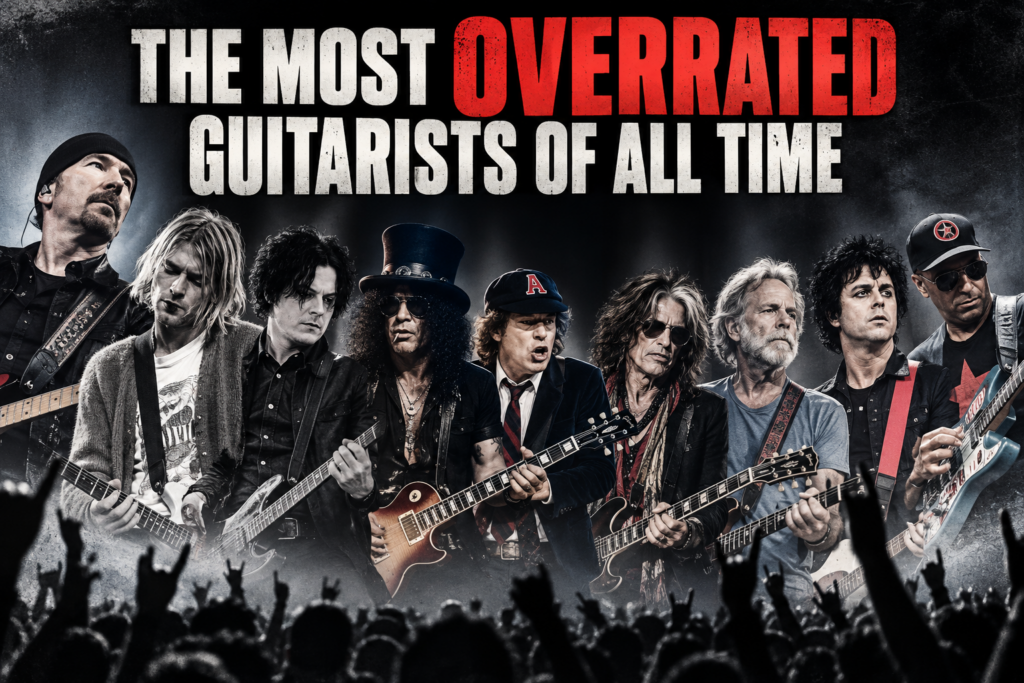
Let’s get one thing straight before anyone starts sharpening their pitchforks: this isn’t a list of bad guitarists.
Almost everyone on this list is a guitarist I enjoy listening to. Some are genuinely excellent musicians. Some wrote riffs that changed rock music. Some helped define entire genres. Some created sounds that millions of people instantly recognize. And some are members of bands I absolutely love.
That’s precisely the point.
The guitarists on this list are considered by many people to be among the greatest guitar players of all time. That’s where I disagree. Being an important guitarist isn’t necessarily the same thing as being an extraordinary guitarist. Writing a handful of iconic riffs doesn’t automatically make someone a virtuoso. Being in one of the biggest bands in the world doesn’t magically give you extraordinary technical ability.
And perhaps most importantly, fandom creates blinders.
When people love a band, they tend to elevate everything associated with that band. A guitarist plays a riff they’ve heard a thousand times, the song becomes enormous, the band becomes legendary, and eventually the guitarist becomes a “guitar god.”
But strip away the massive song, the nostalgia, the stadium, the album sales, and the emotional attachment, and ask a simple question:
What is this person actually doing on the guitar?
Sometimes the answer is astonishing.
Sometimes it’s incredibly creative.
And sometimes it’s three chords and a delay pedal.
10. Kurt Cobain
Kurt Cobain was a brilliant songwriter and one of the most important musicians of his generation.
He was not a brilliant technical guitarist.
And that’s perfectly okay.
Nirvana didn’t need Cobain to shred. The power of his guitar playing came from simplicity, dynamics, distortion, and knowing exactly when to hit the accelerator. His parts were generally accessible enough that an intermediate guitarist could learn many of them without much difficulty.
That’s actually part of Nirvana’s appeal.
The problem is that Cobain’s importance as a musician has sometimes spilled over into claims about his abilities as a guitarist. Because Nirvana changed rock music, people sometimes assume Cobain must have been a revolutionary guitar player.
He wasn’t.
He was a revolutionary songwriter and bandleader who understood exactly how much guitar a song needed.
That’s different.
9. Jack White
Jack White is incredibly creative.
He’s also a terrific rock musician.
His guitar playing has personality, aggression, weirdness, and a willingness to ignore conventional ideas about what the instrument is supposed to sound like.
But creativity and technical difficulty aren’t the same thing.
White can make a relatively simple guitar idea sound enormous because he understands tone, dynamics, distortion, feedback, and arrangement. His playing often sounds more complicated than it actually is.
That’s a compliment to his musical instincts, not evidence that he’s one of the greatest technical guitarists ever.
White is an original. He’s influential. He’s extremely entertaining.
But put him next to the truly elite technical players in guitar history and the difference becomes obvious.
8. Slash
Slash is one of the easiest guitarists to overrate because Guns N’ Roses produced some of the most recognizable guitar moments in rock history.
And I’ll admit it: Slash is really good.
His bends are excellent. His phrasing is strong. His tone is unmistakable. He understands how to construct a rock solo that people actually remember.
But that’s also where the mythology starts taking over.
Slash is often discussed as though he belongs in the absolute top tier of guitarists regardless of category.
He doesn’t.
His playing is heavily rooted in blues-rock and classic hard rock. He took those influences, developed his own voice, and became extremely successful at applying them.
That’s a major accomplishment.
But it doesn’t make him a technical revolutionary.
Sometimes people hear an iconic riff or solo in an enormous song and mentally add another 50 percent to the guitarist’s abilities.
That’s fandom talking.
7. Angus Young
Angus Young perfectly demonstrates the difference between great guitar playing and great guitar technique.
Angus is outstanding at what AC/DC requires.
His rhythm playing is tight. His riffs are memorable. His solos have energy. His timing is excellent. His tone is unmistakable.
But AC/DC’s entire philosophy is based around simplicity.
And that’s why Angus gets overrated when people start discussing him as one of the greatest guitarists who ever lived.
He’s one of the greatest rock guitarists at creating a specific sound and executing it with incredible consistency.
That’s not the same thing as being a guitar virtuoso.
An enormous song with an instantly recognizable riff can create the illusion that the person playing it must possess extraordinary technical abilities.
Sometimes the riff is just really, really good.
6. Joe Perry
Joe Perry has always been cool.
And sometimes being cool counts for a lot.
His guitar playing with Aerosmith has attitude, swagger, groove, and personality. He helped create one of America’s greatest rock bands and contributed some fantastic guitar parts.
But technical virtuosity?
Not really.
Perry is primarily a feel player. He’s a blues-rock guitarist who knows how to make a guitar sound right in a song.
That’s a legitimate and valuable skill.
But Aerosmith’s enormous popularity has helped inflate Perry’s reputation as a guitarist. When you’ve got massive songs, decades of success, iconic album covers, legendary concerts, and millions of fans, everything surrounding the band starts becoming legendary by association.
Perry is a very good guitarist.
He’s just not remotely in the same technical universe as someone like Steve Vai, Guthrie Govan, Allan Holdsworth, or John McLaughlin.
5. Bob Weir
This one hurts me.
I absolutely love the Grateful Dead.
And I absolutely love Bob Weir.
There is something about the way Weir plays guitar that I find incredibly satisfying. His approach is unusual, loose, rhythmic, and deeply connected to what the rest of the Grateful Dead is doing. His playing doesn’t sound like everybody else’s, and that’s a huge part of why the Dead sound like the Dead.
But here’s the reality:
Almost any reasonably competent at-home guitarist can learn to play what Bob Weir actually plays.
That doesn’t make Bob Weir bad.
It doesn’t diminish the Grateful Dead.
And it certainly doesn’t diminish my enjoyment of his playing.
It simply means that technical difficulty isn’t where Weir’s greatness comes from.
Weir’s genius is in interaction.
He understands rhythm in an unconventional way. He knows how to complement a bass player, drummer, and lead guitarist while simultaneously creating his own rhythmic identity. His chord voicings and approach to rhythm guitar are fascinating.
But listen closely and you’ll discover that the actual physical mechanics of many of his parts aren’t particularly difficult.
That’s the distinction people often refuse to make.
Bob Weir is a great musician.
He’s an important guitarist.
He’s an essential part of the Grateful Dead’s sound.
But he’s not a virtuoso.
And because I love the Grateful Dead so much, I’m actually more comfortable admitting that than pretending otherwise.
4. Billy Joe Armstrong
Billy Joe Armstrong’s greatest guitar achievement isn’t technical.
It’s songwriting.
Green Day took basic punk-rock guitar and turned it into enormous mainstream rock songs. Armstrong understood something that technically superior guitarists sometimes forget:
You don’t need complicated guitar playing to write a great song.
But that doesn’t mean Armstrong belongs in conversations about the greatest guitarists ever.
His playing is relatively straightforward. His chords are accessible. His riffs are generally easy to learn.
What isn’t easy is writing songs that connect with millions of people.
That’s Armstrong’s gift.
He’s an outstanding songwriter who happens to play guitar.
That doesn’t automatically make him an outstanding guitarist.
3. Tom Morello
Tom Morello deserves enormous credit for making the guitar sound completely different from what people expected.
His work with Rage Against the Machine is inventive, aggressive, and unmistakable. He used effects, feedback, whammy pedals, pickup manipulation, and various techniques to make his guitar sound like machinery, electronics, turntables, and noises that shouldn’t logically come from a guitar.
That’s brilliant.
But once again, there’s a difference between making a guitar sound extraordinary and being an extraordinary guitarist.
A significant portion of Morello’s most famous sounds come from technology and manipulation rather than traditional guitar technique.
That doesn’t make them less creative.
It just makes the distinction important.
Morello is a sonic innovator.
He’s not necessarily one of the greatest technical guitarists ever.
2. Kirk Hammett
Kirk Hammett is where Metallica fans are going to start throwing things.
I like Metallica.
I like Kirk Hammett.
And I absolutely understand why people love his playing.
But the idea that Kirk Hammett is one of the greatest guitarists of all time is wildly overstated.
Metallica has some of the most important guitar music in heavy metal history. The riffs are enormous. The albums are enormous. The songs are enormous. The cultural impact is enormous.
And that enormousness has spilled over onto Hammett’s reputation.
Kirk is a good metal guitarist. He has written and played some memorable solos, and his use of wah has become part of his signature sound.
But listen critically to the actual playing.
A lot of Hammett’s solos are based on familiar pentatonic and minor-scale patterns, repeated ideas, bends, fast runs, and wah-heavy phrasing. There are certainly moments when he plays exceptionally well, but there are also plenty of moments where the playing is nowhere near the level of the legendary virtuosos.
And that’s the important distinction.
Metallica’s greatness doesn’t automatically equal Kirk Hammett’s greatness.
James Hetfield’s rhythm guitar work is arguably far more important to Metallica’s sound. The band’s riffs and songwriting are monumental.
But because Kirk is the guy standing there playing the guitar solo, fans naturally elevate him.
That’s fandom creating a blind spot.
Put Hammett against truly elite guitarists and the difference becomes obvious.
He’s good.
He’s sometimes very good.
He’s occasionally great.
But all-time guitar great?
That’s a much harder argument to make.
1. The Edge
And then there’s The Edge.
The Edge is the ultimate example of a guitarist whose sound is far more impressive than his actual guitar playing.
I like U2. I like plenty of The Edge’s work.
His understanding of atmosphere, space, delay, repetition, and texture is exceptional.
But here’s the problem:
He’ll play a ridiculously simple guitar part, put it through a ridiculous amount of effects, and suddenly everyone acts like he’s performing some kind of guitar sorcery.
The delay pedal does a lot of the work.
The reverb does a lot of the work.
The layering does a lot of the work.
The production does a lot of the work.
The Edge might play a simple chord or a basic repeating pattern, and the effects turn it into this enormous, swirling, hypnotic wall of sound.
And it sounds fantastic.
But if you unplug the magic trick and look at what his fingers are actually doing, it’s frequently pretty basic.
That’s the uncomfortable part.
The Edge deserves enormous credit for understanding what effects can do for a guitar. He helped popularize an entire approach to guitar sound.
But he didn’t revolutionize guitar technique.
He revolutionized guitar texture.
Those are two very different things.
And I think his reputation often gives him credit for the former when his real accomplishment is the latter.
The Fandom Problem
And this is really what the entire argument comes down to.
People are blinded by fandom.
I know because I’ve done it myself.
My favorite band of all time is Phish.
I’ve been to hundreds of Phish shows. I absolutely love the band. I could listen to Trey Anastasio play guitar for hours.
And yet I’ll be the first person to admit that Trey isn’t an all-time great guitarist.
He’s a fantastic guitarist.
There are moments when Trey is absolutely incredible. There are jams where his phrasing, tone, improvisation, and ability to respond to the other musicians are genuinely spectacular.
But then there are other moments when he’s playing something that is completely bland.
Sometimes there’s a stretch of a Phish performance where the guitar is just… there.
Nothing particularly special.
Nothing technically amazing.
Nothing that would make me put down whatever I’m doing and say, “Holy crap, that’s one of the greatest guitarists who has ever lived.”
And that’s okay.
Loving a musician doesn’t require pretending they’re perfect.
In fact, I think it’s the opposite.
You can love a band while recognizing its limitations.
You can love a guitarist without calling him a virtuoso.
You can acknowledge that someone wrote an iconic riff without pretending that riff required superhuman technique.
And you can recognize that a guitarist changed music without claiming they were technically better than everyone who came before them.
That’s the distinction that gets lost all the time.
Great Music Isn’t Always Great Guitar Playing
Some of the greatest guitar parts in history are incredibly simple.
That’s not a problem.
In fact, simplicity can be brilliant.
The problem is when people take a great song, an iconic riff, a massive band, and decades of fandom and then use those things as proof that the guitarist must be a virtuoso.
It doesn’t work that way.
A great riff is a great riff.
A great song is a great song.
A legendary band is a legendary band.
A huge fan base is a huge fan base.
None of those things automatically equal technical guitar mastery.
Bob Weir doesn’t need to shred to be Bob Weir.
Billy Joe Armstrong doesn’t need to play fusion to write Green Day songs.
Angus Young doesn’t need to play progressive metal to make AC/DC sound like AC/DC.
The Edge doesn’t need to play 200 notes per second to create the U2 sound.
And Trey Anastasio doesn’t need to be Eddie Van Halen, Steve Vai, or Guthrie Govan for me to spend hundreds of nights watching him play.
That’s the beauty of music.
You don’t have to be the greatest guitarist to make great music.
But if we’re going to talk about the greatest guitarists of all time, we should actually judge the guitar playing.
Not the record sales.
Not the nostalgia.
Not the stadiums.
Not the iconic album.
Not the fandom.
Not the one riff everybody knows.
The guitar.
And when you do that, some of the biggest names in rock history suddenly don’t look quite as untouchable as their reputations suggest.