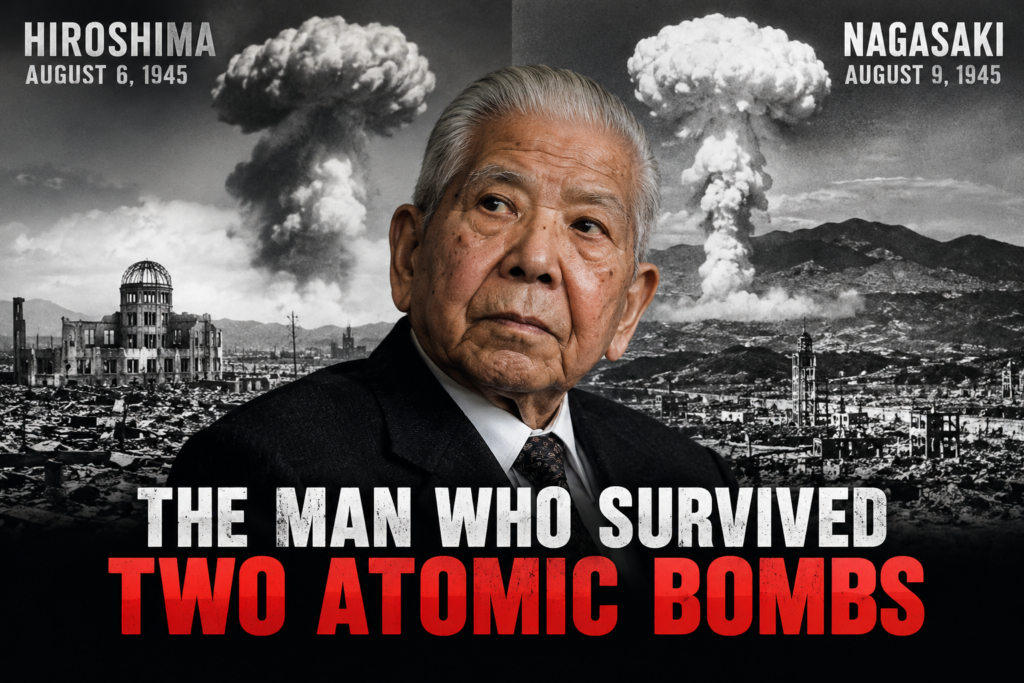
Few stories from the history of World War II sound as unbelievable as that of Tsutomu Yamaguchi, a Japanese man who was present in both Hiroshima and Nagasaki when atomic bombs were detonated in August 1945. He survived the first bombing, traveled to Nagasaki, and then survived the second.
His story is extraordinary not because he was somehow immune to the effects of nuclear weapons, but because of an almost impossible combination of timing, location, circumstance, and luck. Yamaguchi endured two separate nuclear attacks just three days apart and eventually lived for decades afterward.
His experience also provides one of the most personal accounts of what the atomic bombings meant for ordinary people caught in the middle of history.
A Business Trip to Hiroshima
Tsutomu Yamaguchi was born in Nagasaki in 1916. As a young man, he eventually worked for Mitsubishi Heavy Industries, one of Japan’s major industrial companies. During World War II, his job involved technical work connected to the company’s shipbuilding operations.
In the summer of 1945, Yamaguchi was sent to Hiroshima on a business trip.
The timing could hardly have been worse.
Japan was nearing the end of the war. Hiroshima was an important military and industrial center, but it was also a functioning city filled with civilians. Yamaguchi had spent several months working there and was preparing to return home to Nagasaki.
On the morning of August 6, he was making his way toward a railway station.
At approximately 8:15 a.m., an American B-29 bomber dropped an atomic bomb over Hiroshima.
Yamaguchi was roughly two miles from the explosion.
He later recalled seeing an enormous flash. The blast threw him to the ground and caused severe burns. His upper body was badly injured, including his arms and head. The explosion also left him temporarily disoriented.
Yet he was alive.
The destruction around him was almost impossible to comprehend. Buildings had collapsed, fires were spreading, and thousands of people had been killed or injured in an instant.
Yamaguchi spent the night sheltering in Hiroshima.
Despite his injuries, he was determined to get home.
The Journey Back to Nagasaki
The next day, Yamaguchi began the difficult journey back to Nagasaki.
Transportation systems had been devastated, but he eventually managed to travel by train.
The journey itself must have seemed surreal. Hiroshima had been transformed almost instantly, and yet Yamaguchi was now traveling toward his home city.
He arrived in Nagasaki on August 8.
He was severely burned, exhausted and suffering from the effects of the Hiroshima explosion. But instead of remaining at home recovering, he reported to work at the Mitsubishi shipyard the following morning.
August 9, 1945, was the day everything happened again.
Yamaguchi’s injuries were still fresh when he entered his workplace and began describing what he had witnessed in Hiroshima.
His supervisors reportedly had difficulty believing his account.
How could one bomb have destroyed an entire city?
At the time, the scale and nature of the new weapon were still difficult for people to understand. Yamaguchi tried to explain what he had seen.
Then, while he was talking about Hiroshima, another flash filled the sky.
Nagasaki
At approximately 11:02 a.m. on August 9, an American B-29 dropped a second atomic bomb over Nagasaki.
Yamaguchi was inside the Mitsubishi facility, only a few miles from the blast.
Once again, the world around him exploded.
The building was heavily damaged. Windows shattered. Debris flew through the room. The blast knocked people down.
And once again, Yamaguchi survived.
The circumstances were particularly remarkable because he had been injured by the Hiroshima bombing only three days earlier.
The Nagasaki bombing caused enormous destruction and killed tens of thousands of people. Combined with the Hiroshima bombing, the attacks became one of the defining events of the twentieth century.
For Yamaguchi, however, this was not history.
It was happening to him for the second time.
Why Did He Survive?
The obvious question is how anyone could survive two atomic bombings.
There was no single explanation.
Yamaguchi was not at the exact center of either explosion. Distance was crucial. The destructive effects of an atomic bomb decrease dramatically as distance from the blast increases.
Buildings also provided some protection.
At Hiroshima, Yamaguchi was far enough away that although he suffered severe burns and injuries, he was not killed immediately. At Nagasaki, his position inside a substantial industrial building again offered some protection from the blast.
Luck played an enormous role.
So did circumstances that would have been impossible to plan.
Yamaguchi happened to be in Hiroshima when the first bomb was dropped. He happened to survive. He happened to make it back to Nagasaki. He happened to be at work when the second bomb exploded. And he happened to survive that as well.
The odds were extraordinarily small.
The Long-Term Effects
Surviving the explosions did not mean Yamaguchi escaped unharmed.
He suffered severe burns and other injuries. His hair fell out, and he experienced periods of serious illness. Like many survivors, he was exposed to radiation whose long-term effects were not fully understood at the time.
In the immediate aftermath, medical treatment was extremely difficult. Both cities had suffered catastrophic destruction, and countless doctors, nurses and medical facilities had themselves been affected.
Yamaguchi eventually recovered enough to return to ordinary life.
For many years, however, he rarely spoke publicly about his experience.
That changed gradually as he grew older.
He became increasingly willing to discuss what he had witnessed and to speak about the consequences of nuclear warfare.
Recognition as a Double Survivor
For decades, Yamaguchi’s story was known, but his status as a survivor of both bombings was not immediately recognized in the way it eventually would be.
Japan has a formal system for recognizing people who survived the atomic bombings. Yamaguchi was eventually officially recognized as a survivor of both Hiroshima and Nagasaki.
He became known as a nijū hibakusha, essentially a person exposed to both atomic bombings.
Other people may also have experienced both attacks, but Yamaguchi became one of the most famous examples because he publicly documented his experience.
His story attracted international attention, particularly late in his life.
He appeared in documentaries and gave interviews describing what had happened.
Rather than presenting himself as a miraculous superhero who somehow defeated two nuclear weapons, he emphasized the human cost of nuclear war.
A Message About Nuclear Weapons
As Yamaguchi became more outspoken, his story took on a broader meaning.
He wanted people to understand that nuclear weapons were not simply military technology.
They affected individual human beings.
Families disappeared. Cities vanished. Survivors carried physical injuries and psychological trauma for the rest of their lives.
Yamaguchi became an advocate for nuclear disarmament and spoke to audiences around the world.
His message was particularly powerful because he had experienced something almost no one else could claim.
He had seen an atomic bomb destroy one city.
Then he had seen another destroy his own.
His perspective was not theoretical. It was personal.
His Final Years
Yamaguchi lived a remarkably long life considering what he had endured.
He eventually became a father and grandfather and lived well into his 90s.
In his later years, he became increasingly concerned about nuclear weapons and the possibility that future generations might experience what he had experienced.
He died in Nagasaki in 2010 at the age of 93.
By then, his story had become internationally known.
His life had stretched from the early twentieth century through the atomic age and into a world where nuclear weapons remained a major global concern.
More Than a Strange Historical Coincidence
The story of Tsutomu Yamaguchi is sometimes presented almost like an unbelievable historical curiosity: one man, two cities, two atomic bombs, three days.
That description is accurate, but it misses the deeper significance.
Yamaguchi’s survival was extraordinary. His suffering was not.
Hundreds of thousands of people were affected by the atomic bombings of Hiroshima and Nagasaki, either through immediate injuries or the long-term consequences of radiation exposure and trauma. Most of those people never had the opportunity to tell their stories to the world.
Yamaguchi did.
His experience provides a rare window into what it was like to witness both bombings from the ground.
It also demonstrates just how much of survival can come down to circumstances beyond anyone’s control.
He survived Hiroshima because he happened to be at a particular distance from the blast.
He survived Nagasaki because he happened to be inside a building at the right moment.
He survived the aftermath because he received enough care and had the physical resilience to recover.
None of that makes his story less remarkable. It makes it more sobering.
A Life That Became History
Tsutomu Yamaguchi never set out to become a historical figure.
He was an engineer and businessman going about his life during one of the most turbulent periods in modern history.
Then, in the space of three days, he became a witness to two events that changed the world.
His story remains remarkable because it combines an almost unbelievable coincidence with an intensely human experience.
He was not simply the man who survived two atomic bombs.
He was someone who saw two cities transformed by weapons that had never existed before, suffered the consequences personally, and then spent much of his later life trying to make sure people understood what those weapons could do.
Yamaguchi’s survival was a statistical miracle.
His decision to keep telling the story was something else entirely: a choice.
And that may be the most important part of his legacy.