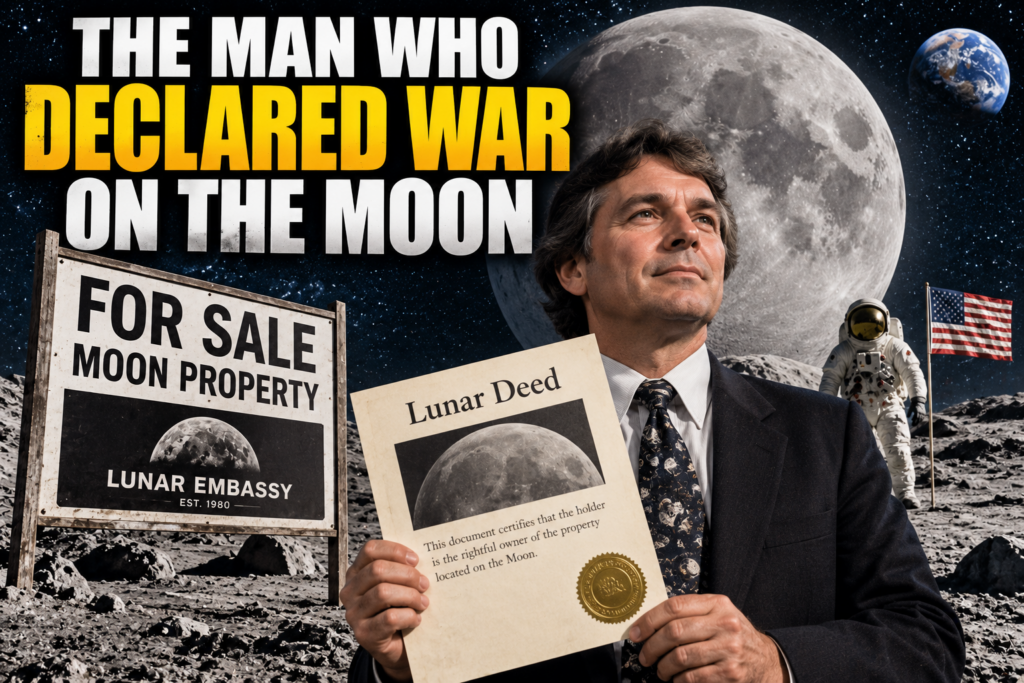
There is something wonderfully absurd about the idea of declaring war on the Moon.
It isn’t a country. It doesn’t have a government. It doesn’t have an army. It doesn’t even belong to anyone.
At least, that’s what most people would assume.
Dennis Hope had a different idea.
In the 1980s, Hope, an American entrepreneur from Nevada, discovered what he believed was a loophole in international law that allowed him to claim ownership of extraterrestrial real estate. He eventually began selling plots of land on the Moon to customers around the world.
He didn’t literally declare war on the Moon, despite the colorful way the story is sometimes told. His real claim was considerably stranger: he said he owned it.
And he wasn’t stopping with the Moon.
Hope also claimed large portions of Mars, Venus and Mercury, turning himself into one of the most unusual property entrepreneurs of the modern era.
The story is part legal experiment, part business venture, part publicity stunt—and entirely bizarre.
The Moon Needs a Landlord
Dennis Hope’s story began with a personal financial problem.
According to accounts of his business, Hope was going through a difficult period in his life in the late 1970s and early 1980s. He began thinking about ways to make money and eventually became interested in an obscure area of international law.
The question was simple:
Who owns the Moon?
The answer seemed obvious.
Nobody.
The United States had landed astronauts there. The Soviet Union had sent spacecraft. Other countries had photographed it, studied it and sent probes toward it.
But no country had officially claimed the Moon as its own.
Hope started examining the legal agreements governing outer space and noticed language concerning national governments claiming territory in space.
His interpretation was that these restrictions applied to nations, not necessarily private individuals.
That was the opening he was looking for.
The Legal Loophole
The central document in Hope’s argument was the 1967 Outer Space Treaty.
The treaty established the principle that celestial bodies such as the Moon should not become the territory of individual nations.
Governments could not simply plant a flag on the Moon and declare:
“Congratulations, everyone. We own this now.”
The treaty also established that outer space and celestial bodies were to be used for peaceful purposes and that they were not subject to national appropriation.
Hope interpreted this differently.
He argued that while governments were prohibited from claiming celestial territory, the treaty did not explicitly prevent an individual from doing so.
So he filed paperwork claiming ownership.
The logic was unconventional.
The consequences were even more unconventional.
Hope now had a Moon.
Or at least, he believed he did.
Selling Lunar Real Estate
Having claimed the Moon, Hope faced a practical question.
What do you do with a Moon?
His answer was surprisingly capitalist.
Sell it.
Hope established the Lunar Embassy, a business that marketed lunar property to customers.
People could purchase certificates claiming ownership of plots of land on the Moon.
Depending on the package, buyers could receive maps, certificates and other documentation identifying their supposed lunar property.
Suddenly, ordinary people could become extraterrestrial landowners.
A person who couldn’t afford a house on Earth could theoretically own several acres on the Moon.
The idea was irresistible.
It combined the novelty of space exploration with the familiar language of real estate.
Instead of buying a vacation property in Florida, you could buy property overlooking a lunar crater.
There was just one minor problem.
Getting there.
The World’s Most Inaccessible Real Estate
Buying land is generally considered more useful when you can actually visit it.
Moon property had an obvious disadvantage.
There were no roads.
There were no hotels.
There were no utility connections.
There wasn’t even a reliable way to send a moving truck.
A lunar homeowner couldn’t call a contractor and say, “I’d like a two-bedroom house built next Saturday.”
Even today, decades after Hope began selling lunar property, private citizens cannot simply travel to the Moon and inspect their real estate.
That didn’t stop people from buying.
The novelty was the point.
A lunar property certificate made for a memorable gift, conversation piece or novelty purchase.
It was less like buying a suburban backyard and more like buying a tiny piece of humanity’s future.
Millions of Lunar Homeowners
Hope’s business attracted customers from around the world.
According to claims associated with the Lunar Embassy, millions of people have purchased extraterrestrial property through the company.
Whether those buyers actually obtained legally enforceable property rights is a completely different question.
The certificates certainly gave customers something tangible.
They could hold a document saying that they owned a particular parcel of the Moon.
But possessing a certificate isn’t necessarily the same thing as possessing a legally recognized property title.
That distinction becomes extremely important when dealing with real estate located approximately 240,000 miles away.
Can Anyone Actually Own the Moon?
This is where the story gets complicated.
The Outer Space Treaty is widely regarded as establishing that nations cannot claim sovereignty over celestial bodies.
But private property rights in space are a much more complicated subject.
Hope’s interpretation has never become an internationally recognized system of lunar property ownership.
There is no global government that has officially recognized his claim.
No major space agency treats his property maps as authoritative.
And there is no lunar land registry accepting applications for backyard swimming pools.
In practical terms, buying one of Hope’s certificates doesn’t give someone an internationally recognized piece of lunar territory in the same way that buying a house on Earth gives you legally enforceable property rights.
That hasn’t stopped the business from continuing.
The Moon Doesn’t Send Lawyers
One reason the scheme is so entertaining is that it exposes the enormous gap between legal theory and physical reality.
Imagine trying to enforce your lunar property rights.
Someone lands on your property.
What do you do?
Call the police?
Which police department?
File a lawsuit?
In which court?
Serve the defendant?
How?
And suppose the person refuses to leave.
You have a trespasser on the Moon.
Good luck with that.
The problem becomes even more complicated because there is no universally accepted lunar government capable of enforcing ordinary property law.
Earth has spent thousands of years developing systems for buying, selling, taxing and defending land.
The Moon doesn’t have any of that.
The Business Became a Cultural Phenomenon
Regardless of the legal arguments, Hope understood something important about human psychology.
People love the idea of owning something extraordinary.
Space has always had enormous cultural appeal.
The Apollo missions transformed the Moon from a distant object in the night sky into a place humans could actually visit.
Hope took that fascination and turned it into a commercial product.
For a relatively small amount of money, a customer could tell friends:
“I own land on the Moon.”
That sentence alone was worth something.
It was a great conversation starter.
It was an unusual birthday present.
It was a piece of space-age memorabilia.
And for some customers, it may have represented something more philosophical—a symbolic connection to humanity’s future beyond Earth.
Hope Didn’t Stop With the Moon
The Moon wasn’t enough.
Hope expanded his extraterrestrial real estate empire to other planets.
He claimed large portions of Mars, Mercury and Venus.
He also sold property packages associated with these worlds.
The idea became increasingly surreal.
A customer could potentially own a piece of the Moon, Mars or another celestial body without ever leaving Earth.
In a way, Hope created the world’s most speculative real estate market.
There were no open houses.
No photographs of the kitchen.
No school district ratings.
No neighborhood association.
No property taxes.
And absolutely no chance of driving by to see whether the previous owner had left junk in the garage.
What About a Moon House?
The strangest question is whether these purchases could ever become useful.
Imagine that lunar settlements become common in the future.
Suppose humans eventually establish permanent cities on the Moon.
What happens to Hope’s customers?
Could someone show up at a lunar settlement with a decades-old certificate and say:
“This is my land”?
That’s where the uncertainty becomes enormous.
Future governments and international organizations would have to determine how lunar resources and territory are governed.
They may create entirely new systems for habitation, scientific research, mining and settlement.
There is no guarantee that a certificate purchased from a private company today would have any legal standing under those future systems.
In other words, lunar property buyers are betting on a legal future that hasn’t been written yet.
The “War” With the Moon
So how did a man selling Moon real estate become associated with the idea of declaring war on the Moon?
The answer is mostly storytelling.
Hope didn’t actually assemble an army.
He didn’t send tanks toward the Sea of Tranquility.
He didn’t fire missiles at the lunar surface.
He didn’t stand outside a government building and announce hostilities against Earth’s satellite.
His real achievement was considerably stranger.
He looked at a celestial body that humanity had admired for thousands of years and asked:
“Why can’t I sell it?”
Then he tried.
That’s what makes the story so memorable.
The Ultimate Real Estate Pitch
Dennis Hope’s lunar property scheme sits somewhere between entrepreneurship, legal interpretation and science-fiction fantasy.
Critics can argue that his interpretation of international space law doesn’t establish genuine ownership.
They can point out that no internationally recognized authority has validated his lunar real estate claims.
They can laugh at the idea of selling land that nobody can currently visit.
All of those objections are reasonable.
But Hope still accomplished something remarkable.
He turned an abstract legal question into a business.
He took something that had always seemed completely outside the real estate market—the Moon—and gave it addresses, maps, certificates and customers.
He transformed lunar land into a product.
A Piece of the Moon
The story of Dennis Hope is ultimately less about whether someone actually owns the Moon and more about the extraordinary things people will buy when imagination, technology and commerce collide.
Human beings have always wanted to own unusual things.
People collect meteorites.
They buy pieces of historic buildings.
They purchase celebrity memorabilia.
They name stars.
Hope simply took the idea one enormous step further.
He offered people the chance to own a piece of another world.
Maybe the certificates will someday become valuable historical curiosities.
Maybe future lunar governments will completely ignore them.
Maybe humanity will eventually build cities on the Moon and discover that the entire concept of extraterrestrial real estate needs to be reinvented.
Or maybe lunar property will remain exactly what it is today: a fascinating novelty that allows someone to look up at the night sky and say, with a straight face:
“That’s mine.”
Dennis Hope never actually declared war on the Moon.
He did something much stranger.
He tried to sell it.