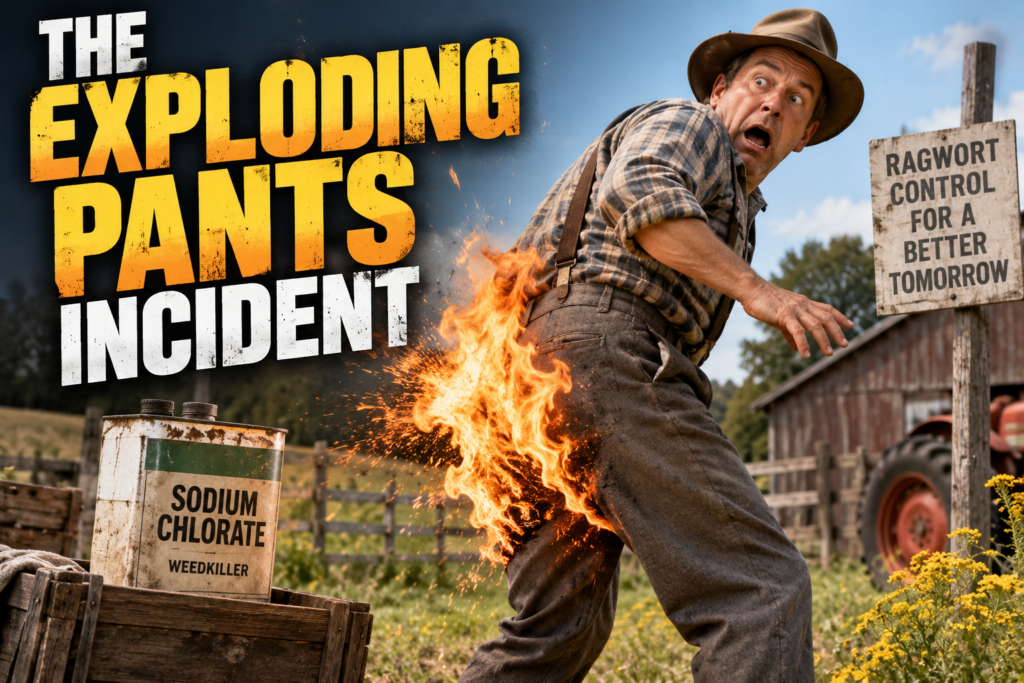
It sounds like something invented for a ridiculous comedy sketch: a farmer puts on his work clothes, goes about his day, and suddenly his pants burst into flames.
Yet during the early 1930s, New Zealand really did experience a bizarre series of incidents involving trousers that caught fire, sometimes with such violence that witnesses described them as exploding. The strange phenomenon became associated with an agricultural chemical called sodium chlorate, which farmers were using to fight a troublesome weed called ragwort.
The incidents were unusual enough to become a curious footnote in New Zealand history, but there was a serious scientific explanation behind them. Sodium chlorate is a powerful oxidizing agent, and when it contaminated natural fibers such as cotton or wool, the combination could become dangerously combustible when exposed to heat or flame.
The result was one of the strangest occupational hazards imaginable: chemically treated trousers that could become a fire hazard.
The Ragwort Problem
The story begins with a weed.
Ragwort had become a significant problem for New Zealand farmers. The yellow-flowering plant could spread through pasture and was particularly dangerous because it was poisonous to livestock. Farmers therefore needed an effective way to control it.
Chemical weedkillers offered an attractive solution.
Sodium chlorate was used as a herbicide, and farmers applied it to areas where ragwort was growing. At the time, people did not have the same level of chemical-safety information that workers have today. Protective clothing and detailed instructions about contamination were not necessarily part of everyday agricultural practice.
That created an unexpected problem.
Farmers could easily get the chemical on their clothing while spraying or handling it. A tiny amount of residue might not appear particularly threatening. The clothing still looked like ordinary clothing.
The danger emerged later.
Richard Buckley’s Pants
One of the best-known cases involved a New Zealand farmer named Richard Buckley.
On August 12, 1931, a local newspaper reported an extraordinary incident involving Buckley’s trousers. His pants had been hanging up to dry near a fire when they suddenly exploded with a loud report. Importantly, Buckley was not actually wearing them at the time.
That detail makes the story slightly less horrifying—and considerably more fortunate.
Had he been wearing the trousers when they ignited, the consequences could have been much worse.
Buckley’s experience was not simply a bizarre one-off. Other farmers encountered similar problems, including cases in which people were actually wearing contaminated clothing when it caught fire.
Suddenly, a pair of ordinary work trousers had become something farmers had to worry about.
What Was Making the Pants Burn?
The culprit was sodium chlorate.
Chemically, sodium chlorate is a strong oxidizing agent. On its own, it does not behave like an ordinary fuel. The problem occurs when it becomes concentrated on combustible organic material.
Cotton and wool are organic fibers. When sodium chlorate contaminated those materials, the chemical could dramatically increase their ability to burn.
The process could become particularly dangerous after the chemical dried and became concentrated.
A farmer might spray weedkiller during the day, get a little of it on his clothing, and think nothing of it. Later, he might hang those clothes near a stove or fireplace to dry.
That was where the trouble could begin.
Heat could trigger a rapid combustion reaction involving the contaminated fibers.
The resulting fire could appear sudden and violent enough to seem like an explosion.
Strictly speaking, however, calling these events “explosions” can be misleading. Later investigations showed that the trousers were generally undergoing extremely rapid combustion rather than producing the kind of explosive shock wave associated with a conventional high explosive.
Still, if your trousers suddenly erupt into flames with a loud bang, “my pants caught fire” probably doesn’t adequately describe the experience.
When Work Clothes Became Dangerous
The strangest part of the story was that the danger wasn’t necessarily obvious.
Farmers were accustomed to their clothing getting dirty. A pair of work pants covered in dust, mud, grass or chemical residue was nothing unusual.
There was no flashing warning light.
There was no dramatic smell announcing that the trousers had become hazardous.
The contaminated clothing could simply sit there until conditions were right.
Heat was particularly dangerous.
A pair of trousers might be hung near a fire or another source of warmth. As the fabric heated, the chemical residue could participate in a violent combustion reaction.
Reports also described clothing smoking or catching fire in situations where people would never expect it.
The result was a bizarre new category of farm accident.
The problem wasn’t merely that the weedkiller could burn a person’s skin. It could effectively turn the person’s own clothing into fuel.
The Real Danger
The comedy of the phrase “exploding pants” tends to overshadow the fact that these incidents could cause serious injuries.
A person wearing contaminated trousers could suffer severe burns before they had time to understand what was happening.
Removing burning clothing quickly could be difficult and dangerous. Panic would make the situation even worse.
The incidents demonstrated a larger problem that extended well beyond sodium chlorate.
Agricultural technology was changing rapidly during the twentieth century. Chemical weedkillers and pesticides could dramatically improve farming efficiency, but they also introduced hazards that workers did not always understand.
Farmers were essentially learning about the dangers through experience.
Unfortunately, experience sometimes meant getting burned.
Scientists Investigate the Mystery
The exploding-trousers stories eventually attracted serious historical and scientific attention.
Decades later, New Zealand historian James Watson examined the phenomenon in detail. His research explored the story of Richard Buckley and the broader role that technological change played in New Zealand agriculture between the two world wars.
Watson’s work became famous enough to earn an Ig Nobel Prize in 2005. The Ig Nobel awards are designed to recognize research that initially makes people laugh but can also encourage them to think about serious scientific questions.
The subject was therefore a perfect fit.
There was something inherently funny about the phrase “exploding trousers,” but the science behind it was real.
The MythBusters Test
The story eventually reached an even wider audience through the television series MythBusters.
In an episode devoted to “Exploding Pants,” the show’s hosts attempted to reproduce the phenomenon using different substances and ignition methods.
Their experiments supported the basic explanation involving sodium chlorate.
They found that fabric treated with the herbicide could ignite under certain conditions involving heat, flame and impact. Other substances tested did not produce the same effect.
The experiments also helped clarify the terminology.
The trousers weren’t behaving like a stick of dynamite.
They were undergoing rapid combustion.
That distinction matters scientifically, but it doesn’t make the historical incidents any less spectacular.
A pair of pants that suddenly bursts into flames is still an extraordinarily bad pair of pants.
Why Didn’t Everyone Know About This?
One reason the story seems so strange today is that modern chemical safety practices are much more familiar.
People now understand that agricultural chemicals can require specialized storage, protective clothing and careful handling. Labels provide warnings about exposure, contamination and disposal.
In the early twentieth century, those standards were not nearly as developed.
Farmers were working with chemicals that could be extremely useful without necessarily having access to comprehensive information about every possible interaction.
The sodium chlorate incidents became an accidental lesson in chemical safety.
The lesson was simple: just because a chemical is useful for killing weeds doesn’t mean it is harmless when it gets onto your clothes.
A Very Strange Piece of History
The exploding trousers episodes occupy an unusual place in history because they are both funny and unsettling.
The image is almost impossible to take seriously at first. A farmer’s pants exploding sounds like a cartoon gag.
Then the details emerge.
The chemical was real.
The farmers were real.
The injuries were real.
And the science behind the incidents makes perfect sense.
Richard Buckley’s famous case was particularly fortunate because he wasn’t wearing the trousers when they went off. Others weren’t so lucky.
The story also demonstrates how historical technology can produce unexpected consequences. A chemical introduced to solve one agricultural problem created another problem that nobody had anticipated.
The result was an unusual chapter in the history of farming—and perhaps the only chapter in agricultural history that can genuinely be summarized as “be careful what you do with your pants.”
The Legacy of the Exploding Pants
The incidents eventually faded from everyday memory, but the story has survived because it is almost perfectly designed for historical curiosity.
It has everything a strange-history story needs: an ordinary problem, an unexpected invention, a bizarre chain of events, a scientific explanation and a memorable name.
More importantly, the story reminds us that technological progress does not always arrive with a complete instruction manual.
Farmers adopted a chemical to control a dangerous weed. They soon discovered that the same chemical could create a dangerous reaction with their clothing.
It sounds ridiculous.
It wasn’t.
The exploding trousers of New Zealand were a genuine consequence of chemistry, agricultural change and limited understanding of chemical hazards. Modern experiments have demonstrated that the basic phenomenon was entirely plausible, turning what sounds like an absurd legend into a strange but legitimate piece of history.
And somewhere in the history books, Richard Buckley’s trousers remain a reminder that sometimes the strangest historical stories really are true.
Especially when the story involves pants.