 Natural disasters usually involve earthquakes, hurricanes, floods, or fires. Industrial accidents often bring to mind explosions or chemical spills. Few people, however, expect one of America’s deadliest industrial disasters to involve a giant tank of molasses.
Yet on January 15, 1919, that’s exactly what happened.
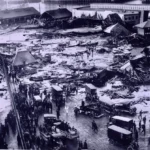
Without warning, a massive storage tank in Boston’s North End suddenly burst apart, releasing an enormous wave of molasses that raced through city streets with astonishing speed and devastating force. Buildings were demolished, railroad tracks were twisted, horses and wagons were swept away, and dozens of people found themselves trapped in a thick, sticky flood that quickly became impossible to escape.
The Great Molasses Flood remains one of the strangest disasters in American history. Despite sounding almost comical today, it was a genuine tragedy that claimed 21 lives, injured more than 150 people, and permanently changed industrial safety standards across the United States.
More than a century later, the event continues to fascinate historians, engineers, and curious readers alike because it demonstrates how something seemingly harmless can become deadly under the wrong circumstances.
A Giant Tank in Boston’s North End
The story begins several years before the disaster itself.
In 1915, the United States Industrial Alcohol Company constructed a massive steel storage tank at Commercial Street in Boston’s bustling North End neighborhood.
The tank stood approximately 50 feet tall and measured about 90 feet in diameter.
When full, it could hold roughly 2.3 million gallons of molasses.
At the time, molasses wasn’t simply used for baking cookies or sweetening recipes.
It was an important industrial product.
Molasses served as a key ingredient in producing industrial alcohol, which was used in manufacturing explosives, munitions, and various commercial products. During World War I, demand for industrial alcohol had increased dramatically, making large storage facilities financially valuable.
Unfortunately, the enormous tank had problems almost from the moment it was built.
Warning Signs Nobody Addressed
Workers and nearby residents noticed issues immediately.
The tank leaked regularly.
In fact, children living in the neighborhood reportedly collected dripping molasses in small containers to take home.
Instead of fixing the leaks properly, company officials often painted the tank brown, making the escaping syrup less noticeable.
Even more concerning, the tank reportedly groaned and creaked as it expanded and contracted.
Many witnesses later recalled hearing strange metallic noises coming from the structure.
Engineers today believe these warning signs pointed toward serious structural weaknesses.
The steel used during construction may have been too thin for a tank of its size, while poor-quality rivets and inadequate engineering likely contributed to the growing danger.
Despite these obvious problems, the tank remained in operation.
A Perfect Storm of Conditions
January 15, 1919, began unusually warm for a Boston winter.
Temperatures climbed into the 40s after an extended period of freezing weather.
Just days earlier, a fresh shipment of warm molasses had been pumped into the already nearly full storage tank.
That temperature difference mattered.
Cold molasses is extremely thick.
Warmer molasses becomes thinner and flows much more easily.
The warmer shipment increased internal pressure while also making the contents significantly more fluid.
At approximately 12:40 p.m., disaster struck.
The Tank Explodes
Witnesses described hearing a loud rumble followed by an explosive crack.
The enormous steel tank suddenly split apart.
Its walls burst outward, sending thousands of tons of steel flying across the surrounding neighborhood.
Then came the molasses.
An estimated 2.3 million gallons surged into the streets almost instantly.
The initial wave reportedly reached heights of 25 feet and moved at speeds estimated around 35 miles per hour.
That speed surprised many people.
Few imagine molasses moving quickly.
Under tremendous pressure inside the tank, however, the syrup behaved more like a fast-moving tidal wave than a slow-moving liquid.
Within seconds, entire buildings disappeared beneath the flood.
Chaos in the Streets
The wave swept through Boston’s North End with terrifying force.
Wooden homes were pushed from their foundations.
Storefronts collapsed.
A nearby fire station suffered severe damage.
Elevated railroad tracks were bent and twisted.
Horse-drawn wagons overturned instantly.
People caught outdoors had almost no time to react.
Some were knocked unconscious by the impact.
Others became trapped beneath collapsed buildings.
Many found themselves struggling inside chest-deep molasses that rapidly became thicker as it cooled in the winter air.
Escaping proved extraordinarily difficult.
Unlike water, molasses clings to everything it touches.
The more victims struggled, the more exhausted they became.
A Difficult Rescue
Emergency responders quickly rushed to the disaster scene.
Police officers.
Firefighters.
Doctors.
Military personnel from nearby facilities.
Volunteers from across Boston.
Everyone faced the same challenge.
Simply moving through the sticky syrup required enormous effort.
Rescuers often found themselves sinking knee-deep while attempting to reach victims.
Ladders became coated.
Stretchers stuck to the ground.
Equipment malfunctioned.
Divers searching submerged debris faced especially dangerous conditions because visibility was almost nonexistent.
The rescue effort continued for several days as workers searched the wreckage for survivors.
Sadly, many victims could not be saved.
The Human Cost
When the cleanup finally ended, the full scale of the tragedy became clear.
Twenty-one people had lost their lives.
More than 150 others suffered injuries ranging from broken bones to severe trauma.
Many victims died from crushing injuries caused by collapsing buildings.
Others drowned or suffocated after becoming trapped beneath the thick molasses.
Several horses also perished during the disaster, unable to escape the powerful wave.
The surrounding neighborhood experienced widespread destruction.
Homes disappeared.
Businesses closed.
Infrastructure required extensive rebuilding.
For local residents, the flood represented far more than an unusual historical event.
It permanently changed their community.
The Massive Cleanup
Cleaning up millions of gallons of molasses proved almost as challenging as surviving the disaster itself.
Workers used seawater pumped from Boston Harbor to wash streets.
Sand helped absorb some of the sticky residue.
Large crews shoveled hardened molasses into carts for disposal.
The cleanup lasted weeks.
Even after visible damage disappeared, molasses remained everywhere.
Residents reported sticky sidewalks for months.
Shoes tracked syrup into homes and businesses.
Automobiles carried molasses throughout the city.
Some stories claim Boston Harbor remained slightly brown for an extended period, although those accounts may be somewhat exaggerated.
One legend persists to this day.
Longtime Bostonians occasionally joke that warm summer afternoons still carry the faint smell of molasses in parts of the North End.
Whether entirely true or not, the story has become part of local folklore.
The Investigation
Public outrage quickly focused on the United States Industrial Alcohol Company.
Victims argued the disaster could have been prevented.
A lengthy legal battle followed.
At the time, determining corporate responsibility proved far more complicated than today.
The investigation lasted approximately six years and became one of the most significant civil engineering cases of its era.
Expert witnesses examined construction methods, steel quality, engineering calculations, and maintenance records.
The findings proved damning.
Investigators concluded the tank had been poorly designed, inadequately tested, and dangerously constructed.
Evidence suggested it had never been properly filled with water to check for leaks before entering service.
Instead, it began storing molasses almost immediately after construction.
The court ultimately found the company responsible.
Thousands of claimants received financial compensation for injuries, deaths, and property damage.
A Turning Point for Engineering
The Boston Molasses Flood had consequences extending far beyond Massachusetts.
Following the disaster, governments strengthened building regulations for large industrial structures.
Engineering plans increasingly required independent review.
Construction standards became stricter.
Routine inspections received greater emphasis.
Companies could no longer simply erect massive storage facilities without demonstrating they met appropriate safety requirements.
Modern engineering practices requiring certified calculations, material testing, and structural approval evolved partly because of disasters like this one.
In that sense, the tragedy helped prevent countless future accidents.
Why the Story Endures
The Boston Molasses Flood remains unforgettable because it combines tragedy with sheer improbability.
The phrase itself almost sounds fictional.
A flood…
Of molasses.
Yet every major element truly happened.
That contrast captures people’s imaginations.
The disaster also illustrates how ordinary materials can become deadly under extraordinary conditions.
Molasses seems harmless inside a kitchen cupboard.
Stored under enormous pressure inside a poorly constructed industrial tank, it became catastrophic.
Perhaps most importantly, the event reminds us that safety regulations often arise only after preventable tragedies expose dangerous weaknesses.
One of America’s Most Unusual Disasters
More than 100 years after the Great Molasses Flood, it continues to occupy a unique place in American history. It is remembered not only because of its unusual cause but because it fundamentally changed the way engineers, governments, and businesses approached public safety.
The images remain astonishing: a 25-foot wave of sticky syrup racing through city streets, rescuers struggling to free trapped victims, and an entire neighborhood transformed in a matter of seconds. While the story often appears on lists of history’s strangest events, it’s important to remember the human tragedy behind the headlines. Twenty-one people lost their lives, families were forever changed, and a community endured months of recovery from a disaster that should never have happened.
Today, the Boston Molasses Flood serves as both a fascinating historical curiosity and a powerful lesson in engineering responsibility. It demonstrates that ignoring warning signs, cutting corners during construction, and failing to address obvious safety concerns can lead to consequences far beyond anyone’s imagination.
History has seen countless floods, but only one involved millions of gallons of molasses. That remarkable combination of tragedy, science, and sheer improbability ensures the Boston Molasses Flood will remain one of the most unforgettable disasters ever recorded.