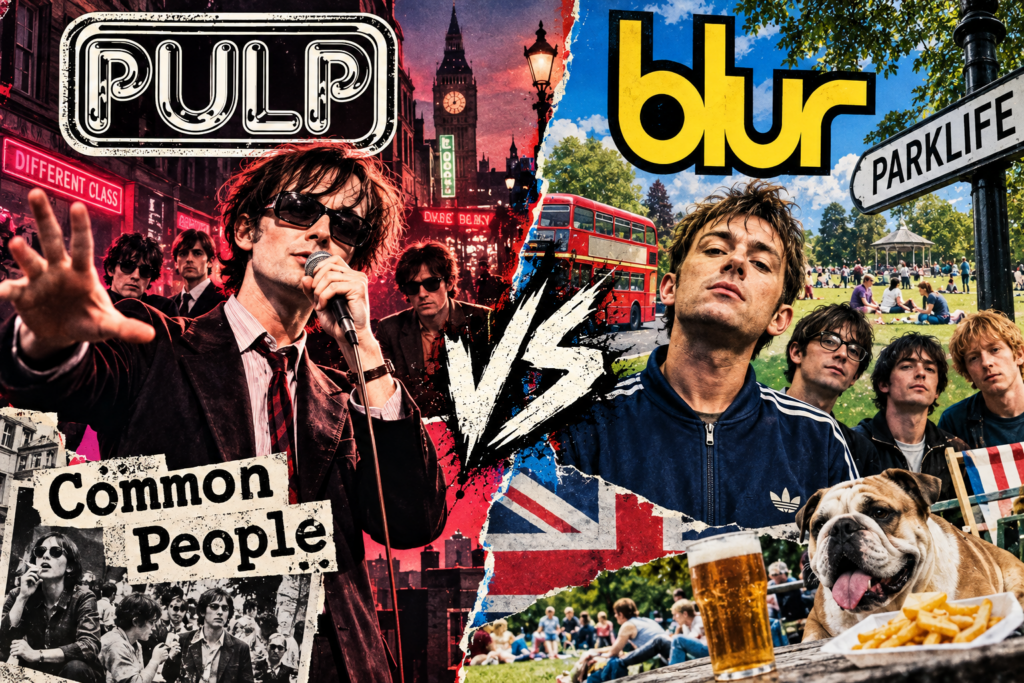
Two songs. Two bands. Two very different snapshots of British life.
Pulp’s “Common People” and Blur’s “Parklife” are two of the defining songs of Britpop, but they approach British culture from very different angles.
“Common People” is sharp, bitter and intensely personal. Jarvis Cocker takes a story about class, privilege and someone wanting to experience life like an ordinary person and turns it into one of the great pieces of British pop storytelling.
“Parklife” is more observational. Damon Albarn and Phil Daniels create a bizarre collection of everyday British characters, while Blur turn parks, joggers, queueing, working life and suburban existence into something simultaneously ridiculous and strangely affectionate.
One is angry.
The other is amused.
One tells you exactly what it thinks of class tourism.
The other watches Britain being weird and says, “Yeah, that’s pretty much us.”
Both became defining Britpop songs.
Both are nearly impossible to separate from 1990s British culture.
But which one wins?
Song Profile: “Common People”
Released in 1995 on Pulp’s Different Class, “Common People” was the song that transformed Pulp from an acclaimed alternative band into one of Britpop’s biggest acts.
At its heart is a story.
Jarvis Cocker describes an encounter with a wealthy woman who expresses a desire to live like “common people.” Cocker immediately recognizes the fundamental problem with that fantasy: for someone with money and privilege, poverty can be experienced as an adventure and then abandoned whenever it becomes uncomfortable.
That idea gives the song its bite.
Musically, Pulp build the track gradually. It starts with a relatively restrained keyboard-driven arrangement before the guitars, drums and bass gradually turn the song into a massive crescendo.
And then there’s Cocker.
His delivery is conversational, sarcastic and theatrical. He isn’t simply singing the story. He’s practically acting it out.
By the final stretch, the song has transformed from an observational story into an enormous release of frustration.
It is catchy enough for a stadium.
It is specific enough to feel like a short story.
And it is angry enough to make the entire thing feel dangerous.
Song Profile: “Parklife”
Blur released “Parklife” in 1994 as the title track of their third album, and it became one of the defining songs of the Britpop explosion.
Where “Common People” focuses on one particular social encounter, “Parklife” throws a camera onto everyday British life and starts filming.
The song moves through a series of observations about ordinary existence, with Damon Albarn providing the verses and actor Phil Daniels delivering the unforgettable spoken-word sections.
Daniels’ voice is absolutely central to the song.
He doesn’t sing in the traditional sense.
He talks.
He boasts.
He complains.
He observes.
He sounds like someone who has spent years sitting on a park bench judging everyone who walks past.
Musically, Blur keep things relatively simple. The bass and guitar provide a bouncy, almost jaunty foundation while the song’s arrangement constantly reinforces its playful British character.
“Parklife” is satire, but it’s not necessarily cruel.
It feels like Blur are laughing at Britain while also clearly enjoying being part of it.
Round 1: Songwriting
“Common People” is an extraordinarily well-constructed song.
It begins with a story, establishes its central conflict, gradually increases the musical intensity and then explodes into the chorus.
The arrangement mirrors the emotional progression of the story.
“Parklife” is more fragmented by design. It works as a collection of observations rather than one continuous narrative.
That’s part of its charm, but “Common People” has a more complete arc.
It feels like a short story set to music.
Winner: Common People
Pulp takes the first round.
Round 2: Vocals
This is a battle between two completely different approaches.
Damon Albarn has a pleasant, understated voice that fits Blur’s observational style perfectly.
But Jarvis Cocker is operating on another level.
His voice is theatrical without becoming ridiculous, sarcastic without losing the melody and emotional without becoming sentimental.
Then there’s the way he gradually increases the intensity as the song progresses.
By the final section, he’s practically delivering a monologue at full volume.
Winner: Common People
Jarvis Cocker wins this one comfortably.
Round 3: Lyrics
This is arguably the most important category in the entire battle.
“Parklife” is packed with memorable observations and amusing British character sketches.
But “Common People” has a central idea that gives every line a purpose.
The song isn’t simply making fun of someone.
It’s examining class.
It takes the idea of treating poverty as a lifestyle choice and tears it apart.
There is humor, but there is also genuine anger underneath it.
Winner: Common People
Pulp delivers the sharper piece of writing.
Round 4: Guitar & Instrumentation
“Common People” has a great guitar sound, particularly as the arrangement builds toward its huge final sections.
But Blur have an advantage here.
“Parklife” is full of little instrumental details that give the song its personality. Graham Coxon’s guitar work, Alex James’s bass and Dave Rowntree’s drumming create a wonderfully tight foundation.
The instrumental arrangement is deceptively simple.
Everything is exactly where it needs to be.
Winner: Parklife
Blur gets the point for creating the more distinctive instrumental package.
Round 5: Chorus
Now we’re getting into dangerous territory.
“Parklife!”
That one word is practically a cultural institution.
Phil Daniels shouts it, the band responds, and suddenly everyone in the room knows what they’re supposed to do.
But “Common People” has a monster chorus too.
Once that guitar kicks in and Cocker delivers the central refrain, the song becomes enormous.
Both are spectacular live.
But “Parklife” has the advantage of being almost impossible not to yell.
Winner: Parklife
Blur takes the chorus round.
Round 6: Energy
“Parklife” is energetic in a completely different way.
It’s bouncy, playful and constantly moving.
“Common People” starts relatively quietly and then keeps getting bigger until it becomes almost overwhelming.
That buildup is the difference.
By the end of “Common People,” the song sounds like it has escaped the studio.
The guitars are louder, the drums are pounding and Cocker is delivering the final sections with barely contained fury.
Winner: Common People
Pulp wins on sheer escalation.
Round 7: Character & Personality
This is where “Parklife” is incredibly difficult to beat.
The song has characters everywhere.
The narrator, the people in the park, the strange observations, the spoken-word delivery from Phil Daniels—it all creates a distinctly British universe.
“Common People” has one central character and one narrator.
“Parklife” feels like an entire neighborhood.
You can practically see the people Blur are describing.
Winner: Parklife
Blur takes it.
Round 8: Cultural Impact
Both songs became defining Britpop moments.
“Parklife” helped establish Blur as one of Britain’s biggest bands and became almost inseparable from the image of Britpop itself.
The song was everywhere.
Television.
Radio.
Sports events.
Comedy.
Advertising.
“Common People” had an equally enormous impact, but its cultural life arguably went beyond Britpop.
It became a permanent reference point for discussions of class, British identity and 1990s music.
It also transformed Pulp’s profile almost overnight.
This is extremely close.
Winner: Common People
Pulp gets the edge because the song’s central idea has remained culturally relevant far beyond the Britpop era.
Round 9: Replay Value
Both songs are remarkably durable.
“Parklife” is one of those tracks that can come on almost anywhere and immediately change the atmosphere.
It’s fun.
It’s short.
It’s catchy.
And Phil Daniels makes it impossible to confuse with anything else.
“Common People” is also endlessly replayable, but its emotional intensity makes it a slightly different experience.
Sometimes you want to listen closely.
Sometimes you just want something fun.
That’s where Blur have the advantage.
Winner: Parklife
Blur wins on effortless replayability.
Round 10: Defining Britpop
If you had to explain Britpop to someone who had never heard it, these two songs would be nearly perfect examples.
“Parklife” captures the playful, observational, distinctly British side of the movement.
“Common People” captures its sharper, more socially conscious side.
Blur made British everyday life sound amusing.
Pulp made British class differences sound absurd.
But which one better represents the movement as a whole?
“Parklife” probably has the broader Britpop identity.
Winner: Parklife
Blur takes the final regular round.
Round 11: The Tiebreaker — Which Is the Better Song?
Five rounds apiece.
So forget the history.
Forget which song better represents Britpop.
Forget the cultural significance.
Which is simply the better song?
This is where “Common People” pulls ahead.
“Parklife” is brilliantly constructed and almost impossibly distinctive. Its spoken-word sections, bouncy arrangement and unforgettable chorus make it one of the most recognizable songs of the 1990s.
But “Common People” has more emotional weight.
It tells a complete story.
It has a clear point of view.
It builds musically from beginning to end.
And Jarvis Cocker gives the performance an intensity that makes the final section feel like a genuine release rather than simply another chorus.
“Parklife” makes you smile.
“Common People” makes you sing, laugh, think and eventually scream along with it.
That combination is incredibly difficult to beat.
Winner: Common People
Pulp wins the tiebreaker and the battle.
Final Score
Common People — 6 rounds
Parklife — 5 rounds
The Winner: “Common People”
Pulp takes the battle, but Blur made them go the distance.
“Parklife” is one of the great character pieces in British pop. It captures an entire world in a few minutes, and Phil Daniels’ performance is so distinctive that the song could never have been mistaken for anyone else’s.
But “Common People” has something more.
It has a story with a beginning, middle and end. It has social commentary without becoming a lecture. It has humor without losing its anger. And most importantly, it has an enormous musical payoff.
Blur looked at Britain and laughed.
Pulp looked at Britain and asked why it was like this.
“Parklife” is the cheeky one.
“Common People” is the heavyweight.
The songs are almost perfect opposites, which is exactly why they make such a great battle.
“Parklife” captures the colorful absurdity of everyday British life.
“Common People” captures the frustration underneath it.
And when the final round comes down to which song you would actually want to hear one more time, Pulp has the advantage.
Winner: Pulp — “Common People”