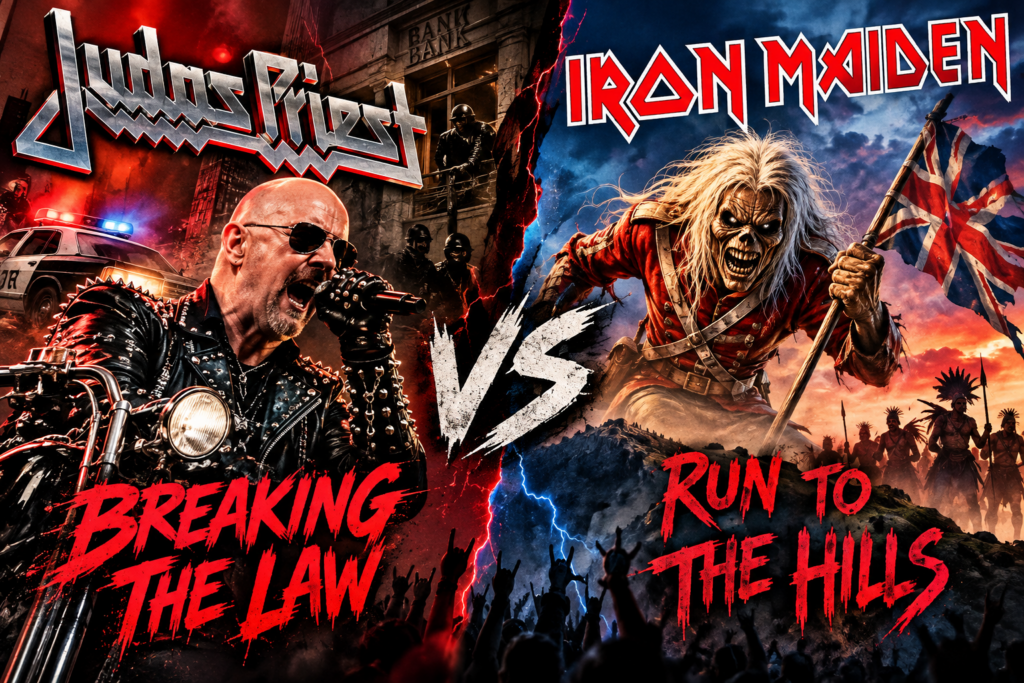
Two songs. Two bands. Two completely different approaches to heavy metal.
Judas Priest’s “Breaking the Law” and Iron Maiden’s “Run to the Hills” are among the most recognizable songs in the history of British heavy metal, but they get there in very different ways.
“Breaking the Law” is short, blunt and almost ridiculously simple. It takes one of the greatest metal guitar riffs ever recorded, adds Rob Halford’s unmistakable voice and gets out of the way before it has a chance to overstay its welcome.
“Run to the Hills” is bigger, faster and considerably more ambitious. Bruce Dickinson’s vocals soar over Steve Harris’s galloping bass lines while Dave Murray and Adrian Smith provide the guitars that helped define Iron Maiden’s sound.
One is a compact metal sledgehammer.
The other is a full-speed metal charge.
Both became defining songs for their respective bands. Both helped establish the sound of British heavy metal in the early 1980s.
But which one wins?
Song Profile: “Breaking the Law”
Released in 1980 on Judas Priest’s British Steel, “Breaking the Law” is one of those songs where the simplicity is the entire point.
The opening guitar riff is immediately recognizable. K.K. Downing and Glenn Tipton don’t need a complicated arrangement to make an impact. The riff is repetitive, muscular and incredibly effective.
Rob Halford’s vocal performance is equally direct. Instead of relying on the high-pitched screams that would become one of his trademarks, Halford delivers the song with a controlled, almost conversational menace.
Then comes the chorus.
“Breaking the law” repeated over and over shouldn’t work as well as it does.
But it does.
The song is barely three minutes long, and there isn’t a second of wasted space. The guitars establish the hook, Halford delivers the attitude, the rhythm section keeps everything moving and the song disappears almost as quickly as it arrived.
That economy is a huge part of its appeal.
Judas Priest didn’t need to demonstrate everything they could do.
They just needed one riff.
Song Profile: “Run to the Hills”
Iron Maiden’s “Run to the Hills” arrived in 1982 on The Number of the Beast, and it immediately demonstrated how much bigger and more elaborate Maiden’s approach to heavy metal had become.
Steve Harris’s galloping bass line is the engine driving the entire song. The guitars add melodic harmonies and rapid-fire riffs while Clive Burr’s drumming gives the track its relentless momentum.
And then there is Bruce Dickinson.
His vocal performance is one of the song’s defining features. He moves from aggressive verses into soaring, high-energy passages that make the song feel enormous.
“Run to the Hills” also has more structural movement than “Breaking the Law.” It builds, shifts gears and creates the sensation of constantly moving forward.
Where Judas Priest went for maximum impact with minimum ingredients, Iron Maiden packed considerably more musical information into the song.
It is heavier, faster and more technically demanding.
Round 1: Songwriting
“Breaking the Law” is a masterclass in economy.
The riff is immediately memorable, the structure is easy to follow and the chorus is impossible to forget.
But “Run to the Hills” is considerably more ambitious. The arrangement moves between contrasting sections while maintaining a strong central hook. Harris builds the song around that galloping rhythm and gives the guitars plenty of room to add melodic detail.
“Breaking the Law” is incredibly efficient.
“Run to the Hills” is more developed.
Winner: Run to the Hills
Priest gets maximum results from minimal ingredients, but Maiden’s songwriting is more sophisticated.
Round 2: Vocals
This is a battle between two of heavy metal’s greatest singers.
Rob Halford’s performance on “Breaking the Law” is remarkably restrained. He doesn’t need to scream his way through the song. His delivery gives the track an attitude that makes the lyrics feel almost casually rebellious.
Bruce Dickinson takes the opposite approach.
His performance on “Run to the Hills” is explosive. The high notes, aggression and sheer range make the vocal one of the song’s most memorable elements.
Halford is iconic.
Dickinson is spectacular.
Winner: Run to the Hills
Dickinson’s performance gives Maiden the edge.
Round 3: Guitar Riff
This may be the closest round of the entire battle.
“Breaking the Law” has one of the most recognizable guitar riffs in metal history. You don’t need the drums, bass or vocals. Give someone the riff and they immediately know the song.
“Run to the Hills” has several excellent guitar parts, including its famous galloping passages and harmonized sections.
But this isn’t really close.
The Priest riff is one of those riffs that has escaped the boundaries of heavy metal and become part of popular culture.
Winner: Breaking the Law
Judas Priest takes this round easily.
Round 4: Bass & Rhythm Section
“Breaking the Law” has a tight, straightforward rhythm section that serves the guitar riff perfectly.
But Iron Maiden has Steve Harris.
Harris’s bass isn’t simply sitting underneath the guitars. It drives “Run to the Hills.” That galloping bass style became one of the defining characteristics of Iron Maiden’s sound.
Clive Burr matches him with rapid, energetic drumming that keeps the entire track moving at a furious pace.
Winner: Run to the Hills
Maiden’s rhythm section is doing considerably more work.
Round 5: Energy
“Breaking the Law” is energetic, but its power comes from its stomp.
It feels like a fist coming straight at you.
“Run to the Hills” feels like being chased by that fist.
The galloping rhythm creates constant forward momentum, and the drums and guitars make the song feel like it is accelerating even when the tempo itself remains controlled.
The Maiden track simply has more velocity.
Winner: Run to the Hills
For sheer adrenaline, Iron Maiden takes it.
Round 6: Chorus
This is another round where simplicity wins.
“Breaking the law” is one of those choruses that requires absolutely no explanation. Even someone who has never heard the entire song probably knows what comes next once the riff starts.
“Run to the Hills” has a fantastic chorus, but it is more dependent on Dickinson’s vocal performance and the surrounding arrangement.
The Priest chorus is practically a chant.
And it sticks in your head immediately.
Winner: Breaking the Law
Judas Priest wins on pure memorability.
Round 7: Production
“British Steel” has a relatively stripped-down production compared with the increasingly elaborate metal records that followed it.
That works perfectly for “Breaking the Law.” Everything is clear, punchy and focused around the riff.
The Number of the Beast gives “Run to the Hills” a much bigger sound. The guitars have more dimension, the drums hit harder and Dickinson’s vocals dominate the track.
The Maiden production makes the song feel enormous.
Winner: Run to the Hills
The larger production suits Maiden’s bigger musical approach.
Round 8: Originality
Both songs helped define their bands.
“Breaking the Law” took heavy metal’s basic ingredients and stripped them down to an almost punk-like simplicity. It proved that metal didn’t always need lengthy guitar solos or complicated arrangements to be effective.
“Run to the Hills” helped establish another side of the genre: melodic, ambitious and technically demanding heavy metal.
Iron Maiden’s approach was more distinctive.
The galloping bass, harmonized guitars and Dickinson’s vocals created a sound that was unmistakably Maiden.
Winner: Run to the Hills
Maiden gets the edge for creating a more distinctive musical identity within the song.
Round 9: Cultural Impact
“Breaking the Law” is one of the songs that immediately comes to mind when people think of classic heavy metal.
The music video became famous for its ridiculous bank robbery storyline, while the song itself became a permanent part of Judas Priest’s live repertoire.
But “Run to the Hills” had an enormous impact too.
It became one of Iron Maiden’s signature songs and helped make The Number of the Beast one of the landmark albums of the New Wave of British Heavy Metal.
Both songs became gateways into metal for generations of listeners.
But Priest’s song has one advantage.
You don’t even have to be a metal fan to recognize it.
Winner: Breaking the Law
The riff and chorus have become almost universally recognizable.
Round 10: Overall Metal Factor
This is where the battle gets interesting.
“Breaking the Law” represents one of metal’s greatest strengths: simplicity.
It’s loud, aggressive, memorable and impossible to mistake for anything else.
“Run to the Hills” represents another side of metal: speed, musicianship, melodic guitar work, powerful vocals and a sense of scale.
If “Breaking the Law” is the guy standing in the parking lot with a leather jacket and a guitar riff, “Run to the Hills” is the guy charging over the hill on horseback with an entire army behind him.
Both are metal.
But if we’re judging which song packs more of the genre’s defining characteristics into one track, Maiden has the advantage.
Winner: Run to the Hills
Iron Maiden takes the final round.
Final Score
Breaking the Law — 4 rounds
Run to the Hills — 6 rounds
The Winner: “Run to the Hills”
Iron Maiden takes the battle, but Judas Priest absolutely makes them work for it.
“Breaking the Law” might actually be the more instantly recognizable song. Its guitar riff is legendary, its chorus is ridiculously catchy and its short running time makes it almost impossible to get tired of.
But “Run to the Hills” does more.
The songwriting is more ambitious. The rhythm section is more dynamic. The vocals are more demanding. The guitars are more elaborate. And the entire performance feels like it is operating at maximum speed.
Judas Priest perfected the metal riff.
Iron Maiden perfected the metal charge.
“Breaking the Law” is the song you hear once and immediately remember.
“Run to the Hills” is the song that makes you want to turn the volume up.
And when these two giants go head-to-head, that extra musical firepower gives Iron Maiden the victory.
Winner: Iron Maiden — “Run to the Hills”