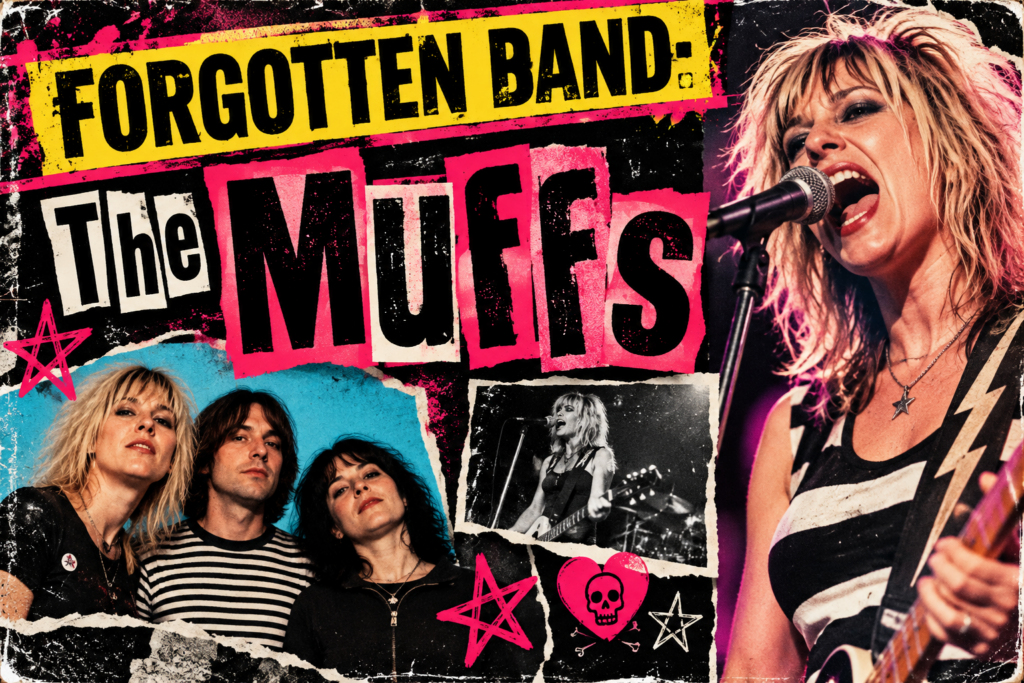
There are bands that disappear because they were terrible. There are bands that disappear because they had one hit and nothing else. And then there are bands like The Muffs, who somehow managed to release a stack of excellent records, build a devoted following, influence plenty of musicians, and still end up in the musical equivalent of a forgotten drawer.
The Muffs were never completely unknown. Alternative-rock fans who were paying attention in the 1990s knew exactly who they were. Their music appeared in movies, television shows and video games, and their version of “Kids in America” introduced them to an even larger audience.
But compared with the amount of talent in the band, The Muffs should have been much bigger.
They were loud, catchy, funny, messy and completely uninterested in pretending to be cooler than they actually were. They could sound like a punk band one minute and a ridiculously infectious power-pop band the next. At the center of it all was Kim Shattuck, whose voice could go from sweet to ferocious in the space of about three seconds.
And that’s probably the best way to describe The Muffs.
They sounded like they were having fun.
From The Pandoras to The Muffs
The story of The Muffs starts with Kim Shattuck and Melanie Vammen, who had previously been members of the Los Angeles garage-rock group The Pandoras.
After leaving The Pandoras, Shattuck and Vammen formed The Muffs in the early 1990s. Ronnie Barnett of The Muffs’ eventual classic lineup joined on bass, while Roy McDonald became the drummer.
The band quickly developed a sound that was impossible to mistake.
There were punk influences everywhere, but The Muffs weren’t interested in making relentlessly aggressive music. They understood the value of a great melody.
Their songs were short, loud and packed with hooks.
That combination helped separate them from many of the alternative and punk bands around them.
They could be abrasive without becoming exhausting.
They could be poppy without becoming manufactured.
And they had something else that a lot of bands lacked:
Personality.
The Muffs Arrive
The band’s self-titled debut arrived in 1993.
It immediately established what The Muffs were all about.
The songs were fast, distorted and catchy, with Shattuck’s vocals constantly bouncing between melodic singing and her trademark screaming.
That scream became one of the band’s defining characteristics.
It wasn’t the polished, carefully controlled kind of screaming that eventually became common in alternative rock. Shattuck sounded like she might actually lose her voice halfway through the song.
That unpredictability was part of the appeal.
You never quite knew when a sweet pop melody was about to explode into a furious yell.
The Muffs followed the debut with Blonder and Blonder in 1995, which remains one of their essential albums.
If the first album established their sound, Blonder and Blonder demonstrated just how good they could be at writing ridiculously memorable songs.
Tracks like “Sad Tomorrow” and “Oh Nina” showed that underneath all the distortion and attitude was a genuinely gifted pop songwriter.
Then Came “Kids in America”
The Muffs’ biggest exposure came when they recorded their own version of Kim Wilde’s “Kids in America.”
Their version appeared on the soundtrack to the 1995 movie Clueless.
Suddenly, a band that had been operating in the alternative underground was being heard by a much larger audience.
The song fit perfectly with the movie’s energetic teenage aesthetic.
It was loud.
It was fast.
It was sarcastic.
And it sounded unmistakably like The Muffs.
For a moment, it seemed like the band might finally break into the mainstream.
But that’s where the story takes a familiar turn.
The Muffs never became massive.
They never became one of the defining bands of the decade.
They remained a cult favorite.
And, in hindsight, that may have been both a blessing and a curse.
The Problem With Being Too Good for the Mainstream
The Muffs occupied an awkward musical space.
They were too punk for mainstream pop.
Too melodic for hardcore.
Too scrappy for polished alternative rock.
Too weird to be packaged neatly.
And yet they had the songwriting ability to produce genuine pop hits.
That combination should have made them huge.
Instead, it made them difficult to categorize.
The 1990s music industry loved categories.
Grunge.
Pop punk.
Alternative.
College rock.
Indie.
The Muffs didn’t fit perfectly into any of them.
They simply sounded like The Muffs.
That is usually great for artistic longevity.
It isn’t always great for selling millions of records.
They Never Really Went Away
The Muffs continued recording throughout the 1990s and 2000s, releasing albums including Happy Birthday to Me, Alert Today, Alive Tomorrow, Really Really Happy and The Muffs.
They never completely disappeared.
They just became one of those bands that you had to know about.
If you were digging through alternative-rock playlists or looking for great punk-pop records, eventually you would stumble across them.
And when you did, there was usually the same reaction:
“Why didn’t I listen to these guys earlier?”
That’s one of the strange things about The Muffs.
Their music hasn’t aged particularly badly.
In fact, some of it sounds better now.
The production might sound unmistakably 1990s, but the songs themselves are timeless little blasts of power pop.
They don’t require nostalgia to work.
They’re simply good songs.
Kim Shattuck Was the Secret Weapon
It’s impossible to discuss The Muffs without talking about Kim Shattuck.
She wasn’t simply the singer.
She was the personality of the band.
Her voice could be sarcastic, vulnerable, hilarious, furious and sweet, sometimes within the same song.
She also had an instinct for keeping songs from becoming overly polished.
The imperfections were part of the charm.
Shattuck later became a member of The Pixies for a short period and also continued performing with The Muffs.
Her death in 2019 at the age of 56 was a devastating loss for fans of the band and the wider punk and alternative community.
The Muffs continued after her death through archival material and releases, but there was obviously no replacing the person who had given the band its unmistakable personality.
Why Did We Forget The Muffs?
That’s the strange part.
They had everything.
Great songs.
A distinctive singer.
A recognizable sound.
Major-label exposure.
A memorable soundtrack appearance.
A loyal fan base.
And enough albums to build a substantial catalog.
They simply never became part of the standard story of 1990s alternative rock.
Mention Nirvana, Green Day, The Offspring, Weezer or Hole and most people immediately know what you’re talking about.
Mention The Muffs and you might get:
“The Muffs… wait. I know that name.”
Then you play “Kids in America.”
“Oh!”
Exactly.
That’s The Muffs.
A band you forgot you loved.
The Rediscovery
The good news is that The Muffs are incredibly easy to rediscover.
Start with The Muffs and Blonder and Blonder. Then work through the later records.
You’ll quickly discover that “Kids in America” isn’t some isolated novelty.
It’s just the song that happened to escape the cult.
The real appeal of The Muffs is the combination of melody and chaos.
They could write a gorgeous pop song and then scream their heads off in the middle of it.
They could sound polished for thirty seconds before deliberately blowing the whole thing apart.
They were punk without being miserable.
They were pop without being fake.
And they were funny without turning every song into a joke.
That’s a pretty difficult balance to pull off.
The Muffs deserved a much bigger place in the history of 1990s alternative music.
They weren’t just a soundtrack band.
They weren’t just another punk-pop group.
They were one of the most consistently entertaining bands of their era.
And if you’ve forgotten them, don’t feel too bad.
That’s basically the story of The Muffs.
They’ve been waiting patiently for you to remember.
And once you do, you’re probably going to wonder how the hell you forgot them in the first place.