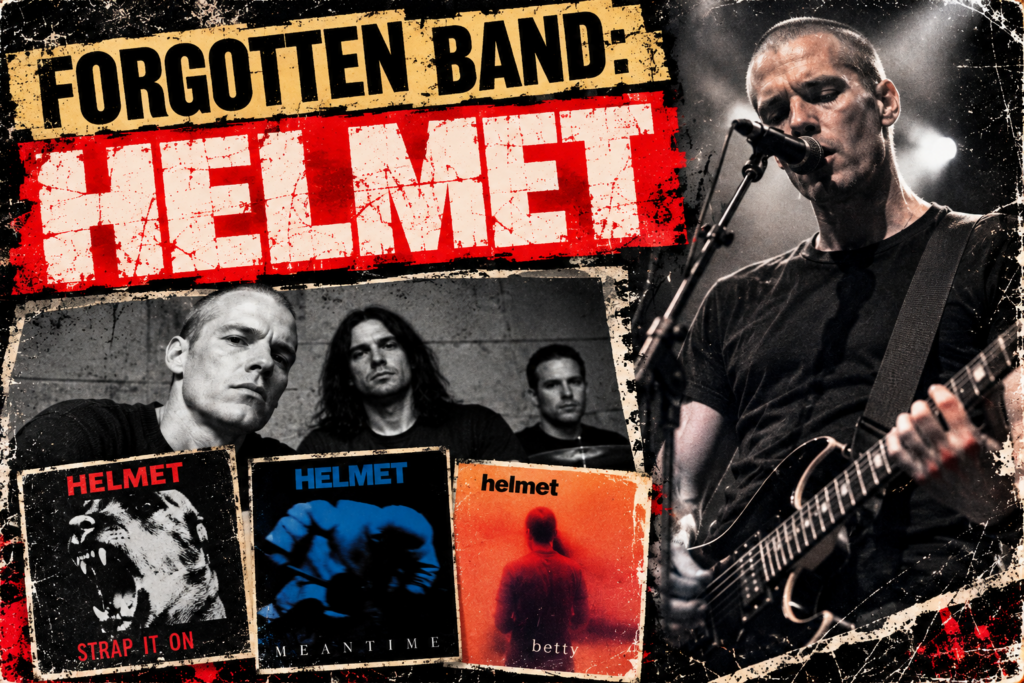
There are bands that disappear because they weren’t very good. There are bands that disappear because they had one hit and then vanished. And then there are bands like Helmet, who somehow managed to influence an enormous number of musicians, score a genuine alternative-rock hit, make several excellent albums and still end up feeling like a forgotten piece of the 1990s.
Helmet were never completely forgotten. Anyone who spent time digging through alternative metal, post-hardcore or ’90s heavy music knows exactly who they are. But compared with the influence they had, their place in popular music history is strangely small.
And that’s a shame because Helmet didn’t sound like anybody else.
They were heavy without being traditional metal. They were aggressive without relying on speed. They were technically sharp without sounding like a bunch of musicians showing off. Their riffs were brutally simple, but somehow incredibly difficult to duplicate.
At the center of it all was guitarist and singer Page Hamilton, whose dry, almost detached vocal style was the perfect match for the band’s enormous guitar sound.
Helmet didn’t need to scream constantly.
The riffs did enough screaming for them.
New York Before Alternative Metal
Helmet formed in New York City in 1989, with Hamilton joined by bassist Henry Bogdan and drummer John Stanier.
From the beginning, they occupied an interesting space between underground punk, hardcore and heavy metal.
They didn’t have the traditional look of a metal band.
There were no leather pants.
No giant hair.
No guitar solos that lasted six minutes.
No interest in becoming the next arena-rock sensation.
Instead, Helmet built songs around heavy, repetitive guitar riffs and unusual rhythmic patterns.
The result was music that could sound almost mechanical.
Then it would suddenly explode.
Their early work attracted attention from the underground scene, eventually leading to a deal with Amphetamine Reptile Records.
Their debut album, Strap It On, arrived in 1990 and immediately established the band’s identity.
It was abrasive, strange and ridiculously heavy.
But there was something else happening underneath the noise.
These songs had grooves.
Meantime Changes Everything
Helmet’s breakthrough came with Meantime in 1992.
This is the album that should be mentioned whenever someone talks about the development of alternative metal.
It was heavy enough for metal fans, weird enough for alternative audiences and rhythmic enough to appeal to people who didn’t normally listen to either.
The production was cleaner than their debut, but Helmet never lost the unpleasant edge that made them interesting.
The riffs sounded like machinery.
The drums were incredibly tight.
And Page Hamilton’s vocals remained almost conversational.
Then came “Unsung.”
That song gave Helmet their biggest mainstream exposure.
The guitar riff is deceptively simple.
It doesn’t sound complicated.
But try playing it properly.
Suddenly it becomes obvious why Helmet was different.
The rhythm is everything.
Helmet understood that a heavy riff doesn’t have to be fast.
It just has to hit at exactly the right moment.
They Were Never Really Grunge
This is where Helmet’s history gets interesting.
They arrived during the grunge explosion, but they didn’t really belong to it.
They were from New York rather than Seattle.
They weren’t particularly interested in the bluesy side of alternative rock.
They didn’t sound like Nirvana.
They didn’t sound like Pearl Jam.
They didn’t sound like Soundgarden.
Helmet were building something much more angular and mathematical.
The band became associated with the broader alternative-rock movement because that’s where the record stores and radio stations put them.
But their music pointed somewhere else.
You can hear pieces of Helmet’s sound in the alternative metal and nu-metal explosion that followed.
Bands began combining heavy riffs with hip-hop rhythms, industrial textures and unconventional song structures.
Helmet had already been doing something similar without needing to call it anything.
Betty Was a Weird Left Turn
After the success of Meantime, Helmet could have easily made another version of the same album.
Instead, they made Betty.
Released in 1994, Betty was less straightforward and more experimental.
There were still enormous riffs, but Hamilton and the band were clearly interested in stretching their sound.
Songs became stranger.
The arrangements became more unpredictable.
The album even incorporated unexpected influences and textures.
It wasn’t the obvious commercial follow-up.
That’s probably one reason Helmet never became a massive mainstream band.
They weren’t particularly interested in giving listeners exactly what they expected.
Then Came the Movies
Helmet also became one of those bands whose music seemed to turn up everywhere during the 1990s.
Their songs appeared in movies and soundtracks, helping expose them to people who might never have bought a Helmet album.
They also contributed to the increasingly blurred boundary between alternative rock, metal and mainstream entertainment.
For a while, it seemed like Helmet might finally become a major rock act.
But they never quite made that leap.
And eventually, the band’s original run came to an end.
The Split
Helmet broke up in 1998.
By that point, the alternative-rock landscape had changed dramatically.
The musical world that had embraced Helmet was moving toward nu-metal, pop punk and increasingly polished commercial rock.
The band’s influence remained obvious, but their own commercial momentum had slowed.
Hamilton eventually revived Helmet in the early 2000s with new musicians.
The band has continued through various lineups ever since.
That’s another reason the “forgotten band” label doesn’t quite fit.
Helmet didn’t disappear.
They just stopped being part of the mainstream conversation.
The Bands They Influenced Became Bigger
This may be Helmet’s most frustrating legacy.
You can hear their influence in countless heavy alternative bands.
Their rhythmic approach became particularly important.
Instead of simply hammering away at power chords, Helmet treated the guitar almost like a percussion instrument.
The riffs locked into the drums.
The bass reinforced the groove.
Everything had to fit together.
That approach became hugely influential on alternative metal and later heavy music.
Helmet helped demonstrate that you could make music brutally heavy without playing at ridiculous speeds.
That sounds obvious now.
In the early 1990s, it wasn’t.
Why Did We Forget Helmet?
Because they were never particularly easy to categorize.
They were too heavy for alternative rock.
Too experimental for mainstream metal.
Too controlled for hardcore.
Too weird for radio.
And just as they were becoming commercially successful, the musical landscape was changing underneath them.
That’s the unfortunate timing of Helmet.
If Meantime had arrived a few years later, perhaps the alternative-metal explosion would have made them enormous.
If it had arrived a few years earlier, they might have been remembered as pioneers of the underground metal scene.
Instead, they landed in the middle.
They became influential without becoming iconic.
They Deserve Another Look
If you’ve forgotten Helmet, Meantime is the obvious place to start.
Then go back to Strap It On and move forward through Betty.
What becomes immediately apparent is how modern some of this music still sounds.
The guitars remain huge.
The rhythms still hit.
The songwriting is tight without being predictable.
And Hamilton’s voice gives everything a strange sense of restraint.
Helmet didn’t need to scream at you to convince you they were heavy.
They simply turned up the amplifier and dropped the riff.
That’s it.
No gimmicks.
No costumes.
No arena-rock theatrics.
Just some of the most precise and punishing guitar music to come out of the American alternative scene.
Helmet aren’t really a forgotten band.
They’re something worse.
They’re a band whose influence is remembered more than the band itself.
People remember the sound.
They remember the riffs.
They remember “Unsung.”
They remember that Helmet was important.
But they don’t always go back and listen.
And that’s where they’re missing out.
Because Meantime isn’t just a relic from the early ’90s.
It’s still a monster of an album.
Helmet helped build the road that alternative metal traveled down during the next decade, and plenty of bigger bands drove straight past them on it.
Maybe it’s time to pull over and give the guys who built the road a little credit.
Helmet didn’t need to be the biggest band of the ’90s.
They just needed to be one of the heaviest.
And they were.