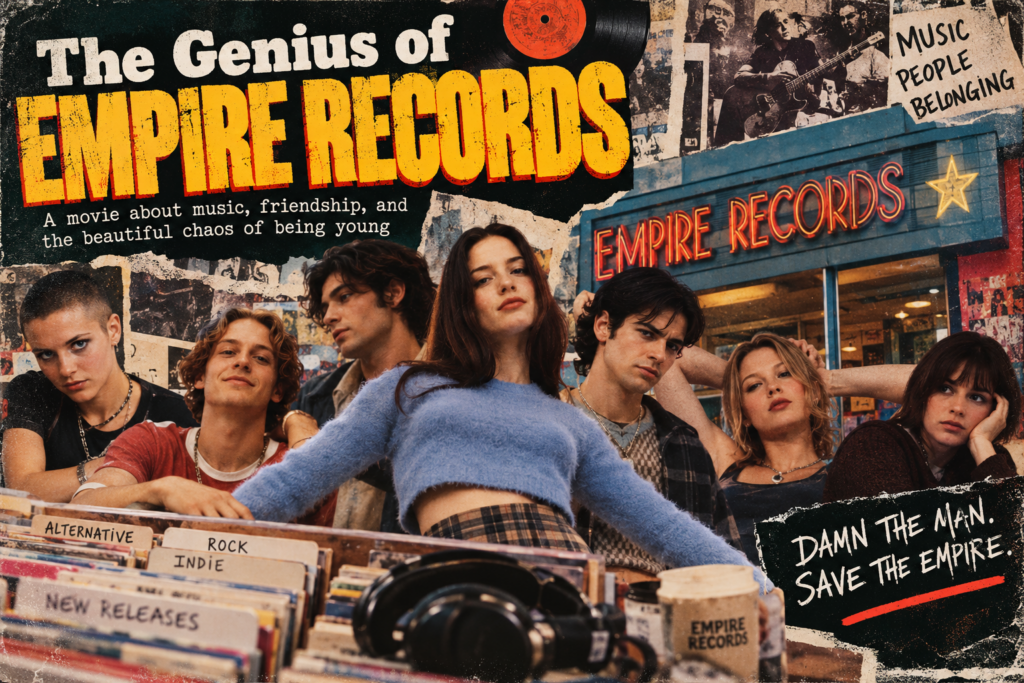
** I’m not going to bury the lead here. Youtube Movies currently has Empire Records available to stream for free. So here it is, if you don’t want to read the article I spent an hour writing, have at it **
Now if you actually wanna read it……..
Some movies capture a moment in time so perfectly that they become more than entertainment. They become time capsules, preserving the music, fashion, attitudes, anxieties, and absurd little details of a generation. Empire Records is one of those movies. Released in 1995, it arrived with an unassuming story about a group of record store employees trying to save their workplace, but beneath its modest premise was something much more meaningful: a celebration of individuality, friendship, music, and the terrifying, exhilarating experience of figuring out who you are.
At the box office, Empire Records didn’t exactly set the world on fire. Critics were largely unimpressed, and the movie initially struggled to find an audience. Yet over the years, it developed a devoted following, particularly among people who recognized themselves in its collection of outsiders, misfits, music obsessives, and young adults who hadn’t quite figured out what they wanted from life.
Its enduring appeal isn’t an accident. The genius of Empire Records lies in its understanding that growing up rarely happens through grand revelations. Sometimes it happens during an awful shift at work, an argument with a friend, a terrible decision made at two in the morning, or a conversation with someone who understands you better than you understand yourself.
And sometimes, it happens in a record store.
A Simple Story With Something Bigger at Its Heart
The premise of Empire Records is deceptively straightforward. The employees of an independent record store discover that their beloved workplace is in danger of being absorbed into a corporate chain. Over the course of a chaotic day, they navigate personal problems, romantic entanglements, musical ambitions, financial disasters, and the usual assortment of teenage catastrophes.
On paper, this sounds like the foundation for a conventional workplace comedy. In practice, the record store becomes a miniature world where each character represents a different struggle with identity, insecurity, ambition, or belonging.
The store isn’t merely where the characters work. It’s where they spend their lives, where they find their friends, and where they feel most comfortable being themselves. It provides a refuge from parents, school, social expectations, and the increasingly complicated business of becoming an adult.
That distinction matters. For many young people, a first job is simply a way to earn money. But occasionally, a workplace becomes a community. The people behind the counter become your friends. The customers become familiar faces. The music playing through the speakers becomes the soundtrack to an entire chapter of your life.
Empire Records understands that emotional connection. The store is imperfect, financially precarious, and occasionally ridiculous, but it belongs to the people who inhabit it.
The looming corporate takeover threatens more than a business. It threatens the characters’ sense of home.
That’s what gives the story its emotional foundation. Saving Empire Records becomes a way of protecting the world they’ve built together.
The Characters Feel Like People You Actually Knew
One of the movie’s greatest strengths is its ensemble cast. Rather than building the entire story around one protagonist, Empire Records distributes its emotional weight across a collection of young people whose personalities, problems, and ambitions collide throughout the film.
They’re exaggerated enough to be entertaining but recognizable enough to feel real.
There’s Lucas, the impulsive employee whose attempt to save the store through a reckless gamble creates the crisis that drives the story. There’s Corey, the academically gifted overachiever whose carefully managed life begins to unravel under the pressure of expectations. Gina is confident, provocative, and determined to be taken seriously, even when she isn’t entirely sure what she wants.
Debra is withdrawn and angry, carrying pain that her coworkers don’t fully understand. A.J. is an aspiring artist caught between romantic feelings and the uncertainty of pursuing a creative life. Warren, meanwhile, arrives as an outsider and quickly becomes part of the store’s increasingly chaotic orbit.
Then there’s Mark, whose laid-back, slightly ridiculous personality provides some of the film’s funniest moments.
What makes these characters work is that none of them has everything figured out. They possess different degrees of confidence, intelligence, sensitivity, and self-awareness, but they’re all struggling with something.
Corey might look like the person most likely to succeed, but academic achievement doesn’t protect her from insecurity. Gina’s boldness doesn’t eliminate her need for validation. A.J.’s artistic ambitions don’t make difficult conversations any easier. Debra’s anger doesn’t tell the whole story of what she’s experiencing.
These contradictions make the characters interesting.
The movie doesn’t suggest that being young automatically makes someone profound or that every problem can be solved with a heartfelt speech. Instead, it presents a group of people who are frequently immature, selfish, confused, and occasionally wonderful.
In other words, they’re believable.
The genius is in allowing their personalities to clash without making every disagreement a moral lesson. They’re coworkers, friends, potential lovers, and occasional irritants. They don’t always understand one another, but their lives overlap enough that they gradually learn to care.
For anyone who worked a job in their teens or early twenties, the dynamic feels remarkably familiar. There was always a Lucas, a Gina, a Corey, or a Mark somewhere in the building. There were friendships that made no sense on paper but worked perfectly in practice.
And there was almost always someone who made an ordinary shift memorable.
The Record Store Is the Real Star
Although the characters carry the story, Empire Records itself is arguably the movie’s most important creation.
The store represents a particular kind of cultural space that has become increasingly difficult to find. It’s a place where music is something you discover rather than something an algorithm delivers to you. You browse without necessarily knowing what you’re looking for. You pick up an album because the cover catches your eye. You ask an employee for a recommendation and end up discovering a band that changes your life.
Music is personal in this environment. It isn’t simply background entertainment. It’s a way of expressing identity, finding community, and communicating feelings that are otherwise difficult to articulate.
The employees understand this instinctively. Their musical interests help define who they are, and the store allows them to share those interests with one another.
The movie also recognizes the social importance of independent businesses. Empire Records isn’t just competing on price or convenience. Its value comes from its personality, its employees, and the feeling that the place belongs to its community.
A corporate chain might offer a more efficient business model, but efficiency isn’t the same thing as character.
That conflict gives the film an unexpectedly enduring theme. The struggle between independent culture and corporate consolidation wasn’t invented in the 1990s, and it certainly hasn’t disappeared. It applies to record stores, bookstores, music venues, movie theaters, and countless other places where the personality of a business is inseparable from the people who make it special.
The film doesn’t need to deliver a lecture about capitalism to make its point. It shows us what would be lost if Empire Records disappeared.
We understand why these characters care because we’ve spent time inside their world.
And that is much more effective than simply telling the audience that independent stores are important.
The Soundtrack Is Practically Another Character
Any discussion of Empire Records that doesn’t give its soundtrack considerable attention is missing a major part of the movie’s identity.
Music isn’t merely placed between scenes to keep the energy moving. It establishes the atmosphere, reveals character, and helps turn the store into a believable cultural universe.
The soundtrack captures the alternative-rock sensibility of the mid-1990s, when grunge was still influencing popular culture, Britpop was finding a wider audience, and alternative music had become a dominant force among young listeners.
The film’s musical selections create a recognizable sense of time without making the experience feel like a history lesson.
Among the standout songs is the Gin Blossoms’ “Til I Hear It from You,” which became closely associated with the movie and reached a much wider audience through its connection to the film. The song captures the restless romantic energy of the story while fitting naturally into its broader musical identity.
Then there’s the inclusion of “Sugarhigh” by Coyote Shivers, a perfect example of the movie’s willingness to embrace playful, slightly chaotic rock-and-roll energy.
The soundtrack also benefits from the presence of artists such as The Cranberries, Better Than Ezra, and other performers associated with the alternative scene of the era. Together, they create an environment that feels lived in rather than artificially assembled.
But the soundtrack’s real achievement is how naturally it connects music with personality.
The characters don’t just happen to work in a record store. They’re people for whom music is part of the language they use to understand the world. Their tastes, attitudes, and emotional responses are shaped by the songs surrounding them.
For audiences who grew up during the period, the music can trigger an almost physical sense of nostalgia. A song begins, and suddenly you’re remembering the clothes you wore, the people you knew, the places you went, and the albums you played until you practically wore them out.
For younger viewers, the soundtrack offers a window into a time when discovering music often required a little more curiosity and a lot more wandering through record-store racks.
The film’s musical identity is so strong that it would be difficult to imagine it working nearly as well without it.
The songs don’t simply accompany the story.
They help define it.
A Movie About Being Young Without Knowing What Comes Next
Beneath the comedy, romance, and musical nostalgia, Empire Records is fundamentally a story about uncertainty.
The characters are standing at the edge of adulthood, but none of them has received a reliable instruction manual. They have ambitions, expectations, insecurities, and romantic fantasies, but the future remains frustratingly unclear.
Corey is trying to meet expectations that may not even reflect what she truly wants. A.J. is wrestling with the vulnerability required to pursue his artistic ambitions and express his feelings. Gina is trying to reconcile the person she presents to the world with the person she wants to become.
Debra’s struggles are more serious, giving the film an emotional dimension that extends beyond ordinary teenage confusion.
These stories work because the movie understands that growing up isn’t a clean transition from ignorance to wisdom. It’s a process of making mistakes, recognizing your limitations, and occasionally discovering that the life you thought you wanted isn’t necessarily the life that will make you happy.
The characters don’t suddenly become adults by the end of the movie. They’re still young, still impulsive, and still capable of making terrible decisions.
What changes is their understanding of themselves and one another.
They begin to recognize that the people around them are dealing with problems that aren’t always visible. Someone who appears confident may be desperately insecure. Someone who seems detached may be hurting. Someone who appears to have a perfect future may be terrified of it.
That recognition creates empathy.
And empathy, rather than maturity in the conventional sense, becomes one of the movie’s most important ideas.
The film suggests that growing up involves learning to see other people more clearly, even when you haven’t quite figured yourself out.
The Genius of Its Imperfect Tone
One reason Empire Records has remained such a divisive movie is that its tone can be all over the place.
It moves between broad comedy, romantic awkwardness, workplace chaos, emotional drama, and moments of genuine sadness. Some scenes are deliberately ridiculous. Others are surprisingly sincere. Occasionally, the movie shifts from one emotional register to another so quickly that it feels as though several different films are competing for the same running time.
Its characters can be cartoonish. Some of its conflicts are resolved with a convenience that real life rarely provides. Certain moments lean heavily into the heightened emotional style of 1990s youth cinema.
These are legitimate weaknesses.
Yet the same qualities contribute to the film’s personality.
Empire Records feels messy because its characters are messy. Its emotional shifts reflect the intensity with which young people can experience life, when a disastrous afternoon feels like the end of the world and a great night with friends feels like the beginning of everything.
The movie doesn’t always know when to be subtle, but it understands the emotional scale of being young.
At that age, you can experience embarrassment, heartbreak, excitement, anger, and joy within the space of a single day. A minor humiliation can feel catastrophic. A romantic gesture can seem monumental. A friendship can become the most important thing in your life.
The film captures that intensity through its restless pacing and occasionally excessive sentimentality.
Its rough edges also prevent it from feeling too polished or corporate. There’s an appealing scruffiness to the whole enterprise, an impression that the movie is more interested in its characters than in maintaining perfect narrative discipline.
Not every scene lands. Not every joke works. Not every character receives the development they deserve.
But the movie has a pulse.
And sometimes, personality is more valuable than perfection.
Why the Movie Became a Cult Classic
The history of Empire Records is part of what makes its legacy so interesting.
The movie was not initially received as the generational touchstone it would eventually become. Its theatrical performance was disappointing, and its reputation grew through later viewings, home video, cable television, and the gradual accumulation of devoted fans.
That evolution reflects something important about the way audiences connect with movies.
A film can fail to make an immediate impression and still find the right people at the right time. Sometimes a movie’s most important audience isn’t the one that sees it on opening weekend. It’s the audience that discovers it years later, when the characters’ experiences suddenly feel personal.
For many viewers, Empire Records became a movie associated with a particular period of life. They watched it with friends, quoted its dialogue, memorized its soundtrack, and returned to it whenever they wanted to revisit the atmosphere of the 1990s.
The film also benefited from the strength of its central setting. A record store is a remarkably effective place to build a coming-of-age story because it brings together people with different personalities while giving them a shared interest.
The characters have somewhere to go, something to do, and a reason to spend time together. Their lives intersect naturally, without requiring the plot to manufacture an elaborate excuse for every encounter.
That makes the movie easy to revisit. Even when viewers know exactly how the story unfolds, they can return simply to spend time with the characters.
This is one of the defining qualities of a cult classic: the pleasure isn’t limited to discovering what happens next. It’s about returning to a world you enjoy inhabiting.
The movie’s cultural afterlife has also been sustained by the music, the fashion, the dialogue, and its association with an era that now feels both familiar and distant.
For those who experienced the 1990s firsthand, it offers a concentrated dose of nostalgia. For viewers who came later, it provides an appealing portrait of a pre-streaming music culture built around physical spaces, shared discoveries, and personal recommendations.
Its imperfections haven’t prevented it from becoming beloved.
In some ways, they’ve helped.
The Movie Understands the Importance of Finding Your People
Perhaps the most emotionally resonant element of Empire Records is its belief that people don’t have to be perfect to matter to one another.
The employees are an unlikely collection of personalities. They don’t always agree, and they certainly don’t always behave well. They make impulsive decisions, hurt one another’s feelings, and occasionally create problems that would be easier to solve if everyone simply acted like a reasonable adult.
But they keep showing up.
They share a workplace, a passion for music, and an increasingly urgent reason to work together. Over time, those connections become more meaningful than their differences.
The film’s emotional payoff depends on the audience believing that this group of people genuinely cares about one another. Their efforts to save the store become a collective expression of loyalty, not merely an attempt to preserve their jobs.
This is an important distinction.
A workplace can be replaceable. A community is harder to reproduce.
The characters are fighting for something that gives their lives structure and meaning. They’re protecting the place where they belong, even if they haven’t fully recognized how important that belonging is until it comes under threat.
That idea extends far beyond the movie’s setting.
Almost everyone has experienced a period in life when a group of friends, a favorite hangout, a workplace, or a shared interest becomes the center of their social universe. At the time, it may feel completely ordinary. Only later do you realize how much those experiences shaped you.
Empire Records captures that feeling before nostalgia has a chance to soften it.
The characters aren’t looking back on their youth. They’re living it, with all the confusion and immediacy that entails.
That’s why the movie’s friendships feel so appealing. They’re not presented as perfect relationships between idealized people. They’re relationships between individuals who are still learning how to care for one another.
The store gives them a place to begin.
A Time Capsule of a World That Has Changed
Watching Empire Records today means encountering a version of music culture that has largely disappeared.
The physical record store was once a central destination for people who loved music. New releases generated excitement. Album covers were objects to examine. Listening to a record involved a physical purchase, and discovering a new artist could be the result of browsing shelves for an hour.
The internet eventually transformed that experience, followed by digital downloads and streaming services. Music became more accessible than ever, but the process of finding it changed dramatically.
Today, someone can explore an enormous catalog without leaving home. Recommendations can be generated automatically, and entire discographies are available with a few taps.
Those conveniences are extraordinary. Yet they also make the particular environment of Empire Records feel increasingly special.
The store represents a time when discovering music was often a social experience. You talked to employees, argued about bands, compared albums, and occasionally bought something simply because a friend insisted that you had to hear it.
The experience involved chance, conversation, and physical presence.
The movie doesn’t need to claim that the past was universally better. It simply reminds us that something valuable existed in that older culture, something that couldn’t be measured entirely in sales figures or streaming numbers.
The record store was a place where people could gather around a shared passion without needing to agree on everything else.
That spirit remains relevant even as the physical setting changes. Independent music venues, local bookstores, record shops, fan communities, and other cultural spaces continue to provide opportunities for people to connect through the things they love.
The world of Empire Records may be rooted in 1995, but its underlying idea isn’t tied to a particular decade.
People still need places where they feel welcome.
They still need music that makes them feel understood.
And they still need friends who will help them get through the days when everything seems to be going wrong.
The Performances That Make It Work
The movie’s ensemble is essential to its lasting appeal, and its cast deserves credit for creating characters who remain memorable even when the script occasionally pushes them toward caricature.
Rory Cochrane gives Lucas an appealing mixture of intelligence, recklessness, and desperation. He’s the kind of person who can convince himself that an increasingly terrible decision is actually a brilliant plan, right up until the consequences arrive.
Liv Tyler brings vulnerability to Corey, making her more than the familiar high-achieving student whose private life doesn’t match her public image. Her performance helps ground a character whose anxieties could otherwise feel like a collection of familiar coming-of-age tropes.
Renée Zellweger gives Gina a brash, funny confidence that masks a more complicated desire to be taken seriously. The character can be frustrating, but Zellweger makes her difficult to dismiss.
Robin Tunney’s Debra provides some of the film’s most affecting moments. She conveys a guardedness that makes the character’s emotional struggles feel distinct from the lighter problems surrounding her. The performance adds weight to a movie that could easily have treated every difficulty as another opportunity for comedy.
Johnny Whitworth gives A.J. an understated awkwardness that works well against the louder personalities around him, while Ethan Embry’s Mark supplies a steady stream of eccentricity.
The supporting cast helps establish the sense that Empire Records exists beyond the boundaries of the main storyline. These characters have personalities and histories that the movie only partially explores, which makes the world feel larger than the plot itself.
That’s another reason the film remains enjoyable. It gives viewers enough information to understand the characters while leaving room for the imagination to fill in the rest.
You can easily picture what these people might have been doing before the movie began or where their lives might take them afterward.
The film’s greatest achievement isn’t that every character is fully developed. It’s that so many of them feel like people whose stories could continue after the credits roll.
Why Empire Records Still Matters
The genius of Empire Records isn’t that it is a flawless movie. It isn’t.
Its plotting can be contrived, its tone occasionally wanders, and its characters sometimes behave in ways that seem designed to move the story forward rather than reflect real human behavior. It wears its heart on its sleeve, and there are moments when that sentimentality becomes a little overwhelming.
But the film possesses qualities that are much harder to manufacture.
It has a distinctive atmosphere. It understands the emotional importance of music. It creates a setting that feels worth saving. Most importantly, it recognizes that the people who surround us during formative years can become inseparable from our memories of that time.
The movie also understands something that many coming-of-age stories overlook: growing up isn’t just about leaving childhood behind. It’s about discovering which parts of yourself you want to keep.
The characters don’t need to abandon their individuality to become responsible. They don’t need to stop loving music, making mistakes, or spending time with people who understand them. They need to learn how to take themselves and one another seriously without losing the qualities that make them interesting.
Empire Records becomes a symbol of that possibility. It represents a space where individuality isn’t merely tolerated but celebrated, where people with different ambitions and personalities can share a common purpose.
That message helps explain why the film has endured despite its rocky initial reception.
The audience doesn’t return because every scene is perfect. It returns because the movie offers something emotionally recognizable: the feeling of finding a place where you belong, surrounded by people who make an otherwise ordinary day feel important.
For some viewers, that place was a record store. For others, it was a video rental shop, a local music venue, a favorite bar, a school hallway, or the living room where friends gathered to listen to albums and talk about everything that mattered.
The setting changes, but the feeling remains.
Empire Records reminds us that some of the most important experiences in life happen in places that look unremarkable to everyone else. The people inside those places understand their significance because they have built something there together.
They have shared jokes, music, arguments, disappointments, and moments of unexpected kindness. They have created memories without realizing that those memories might eventually become the things they treasure most.
That’s the secret behind the movie’s lasting appeal.
It isn’t really about saving a record store. It’s about saving a little corner of the world where a group of young people can be themselves while they figure out what being themselves actually means.
And maybe that’s why Empire Records continues to resonate decades after its release.
The world moves on. Businesses close. Music changes. People grow up and go their separate ways.
But somewhere in the back of our minds, we still remember the places where we felt like we belonged, the friends who made us laugh, and the songs that seemed to understand us better than anyone else.
Empire Records captures that feeling beautifully.
Damn the man. Save the Empire.