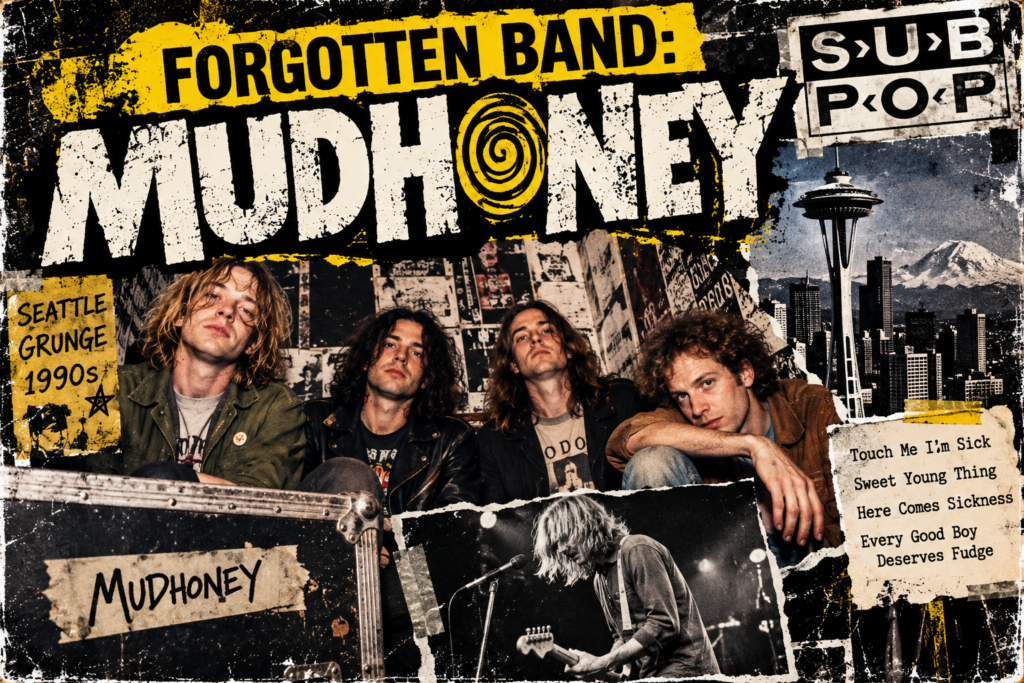
There is something slightly ridiculous about calling Mudhoney a forgotten band.
They were there when the Seattle music scene was turning into the biggest rock story on the planet. They released records on Sub Pop. They helped establish the sound that would eventually be labeled grunge. Kurt Cobain was a fan. Their music became part of the soundtrack to one of the most important alternative-rock movements of the late 1980s and early 1990s.
And yet, when people talk about grunge today, Mudhoney often gets pushed several places down the list.
Everybody remembers Nirvana.
Everybody remembers Pearl Jam.
Soundgarden and Alice in Chains get their share of attention.
Then somebody mentions Mudhoney and you can practically see the question forming:
“Wait… weren’t they one of those Seattle bands?”
Yes.
They were one of those Seattle bands.
Except they were there before almost everybody else.
Before Grunge Was a Thing
Mudhoney formed in Seattle in 1988, emerging from the ashes of two hugely important underground bands: Green River and The Melvins-adjacent scene that was developing around the Pacific Northwest.
The original lineup featured Mark Arm on vocals, Steve Turner on guitar, Matt Lukin on bass and Dan Peters on drums.
If those names aren’t immediately familiar, the music should be.
Mudhoney sounded filthy.
The guitars were distorted and fuzzy. The drums sounded like they were being played in a basement. Mark Arm’s vocals could shift from sarcastic sneering to full-on screaming without warning.
There was punk in there.
There was garage rock.
There was heavy metal.
There was psychedelia.
And there was a willingness to sound completely out of control.
That combination became one of the foundations of the Seattle sound.
The Sub Pop Connection
Mudhoney’s relationship with Sub Pop was crucial.
The label was still a tiny operation when Mudhoney released their debut single, “Touch Me I’m Sick,” in 1988.
That song became one of the defining recordings of the early Seattle scene.
It was loud, nasty and catchy in exactly the right proportions.
It also demonstrated something important about the bands coming out of Seattle.
They weren’t trying to sound like polished arena-rock stars.
They didn’t seem particularly interested in sounding fashionable either.
Mudhoney sounded like a band that had spent too much time listening to punk and garage records and had decided to make everything louder.
“Touch Me I’m Sick” became a cult classic, and Mudhoney quickly became one of the most recognizable names associated with Sub Pop.
Then Nirvana arrived.
And things changed.
Suddenly Everybody Wanted to Be From Seattle
By the early 1990s, Seattle had become the center of the rock universe.
Record companies were signing anything that had a flannel shirt and a distorted guitar.
Bands that had spent years playing tiny clubs were suddenly being offered major-label contracts.
Nirvana’s Nevermind changed everything.
Pearl Jam exploded.
Soundgarden broke through.
Alice in Chains became a major rock act.
The term “grunge” was suddenly everywhere.
Mudhoney, however, never became a superstar.
That wasn’t necessarily because they weren’t good enough.
In fact, their refusal to chase mainstream success may have been part of the reason they remained so respected.
They were never particularly interested in cleaning up their sound for radio.
They didn’t suddenly start writing power ballads.
They didn’t reinvent themselves to take advantage of the grunge explosion.
They just kept being Mudhoney.
The Problem With Being Influential
Mudhoney’s biggest historical problem is that they were more influential than commercially successful.
That’s a strange position for a band to occupy.
They helped create the sound.
Other bands became famous for it.
It’s similar to being the person who invents a recipe and then watching somebody else become famous after opening a restaurant serving it.
Mudhoney helped establish the distorted, ugly, sarcastic side of Seattle rock.
But when the rest of the world discovered Seattle, the spotlight landed elsewhere.
They became the cool band’s favorite band.
That’s great for credibility.
It isn’t necessarily great for your Wikipedia page.
They Had More Than One Song
Another reason Mudhoney gets overlooked is that casual listeners often know only “Touch Me I’m Sick.”
That’s a shame because the band’s catalog is much deeper.
Their self-titled 1989 album remains one of the essential documents of the early Sub Pop era.
Then came Every Good Boy Deserves Fudge in 1991, arguably one of their strongest records.
Instead of chasing the increasingly polished alternative-rock sound, Mudhoney doubled down on their weirdness.
There were punk influences, garage-rock riffs, noisy experiments and surprisingly catchy melodies.
They sounded like they didn’t care whether anybody understood what they were doing.
That attitude was increasingly rare as alternative rock became a commercial industry.
They Even Went Major Label
Mudhoney eventually signed with Reprise Records and released Piece of Cake in 1992.
For a moment, it looked like the band might finally receive the commercial success that had eluded them.
It didn’t quite happen.
But the album demonstrated that Mudhoney could make the jump to a major label without completely losing their identity.
They remained loud.
They remained weird.
They remained gloriously unconcerned with becoming the next Pearl Jam.
Eventually they returned to the independent world and continued recording.
And that’s one of the most impressive things about their story.
They didn’t disappear when grunge faded.
They didn’t become a nostalgia act.
They just kept making records.
The Band That Refused to Go Away
Mudhoney’s longevity is actually one of the reasons they are so easy to overlook.
They’re not a dramatic “what happened to them?” story.
They never broke up for decades.
They never vanished.
They never had a spectacular fall from the top.
They simply continued.
Album after album.
Tour after tour.
Decade after decade.
That isn’t necessarily the kind of story that generates documentaries and endless nostalgia pieces.
But it might be the better story.
Mudhoney survived the grunge explosion, the death of grunge, the rise of alternative rock, the decline of alternative rock, the digital music revolution and the streaming era.
They were still Mudhoney.
Mark Arm’s Voice Remains Instantly Recognizable
One of the band’s greatest assets has always been Mark Arm.
His voice doesn’t sound like a conventional rock singer.
It’s ragged.
It’s sarcastic.
It’s aggressive.
Sometimes it sounds like he’s barely holding the song together.
That was perfect for Mudhoney.
There is no mistaking him once you hear him.
Steve Turner’s guitar work is equally important.
Instead of the polished riffs that would dominate mainstream rock, Mudhoney embraced fuzz, feedback and noise.
The guitars often sound like they’re being pushed beyond their limits.
That’s part of the appeal.
The imperfections become the sound.
Why Did We Forget Them?
Technically, we didn’t.
Mudhoney still has a loyal fan base.
They still tour.
They still release music.
They remain hugely respected by musicians and serious alternative-rock fans.
But culturally, they have been overshadowed.
The story of grunge has become a story about Nirvana, Pearl Jam, Soundgarden and Alice in Chains.
Mudhoney is often treated as part of the opening chapter rather than one of the main characters.
That’s unfortunate.
Because without bands like Mudhoney, the Seattle explosion would have looked very different.
They helped create the environment that made the entire movement possible.
They were there before the major labels came calling.
They were there before the flannel shirts became a fashion statement.
They were there before everybody suddenly claimed to have discovered Seattle.
And they kept going after everybody else moved on.
The Ultimate “Forgotten” Band
Mudhoney isn’t really forgotten.
They’re something more interesting.
They’re underremembered.
Their influence is enormous compared with their mainstream profile.
Their songs still sound filthy and energetic.
Their early records remain essential listening for anyone interested in the origins of grunge.
And their refusal to turn themselves into a polished commercial product is probably one reason their music has aged so well.
If you only know Mudhoney because of “Touch Me I’m Sick,” you’ve barely scratched the surface.
Go back to Mudhoney.
Play Every Good Boy Deserves Fudge.
Listen to Piece of Cake.
Then work your way through the later albums.
You’ll find a band that wasn’t simply riding the grunge wave.
They helped create the damn wave.
And maybe that’s the weirdest part of Mudhoney’s legacy.
They were never the biggest band in Seattle.
They were never the richest.
They were never the most famous.
But when the history of alternative rock gets traced back far enough, their fingerprints are all over it.
That’s not being forgotten.
That’s being one of the bands everyone else forgot to thank.