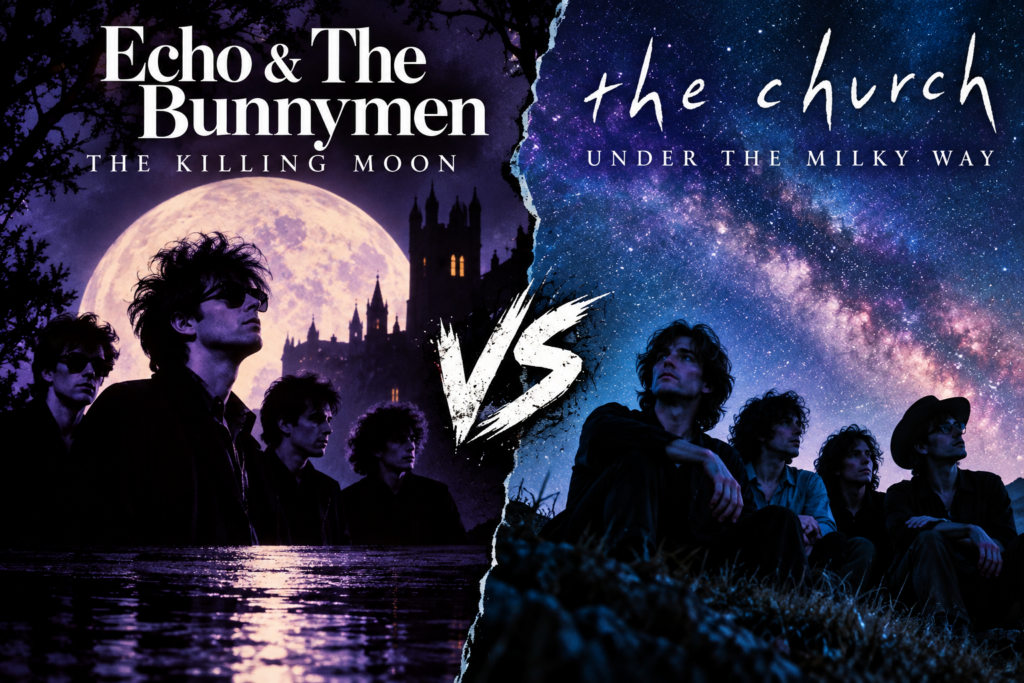
Two songs. Two bands. Two completely different ways of making atmospheric rock feel enormous.
Echo & the Bunnymen’s “The Killing Moon” and The Church’s “Under the Milky Way” are both defining songs of alternative rock, but they approach atmosphere from opposite directions.
“The Killing Moon” is dark, dramatic and hypnotic. Ian McCulloch’s deep, commanding vocal sits above Will Sergeant’s shimmering guitar work, creating a song that feels mysterious from the very first note.
“Under the Milky Way” is dreamy, spacious and almost otherworldly. Steve Kilbey’s detached vocal floats over layers of guitars, keyboards and atmospheric production, creating something that feels less like a traditional rock song and more like a late-night hallucination.
One feels like midnight in an empty city.
The other feels like staring into the sky at 2 a.m.
Both became signature songs for their bands.
Both remain staples of alternative rock.
But which one wins?
Song Profile: “The Killing Moon”
Released in 1984 on Echo & the Bunnymen’s Ocean Rain, “The Killing Moon” is one of those songs that seems to exist outside of time.
The opening immediately establishes the mood. Will Sergeant’s guitar work is atmospheric without becoming overly complicated, while the rhythm section gives the song a steady, almost hypnotic pulse.
Then Ian McCulloch enters.
His deep, dramatic voice gives the song a sense of authority. He doesn’t sound like he’s simply singing over the music. He sounds like he’s commanding the entire atmosphere around him.
The arrangement is remarkably restrained considering how dramatic the song feels. Strings add another layer of tension, while the guitars shimmer around the edges.
Nothing is rushed.
Nothing needs to be.
“The Killing Moon” builds its impact through mood, melody and sheer presence.
It is dark without being depressing, romantic without becoming sentimental and mysterious without losing its hook.
That combination is incredibly difficult to pull off.
Song Profile: “Under the Milky Way”
The Church released “Under the Milky Way” in 1988 on Starfish, and it became the band’s defining song.
Steve Kilbey’s vocal performance is the opposite of Ian McCulloch’s.
Where McCulloch sounds commanding, Kilbey sounds distant and almost detached, as if he’s observing everything from somewhere far away.
The song’s instrumentation creates the perfect environment for that vocal.
The guitars shimmer, the rhythm section remains understated and the production gives everything plenty of space.
One of the song’s most distinctive elements is the atmospheric keyboard work, which adds an almost otherworldly quality to the arrangement.
The result is a song that feels enormous without ever becoming loud.
“Under the Milky Way” doesn’t demand attention.
It simply creates a world and lets you wander around inside it.
Round 1: Songwriting
“The Killing Moon” is beautifully constructed.
The melody is strong, the verses build tension and the chorus provides a memorable release without destroying the song’s mysterious mood.
“Under the Milky Way” is equally sophisticated, but its strength lies more in atmosphere and arrangement than in traditional song structure.
Both songs are deceptively simple.
But “The Killing Moon” has a slightly stronger sense of dramatic progression.
Winner: The Killing Moon
Echo & the Bunnymen take the opening round.
Round 2: Vocals
This is a fascinating contrast.
Ian McCulloch possesses one of alternative rock’s most distinctive voices. His baritone is deep, dramatic and immediately recognizable.
Steve Kilbey’s vocal is almost the complete opposite. His delivery on “Under the Milky Way” is cool, detached and slightly hypnotic.
McCulloch sounds like he’s standing directly in front of you.
Kilbey sounds like he’s somewhere in the distance.
Both approaches work perfectly.
But McCulloch’s voice gives “The Killing Moon” a greater sense of personality.
Winner: The Killing Moon
McCulloch takes it.
Round 3: Guitar Work
Will Sergeant’s guitar playing is one of the great strengths of “The Killing Moon.”
He doesn’t simply provide chords. His playing creates an atmosphere around the vocal, with shimmering tones that give the song its unmistakable character.
The Church have an equally impressive guitar sound.
“Under the Milky Way” uses layered guitars to create a huge amount of space. The parts aren’t necessarily flashy, but they are essential to the song’s mood.
This is one of those rounds where technical complexity isn’t really the point.
The question is which guitar work creates the stronger identity.
Winner: The Killing Moon
Sergeant’s playing is simply more immediately recognizable.
Round 4: Atmosphere
This may be the most difficult round to judge.
“The Killing Moon” sounds dark, mysterious and slightly dangerous. It has a cinematic quality that makes the song feel larger than its actual running time.
“Under the Milky Way” goes in the opposite direction.
It feels weightless.
The guitars, keyboards and spacious production create the sensation of floating through the night.
If “The Killing Moon” is walking through a dark city street at midnight, “Under the Milky Way” is lying on the hood of a car staring at the stars.
Both create extraordinary atmospheres.
But The Church have an advantage here.
Winner: Under the Milky Way
The Church win the atmosphere battle by creating an almost dreamlike environment.
Round 5: Chorus
“The Killing Moon” has a chorus that feels dramatic and powerful without suddenly becoming a completely different song.
McCulloch’s vocal rises while the instrumentation expands around him.
“Under the Milky Way” takes a subtler approach.
Its chorus is memorable because of the melody and the way the entire arrangement opens up around Kilbey’s vocal.
But it doesn’t have quite the same immediate impact.
Winner: The Killing Moon
Echo & the Bunnymen get another point.
Round 6: Production
This is where “Under the Milky Way” becomes extremely difficult to beat.
The production on the song gives every element room to breathe. The guitars, keyboards, vocals and rhythm section occupy their own spaces without making the track feel cluttered.
The sound is polished without becoming sterile.
“The Killing Moon” has a fantastic production as well, particularly considering how much atmosphere is created from relatively few ingredients.
But The Church’s recording feels almost perfectly designed for headphones.
You can hear something different every time you listen.
Winner: Under the Milky Way
The Church take the production round.
Round 7: Memorability
Both songs have instantly recognizable openings.
“The Killing Moon” announces itself within seconds. That guitar sound and McCulloch’s entrance are unmistakable.
“Under the Milky Way” has the same advantage. The opening atmosphere and Kilbey’s voice immediately establish the song.
But there is a difference between recognizing a song and remembering its melody.
“The Killing Moon” has a chorus that tends to stick around in your head.
Winner: The Killing Moon
Echo & the Bunnymen win on pure musical recall.
Round 8: Cultural Impact
“The Killing Moon” became one of the defining songs of the post-punk era and helped cement Echo & the Bunnymen as one of the most important British alternative bands of the 1980s.
Its continued presence in movies, television and alternative-rock culture has kept the song remarkably recognizable decades after its release.
“Under the Milky Way” had a similar effect for The Church.
The song became a major international hit and introduced the Australian band to an audience far beyond the post-punk and alternative scenes they had occupied previously.
Both songs became definitive recordings for their respective bands.
But “The Killing Moon” has arguably had the longer cultural afterlife.
Winner: The Killing Moon
The Bunnymen take another close round.
Round 9: Replay Value
This is where “Under the Milky Way” makes a serious comeback.
“The Killing Moon” is one of those songs that demands attention. Its dramatic structure and powerful vocal performance make it incredibly rewarding, but it’s also a fairly intense experience.
“Under the Milky Way” is different.
You can put it on late at night and simply let it exist in the background.
Then you can listen to it again with headphones and suddenly notice another guitar texture or keyboard layer.
It’s the kind of song that changes depending on the mood you’re in.
Winner: Under the Milky Way
The Church win because the song seems to reveal more of itself with repeated listening.
Round 10: Overall Alternative Rock Factor
This final round comes down to what you want alternative rock to be.
“The Killing Moon” represents the dramatic side of the genre.
It is mysterious, emotional, guitar-driven and unmistakably British. It takes post-punk’s darker tendencies and turns them into something almost cinematic.
“Under the Milky Way” represents the more atmospheric side.
It’s less interested in aggression and more interested in creating a mood. It feels spacious, slightly strange and completely comfortable existing somewhere between rock, psychedelia and dream pop.
“The Killing Moon” is the more powerful song.
“Under the Milky Way” is the more immersive song.
And when considering the overall identity of alternative rock, that immersive quality gives The Church the edge.
Winner: Under the Milky Way
Final Score
The Killing Moon — 6 rounds
Under the Milky Way — 4 rounds
The Winner: “The Killing Moon”
Echo & the Bunnymen take the battle, but this is much closer than the final score suggests.
“The Killing Moon” has almost everything you could want from an alternative-rock classic. The guitar work is instantly recognizable, Ian McCulloch has one of the most distinctive voices of the era, and the song manages to sound both intimate and enormous.
But “Under the Milky Way” is an extraordinary piece of atmospheric songwriting.
The Church understood that sometimes the spaces between the instruments can be just as important as the instruments themselves. Steve Kilbey’s detached vocal, the shimmering guitars and the spacious production create a song that feels completely removed from ordinary reality.
It is difficult to imagine either song being performed by the other band.
That may be the greatest compliment you can give both.
Echo & the Bunnymen made darkness sound romantic.
The Church made the night sound endless.
“The Killing Moon” is the song you put on when you want to feel something.
“Under the Milky Way” is the song you put on when you want to disappear for a while.
But when the two go head-to-head, Echo & the Bunnymen’s combination of songwriting, vocals, guitar work and sheer dramatic presence gives them the victory.
Winner: Echo & the Bunnymen — “The Killing Moon”