 When George Michael released “Faith” in 1987, he was already one of the biggest pop stars on the planet. But the song represented something much more significant than another hit single. It was the moment Michael stepped completely out of the shadow of Wham! and established himself as a solo artist with his own identity, sound, and image.
The title track from his debut solo album, Faith, was almost deceptively simple. Built around a stripped-down acoustic guitar riff, handclaps, percussion, and Michael’s confident vocal, the song sounded dramatically different from the polished synth-pop that had helped make Wham! famous.
That was intentional.
Michael wanted to move in a more mature musical direction, drawing on rockabilly, early rock ‘n’ roll, soul, and R&B. “Faith” combined those influences into something that sounded both retro and completely suited to 1987.
The opening is particularly memorable. The church-organ sound fades into the guitar riff before Michael enters, creating an unusual mixture of gospel imagery and rock ‘n’ roll swagger. The song then settles into a deceptively relaxed groove.
Michael wasn’t simply singing about romantic faith. The song is also about independence and refusing to remain trapped in a relationship that isn’t working.
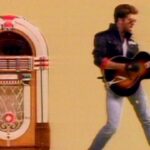
That attitude was reflected in the video, which became one of the most recognizable pieces of MTV-era imagery. Michael appeared in leather, sunglasses, blue jeans, and a leather jacket, playing guitar in front of a jukebox.
The image was a complete transformation from the carefully coordinated pop-star presentation associated with Wham!
The transformation worked.
“Faith” became a massive commercial success, reaching number one on the Billboard Hot 100 in the United States. The album became one of the biggest-selling records of the decade, eventually earning Michael the Grammy Award for Album of the Year.
The song itself became one of the defining singles of 1987.
What made it particularly impressive was how little it actually needed. There wasn’t a giant synthesizer arrangement or an enormous chorus. The hook came from the rhythm, the guitar, Michael’s personality, and the confidence of the performance.
He sounded completely in control.
That confidence was important because “Faith” arrived during one of the most significant transitions of Michael’s career. Wham! had been enormously successful, but remaining part of a duo would always make it difficult for Michael to establish exactly who he was as an artist.
With Faith, he didn’t simply continue what Wham! had started.
He reinvented himself.
The song also demonstrated Michael’s extraordinary ability to move between musical styles. He could write sophisticated pop songs, soulful ballads, dance tracks, and more stripped-down rock-influenced material without sounding like he was simply copying someone else.
“Faith” became the perfect introduction to that new version of George Michael.
More than anything, the song is memorable because it feels effortless. The guitar riff is simple. The arrangement is relatively sparse. The rhythm is straightforward.
But getting simplicity to sound this good is difficult.
Every element is in exactly the right place.
The result was a song that managed to sound retro, modern, sexy, playful, and confident all at once.
Nearly four decades later, “Faith” remains one of George Michael’s defining recordings. It marked the beginning of one of the most successful solo careers of the late 1980s and proved that Michael was capable of becoming something beyond the pop star audiences already knew.
Wham! had made George Michael famous.
“Faith” made it clear that George Michael didn’t need Wham! anymore.