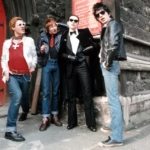
 There is a strange little corner of rock history occupied by bands that were important enough to change music but somehow never became household names. The Damned sit comfortably in that category.
If you know punk, you know The Damned. If you know British rock history, you probably know The Damned. If you have ever gone down a rabbit hole involving punk, goth, post-punk, garage rock, or alternative music, you’ve almost certainly encountered them.
But ask the average person to name the most important British punk bands and you’re likely to hear the Sex Pistols, The Clash, and perhaps The Buzzcocks. The Damned might eventually appear somewhere down the list.
That is remarkable because The Damned were there from the very beginning.
They were not merely observers of the original British punk explosion. They were one of the bands responsible for creating it.
They were the first British punk band to release a single. They released one of the first British punk albums. They played fast, loud, obnoxious music before most of the country had even figured out what punk was supposed to sound like.
And then, rather than spending the rest of their career making the same record over and over, they started changing.
They became darker. Stranger. More theatrical. More melodic. More psychedelic. More gothic. At various points they sounded like a punk band, a garage band, a goth band, a psychedelic rock group, and a completely unhinged rock ‘n’ roll circus.
That refusal to stay in one box may have been part of the reason they never became as commercially recognizable as some of their contemporaries.
It is also exactly what makes The Damned so interesting.
Before Punk Had a Name
The Damned emerged in London during the mid-1970s, when the British music scene was beginning to fracture.
Progressive rock had become increasingly elaborate. Arena rock was getting bigger and more polished. Glam had provided an explosion of theatricality, but even that movement was becoming part of the established music business.
Meanwhile, a collection of young musicians were discovering that you didn’t need enormous budgets, virtuoso musicianship, or twenty-minute songs to make something exciting.
You needed attitude.
The original Damned lineup featured Dave Vanian on vocals, Captain Sensible on guitar, Rat Scabies on drums, and Brian James on guitar. It was an unlikely combination of personalities, but together they created something that was immediate and confrontational.
Dave Vanian looked like he had wandered out of a horror movie.
Captain Sensible looked like he might have wandered in from an entirely different one.
And the music sounded like somebody had plugged a jet engine into a Marshall amplifier.
The Damned were not interested in sounding respectable.
That was the point.
New Rose Changes Everything
In October 1976, The Damned released “New Rose.”
It is difficult to overstate the historical importance of that record.
“New Rose” is widely recognized as the first single released by a British punk band.
The Sex Pistols were generating enormous controversy. The Clash were beginning to develop their identity. The Buzzcocks were emerging from Manchester.
But The Damned got their record out first.
And they didn’t ease anybody into the new musical landscape.
“New Rose” was short, aggressive, fast, and completely uninterested in traditional rock-radio conventions.
It sounded like a band trying to kick down the door.
The single immediately established something that would become a recurring theme throughout The Damned’s career: they were capable of being ridiculous and dangerous at exactly the same time.
There was humor underneath the aggression.
There was theatricality underneath the speed.
And there was a genuine love of old-fashioned rock ‘n’ roll underneath all the noise.
That combination would become one of their defining characteristics.
Damned Damned Damned
In February 1977, The Damned released Damned Damned Damned.
The album was produced by Nick Lowe and became one of the foundational records of British punk.
It was also incredibly short.
The entire thing moves like somebody has just announced that the building is on fire.
There isn’t much interest in wasting time.
Songs arrive, explode, and disappear before you’ve had time to get comfortable.
The album contains some of the band’s best-known early material, including “Neat Neat Neat” and “New Rose,” but what makes the record important is its sense of urgency.
The Damned weren’t trying to construct elaborate arrangements.
They weren’t interested in proving how technically sophisticated they were.
They wanted the songs to hit.
And they did.
The album helped establish the template for British punk’s first wave: short songs, loud guitars, furious drumming, memorable hooks, and an attitude that suggested the entire music industry could probably survive without them.
The irony is that the music industry eventually couldn’t ignore them.
The Band That Wouldn’t Behave
The Damned quickly developed a reputation for chaos.
That reputation wasn’t entirely accidental.
Captain Sensible was one of the more colorful personalities in British punk. Dave Vanian brought a theatrical, almost gothic presence to the band. Rat Scabies was a ferocious drummer. Brian James brought a darker, more traditional punk-rock guitar sound.
They didn’t necessarily look like a conventional rock band.
They didn’t act like one either.
And they certainly didn’t sound like one for very long.
After their first album, Brian James departed following internal tensions and disagreements.
Instead of collapsing, The Damned began moving in a completely different direction.
This is where their story gets particularly interesting.
Most punk bands faced a basic choice: continue making increasingly polished versions of their original sound or evolve into something else.
The Damned chose option three.
They seemed determined to see how many different musical identities they could cram into one career.
From Punk to Darkness
The band’s second album, Music for Pleasure, arrived in 1977.
It was not received as enthusiastically as the debut.
Part of the problem was that it was already showing signs that The Damned weren’t interested in simply repeating themselves.
Captain Sensible was increasingly involved in the band’s musical direction, and their sound was becoming more experimental.
Then things got messy.
The Damned eventually broke up.
For most bands, that would have been the end.
For The Damned, it was more like an intermission.
They returned in the late 1970s with a different sound and a significantly different atmosphere.
The punk fury was still there, but it was being replaced by something more sinister.
Something more atmospheric.
Something that would help lay groundwork for gothic rock.
Machine Gun Etiquette
Then came Machine Gun Etiquette in 1979.
This is where the argument for The Damned’s importance becomes almost impossible to ignore.
The album contains punk, garage rock, psychedelic influences, pop hooks, and the beginnings of the darker sound that would become associated with goth.
“Love Song” showed that The Damned could write something catchy without losing their edge.
“Smash It Up” demonstrated their ability to turn punk aggression into something almost celebratory.
And “Plan 9 Channel 7” leaned heavily into the band’s fascination with horror, atmosphere, and 1960s garage rock.
The Damned were becoming something much bigger than a punk band.
They were becoming a strange hybrid of everything they liked.
That was one of their greatest strengths.
They weren’t embarrassed to love pop music.
They weren’t embarrassed to love horror movies.
They weren’t embarrassed to love psychedelic rock.
They weren’t embarrassed to love garage rock.
And they certainly weren’t embarrassed to make fun of themselves.
Enter the Goths
If The Damned are remembered for anything beyond punk, it is their influence on gothic rock.
Dave Vanian’s appearance had already given the band a visual identity unlike most of their punk contemporaries.
With his pale makeup, dark clothing, and theatrical presentation, Vanian looked less like a punk singer and more like a rock-and-roll vampire.
And then there was the music.
The band’s next major phase would push further into dark, atmospheric territory.
The Black Album, released in 1980, demonstrated just how far they had traveled from the frantic three-chord assault of Damned Damned Damned.
The album included lengthy, atmospheric material alongside more conventional songs.
It wasn’t simply punk anymore.
The Damned were becoming one of those bands where the label started getting in the way.
Calling them punk was accurate.
Calling them goth was also reasonable.
Calling them rock was obvious.
Calling them weird was probably the most accurate description of all.
“Eloise” and the Commercial Peak
The Damned’s career took another unexpected turn in the mid-1980s.
They scored one of their biggest commercial successes with their cover of “Eloise.”
The song was dramatically different from the stripped-down punk of their early years.
It was enormous.
The arrangement was theatrical and bombastic, while Vanian’s voice gave the song an appropriately dramatic quality.
The single became a major British hit and demonstrated that The Damned could operate within a much larger musical world than the punk scene that had originally produced them.
But by then the band’s history had become a revolving door of personnel changes, breakups, reunions, and different musical directions.
Captain Sensible had departed for a successful solo career.
Vanian remained the central figure.
And The Damned continued.
That word may be the most important one in their entire story.
They continued.
The Captain Sensible Problem
One reason The Damned’s history can be difficult for casual listeners to follow is that Captain Sensible became successful outside the band.
His solo career produced the massive novelty hit “Happy Talk” in 1982, which reached number one in the United Kingdom.
That song could hardly have been further removed from the image of The Damned.
This was the same Captain Sensible who had helped create some of the most aggressive British punk music of the 1970s.
Suddenly he was wearing a giant red beret and appearing on mainstream television.
It was ridiculous.
It was also completely consistent with his personality.
Captain Sensible had never seemed particularly interested in following the rules of what a punk musician was supposed to be.
The success of his solo career also contributed to the increasingly unusual trajectory of The Damned.
They were no longer simply one band following one musical path.
They were a collection of personalities constantly pulling the group in different directions.
Somehow, they kept coming back together.
Why Didn’t They Become as Famous as The Clash?
This is the question that hangs over The Damned.
Why aren’t they generally mentioned alongside The Clash and the Sex Pistols when discussing the defining British punk bands?
There isn’t one simple answer.
The Sex Pistols became cultural lightning rods.
The Clash developed into one of the most politically significant rock bands of their era.
The Damned were different.
They didn’t have a single ideological message that defined them.
They didn’t build their identity around political confrontation.
They didn’t become the voice of a particular movement.
They were more interested in music itself.
They were also inconsistent in a way that made them fascinating but perhaps harder to market.
A listener could discover The Damned through punk, goth, garage rock, alternative music, or even mainstream British pop.
The band’s catalog didn’t have one obvious identity.
And commercially, they never maintained the sustained success required to become one of the biggest bands of their generation.
But that doesn’t mean they weren’t influential.
In fact, their influence may be easier to hear in other bands than in their own record sales.
The Forgotten Link Between Punk and Goth
The Damned occupy a fascinating position in British music.
They were part of the original punk explosion, but their willingness to experiment helped point toward the darker alternative music that followed.
That makes them an important bridge between several movements.
You can hear elements of punk’s speed and aggression.
You can hear garage rock.
You can hear psychedelic rock.
You can hear horror-film imagery.
You can hear the beginnings of gothic rock.
You can hear pop songwriting.
You can even hear the seeds of the alternative rock that would become much more prominent in the 1980s and 1990s.
They weren’t necessarily inventing each of those things independently.
Their importance comes from combining them.
The Damned essentially treated genres as suggestions rather than rules.
A Band That Refused to Grow Up
There is also something wonderfully strange about The Damned’s longevity.
Many punk bands eventually became serious.
The Damned never entirely did.
That isn’t an insult.
It may have been their secret weapon.
There was always a sense that they understood rock music was supposed to be fun.
Even when the music became darker, there was still humor underneath it.
Even when the band became more theatrical, there was still punk aggression.
Even when they experimented, they never completely abandoned the simple pleasure of turning up the volume and making a lot of noise.
That attitude allowed them to survive changes in musical fashion that destroyed plenty of other bands.
Punk became post-punk.
Post-punk became new wave.
New wave became goth and alternative rock.
The 1980s became the 1990s.
Grunge arrived.
Britpop arrived.
Alternative rock became mainstream.
And The Damned were still around.
The Legacy
The easiest way to understand The Damned’s legacy is to stop looking for one particular sound.
They weren’t important because they created a single genre.
They were important because they demonstrated how much freedom a rock band could have.
A band could be punk and melodic.
It could be aggressive and funny.
It could be dark without taking itself too seriously.
It could move from two-minute punk songs to extended psychedelic pieces.
It could wear horror-movie imagery without becoming a novelty act.
And it could change without completely losing its identity.
That is a difficult trick.
Most bands that change dramatically eventually sound like different bands.
The Damned often sounded like The Damned even when the music around them was completely different.
So, Are The Damned Really Forgotten?
Not really.
Among punk fans, they are anything but forgotten.
Among musicians, their influence is obvious.
Among people who know British alternative music, their name carries considerable weight.
But compared with the fame of The Clash, the Sex Pistols, or even later bands influenced by them, The Damned remain strangely underappreciated by the wider public.
And perhaps that is the great irony of their career.
They were one of the first British punk bands to put a record on the shelves.
They released one of the most important early punk albums.
They helped establish the sound and attitude of British punk.
They helped point toward gothic rock.
They produced some genuinely great rock songs.
They survived numerous personnel changes and breakups.
They continued recording and performing decades after the original punk explosion.
And yet they somehow remain the band people discover after they have already discovered everybody else.
Maybe that is actually the best way to discover The Damned.
Start with the obvious names.
Listen to the Sex Pistols.
Listen to The Clash.
Listen to The Buzzcocks.
Then eventually someone mentions The Damned.
You put on Damned Damned Damned expecting another historical punk artifact.
Instead, you discover a band that sounds alive.
Then you hear Machine Gun Etiquette and realize they’re doing something completely different.
Then you hear The Black Album.
Then you find the gothic material.
Then the later records.
Then Captain Sensible’s solo work.
Suddenly the supposedly “forgotten” band has turned into a rabbit hole.
And that’s probably the most appropriate fate for The Damned.
They were never particularly good at staying where people expected them to stay.
Why should their place in rock history be any different?
The Damned weren’t simply one of the first British punk bands.
They were one of the bands that proved punk could become almost anything.
Fast.
Loud.
Funny.
Dark.
Melodic.
Weird.
The fact that they never became as famous as some of their contemporaries doesn’t make their story less important.
If anything, it makes rediscovering them more rewarding.
The Damned weren’t forgotten because they weren’t important.
They were forgotten because rock history has a bad habit of simplifying itself.
Punk becomes three bands.
Goth becomes another handful.
Alternative rock gets its own list.
Garage rock gets another.
The messy connections between all of them disappear.
The Damned don’t fit neatly into any of those boxes.
They belong in all of them.
And that’s exactly why, more than four decades after their debut, The Damned still sound like a band waiting to be rediscovered.