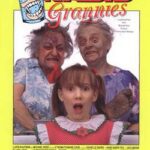
 There are plenty of horror movies about monsters, demons, zombies and possessed children. But Rabid Grannies asks a much more important question: What if two sweet little grandmothers suddenly became flesh-eating monsters?
Released in 1988, Rabid Grannies is exactly the kind of bizarre, low-budget horror comedy that seems almost impossible to explain to someone who hasn’t seen it. Directed and written by Emmanuel Kervyn, the Belgian-French production combines family dysfunction, demonic transformation, splatter effects and an absolutely ridiculous premise. The original title, Les mémés cannibales, translates roughly to “The Cannibal Grannies,” which is arguably even more direct.
The movie runs roughly an hour and a half and became particularly associated with Troma Entertainment, which distributed it in the United States.
The Birthday Party From Hell
The movie begins with what should be a perfectly pleasant family gathering.
Two elderly sisters, Elizabeth and Victoria Remington, invite their relatives to their country estate to celebrate their birthdays. The sisters appear to be wealthy, respectable and completely harmless.
Their relatives, however, aren’t quite as innocent.
A large portion of the family is primarily interested in the inheritance they expect to receive when the elderly women eventually die. The birthday gathering therefore has an uncomfortable undercurrent: everyone is smiling and pretending to be affectionate while mentally counting the money.
There is also one relative who has been excluded from the family because of his involvement with Satanism and other decidedly questionable activities.
That turns out to be a significant detail.
The Gift
The estranged nephew sends the grannies a mysterious birthday present.
Opening the package is the moment everything goes completely insane.
The gift contains a supernatural force that transforms the two seemingly harmless elderly women into monstrous, bloodthirsty creatures.
And suddenly the family members who were waiting for their inheritance have a much more immediate problem.
The women aren’t interested in giving anyone money.
They’re interested in eating them.
The basic setup is wonderfully simple: put a large group of greedy relatives inside an isolated house, transform the hosts into murderous monsters and let the carnage begin.
Granny Goes Monster
One of the movie’s biggest attractions is the transformation itself.
The two women go from conventional elderly ladies to grotesque creatures with exaggerated features and monstrous appearances.
The contrast is the whole joke.
These aren’t hulking monsters emerging from a laboratory.
They’re grandmothers.
They look like they should be preparing tea, complaining about the weather or asking whether anyone has eaten.
Instead, they’re hunting their own relatives.
The filmmakers lean heavily into the visual absurdity. The makeup and creature effects are unapologetically old-school, giving the grannies the kind of exaggerated appearance that fits perfectly with low-budget European horror.
The result isn’t polished Hollywood horror.
It’s much stranger.
Family Dinner Turns Into Slaughter
Once the transformation happens, the movie becomes essentially a siege picture.
The surviving relatives try to figure out what has happened and find ways to escape.
The house becomes a maze.
The grannies become hunters.
The family members become increasingly desperate.
The movie’s dark humor comes from watching people who were initially concerned about inheritance suddenly realize that they have bigger problems.
That greed is an important part of the film’s joke.
These people gathered together because they expected the grannies to die.
Instead, the grannies become the most dangerous people in the house.
The inheritance suddenly doesn’t seem nearly as important.
Troma Finds Another Oddball
American audiences became particularly familiar with Rabid Grannies through Troma Entertainment, the company that specialized in outrageous independent films.
Troma was the perfect home for a movie with this title.
The company had built a reputation around low-budget horror and comedy that embraced bizarre premises, outrageous violence and deliberately unconventional filmmaking. Rabid Grannies fit comfortably into that tradition.
The movie wasn’t designed to be elegant.
It was designed to be memorable.
And there is virtually no possibility of confusing it with anything else.
The Gore
For horror fans, the movie’s practical effects are a major part of its appeal.
Rabid Grannies delivers the kind of exaggerated gore that became a hallmark of underground horror during the 1980s.
Heads get smashed.
Bodies get torn apart.
People are bitten, attacked and generally subjected to horrible things.
The effects aren’t always convincing, but they aren’t really supposed to be.
The movie operates in that strange space where the audience knows the production is cheap, but the filmmakers are still determined to show them something outrageous.
That gives the movie a handmade quality that many modern horror films deliberately try to recreate.
The Production Is Part of the Fun
One of the fascinating things about Rabid Grannies is how international and improvised the production was.
The film was shot in Belgium, including locations in Kortrijk and the castle at Ingelmunster. According to production trivia, the castle’s existing decorations were used rather than being created specifically for the movie.
The cast also faced an unusual language challenge.
Although the movie was intended for English-language distribution, several French-speaking actors struggled with their English dialogue. Some reportedly learned their lines phonetically, with the finished dialogue subsequently dubbed by English speakers.
That helps explain some of the film’s unusual vocal performances.
The dialogue occasionally sounds just slightly disconnected from the actors delivering it.
For a polished studio production, that would be a problem.
For Rabid Grannies, it becomes part of the experience.
A Tiny Budget With Big Ambitions
The film was made on a very limited budget, and its limitations are visible.
Some scenes feel rough.
The acting varies considerably.
The pacing isn’t always smooth.
The special effects sometimes look exactly like what they are: handmade horror effects created by filmmakers working without Hollywood money.
But there’s something admirable about the ambition.
Kervyn wasn’t trying to make a small, quiet horror film.
He wanted monsters, gore, elaborate transformations and a memorable premise.
The result is a movie that occasionally looks like it is trying to be much bigger than it could afford to be.
That mismatch is part of its charm.
The Troma Cut
American audiences didn’t initially see exactly the same movie Kervyn intended.
The version distributed by Troma reportedly contained significant cuts to the gore. Kervyn later expressed dissatisfaction with the changes, saying that the version released in the United States wasn’t his preferred cut.
That became an important part of the movie’s later history.
A producer’s cut eventually restored material that had been removed from the Troma version. Modern releases have therefore given fans opportunities to see a more complete version of the film.
For a movie whose biggest selling point is its outrageous horror effects, losing portions of the gore was a particularly significant change.
Why People Remember It
Rabid Grannies isn’t remembered because it revolutionized horror.
It didn’t.
It isn’t remembered because it features great dramatic performances or sophisticated writing.
It doesn’t.
It’s remembered because the concept is impossible to forget.
Two elderly women receive a supernatural birthday gift and become cannibalistic monsters who begin slaughtering their greedy relatives.
That’s it.
The title tells you almost everything you need to know.
The movie also captures a particular era of horror filmmaking. The late 1980s were filled with increasingly outrageous horror concepts, practical effects and direct-to-video oddities.
Rabid Grannies feels like something that could only have emerged from that period.
Is It Actually Good?
That’s going to depend heavily on what you’re looking for.
If you’re expecting a polished horror comedy, you’ll probably find plenty to criticize.
The acting is uneven.
The dialogue can be awkward.
The pacing occasionally drags.
The production values are unmistakably low-budget.
But if you’re looking for an entertaining piece of bizarre 1980s splatter cinema, it becomes much easier to appreciate.
The movie has personality.
It has a memorable premise.
And it commits completely to its central joke.
It doesn’t try to convince you that these are realistic monsters.
It wants you to watch two apparently harmless grandmothers turn into screaming, flesh-eating demons.
And it delivers exactly that.
The Legacy of Rabid Grannies
More than three decades after its release, Rabid Grannies remains one of those movies that has achieved cult status almost entirely through its sheer weirdness.
Its reputation has been helped by the Troma connection, its outrageous title and its practical gore effects. Modern horror fans have continued to rediscover it through home video, specialty releases and cult-film communities. A restored Blu-ray release has even preserved a producer’s cut along with additional behind-the-scenes material.
There are thousands of horror movies that disappear from memory because they’re interchangeable.
Rabid Grannies has never had that problem.
Nobody forgets what Rabid Grannies is about.
The movie takes one of the most comforting figures in popular culture—the grandmother—and turns her into a bloodthirsty monster.
It’s ridiculous.
It’s cheap.
It’s messy.
It’s occasionally hilarious for all the wrong reasons.
And that’s precisely why it has endured.
If you’ve ever wondered what would happen if a family reunion went horribly, spectacularly wrong, Rabid Grannies has an answer.
**Don’t worry about the inheritance.
Worry about Grandma.**
Where to Stream
You can stream it for Free on Tubi here