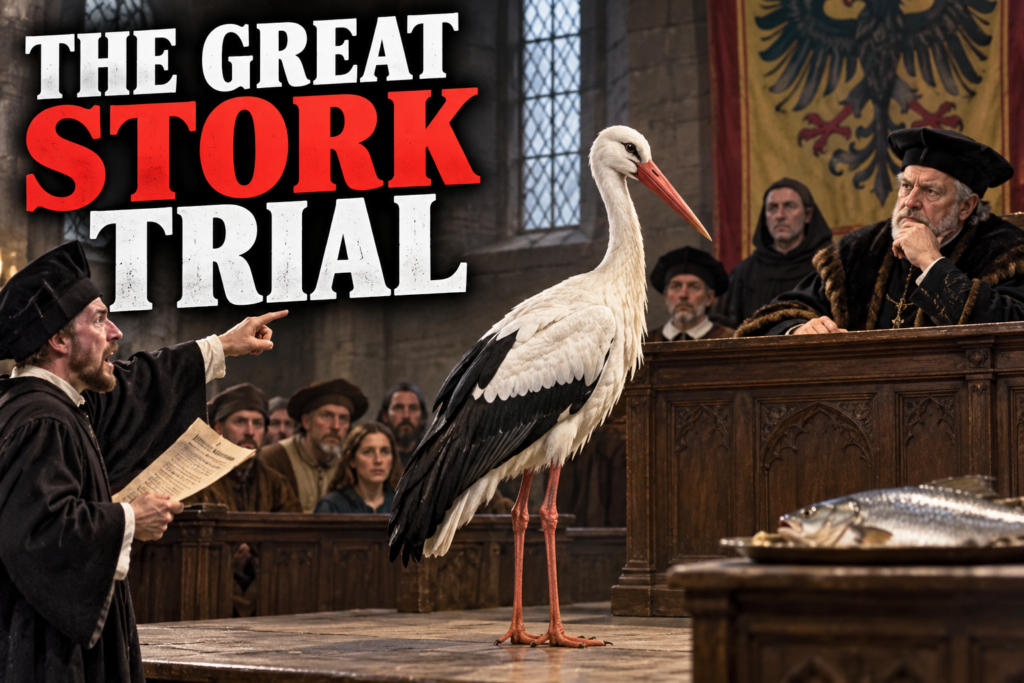
Imagine walking into a medieval courtroom and discovering that the defendant isn’t a criminal, a thief, or a murderer.
It’s a stork.
There is no human sitting in the prisoner’s box. No lawyer is preparing a defense for a person accused of a crime. Instead, a long-legged bird is somehow at the center of a legal proceeding.
Stories about a supposed medieval “Great Stork Trial” have circulated for years, usually describing a stork being brought before a Swiss court after allegedly eating someone’s fish. It is exactly the sort of story that seems perfectly suited to a list of bizarre historical events.
There is just one problem.
The specific story is much harder to verify than the legend suggests.
What is firmly documented is that medieval and early modern European authorities really did prosecute animals, curse them, excommunicate them, and occasionally execute them. Pigs, cows, horses, dogs, insects, birds and even a rooster accused of laying an egg all ended up caught in bizarre legal or religious proceedings.
So while the Great Stork Trial may not have happened exactly as the popular version describes, the idea behind it is not nearly as ridiculous as it sounds.
Animals in Court
Animal trials were a genuine historical phenomenon.
From the Middle Ages into the early modern period, European authorities sometimes treated animals as if they could be held responsible for harmful acts.
The most famous cases usually involved animals accused of killing or injuring human beings.
Pigs were particularly frequent defendants. They could be accused of attacking or killing children and, in some documented cases, were formally sentenced to death.
One famous case occurred in France in 1386, when a sow was executed after being accused of killing an infant. The surviving documentation even records payment to the executioner.
Other animals received similar treatment.
Horses and cattle could be condemned for causing deaths. Dogs could be prosecuted for participating in crimes. Insects and other pests could become the subjects of religious proceedings when they destroyed crops.
This wasn’t simply medieval people being silly.
There was a complicated mixture of religion, law, superstition and practical concerns behind these cases.
The Strange Logic Behind Animal Trials
Modern criminal law is based heavily on the idea of personal responsibility.
A defendant must be capable of understanding an accusation and, in most cases, intentionally committing an act before criminal punishment makes sense.
Animals obviously don’t operate according to those principles.
A pig doesn’t understand a murder statute.
A horse doesn’t know what homicide is.
A cockroach has absolutely no concept of courtroom procedure.
Medieval legal thinking, however, didn’t always separate animals from human society in the way modern law does.
Animals were economically important. They lived alongside humans, worked for them, carried them, produced food and sometimes caused serious injuries.
There was also an older religious and legal tradition in which an animal that caused a death could be destroyed even when the animal itself was not considered morally guilty.
Over time, these ideas became tangled with religious beliefs about sin, evil and supernatural forces.
That helped create an environment in which an animal could become the target of a formal legal or ecclesiastical response.
Where Does the Stork Come In?
Storks actually had an unusual place in European culture.
They were highly visible birds that lived around human settlements, and people attached all sorts of beliefs to them.
Some of the stories about storks were positive. They were associated with good fortune, family life and parental devotion.
Other traditions treated animals as possible carriers or manifestations of supernatural forces.
Historical records compiled in the nineteenth century mention an even stranger tradition: stories of storks being cursed or burned at Avignon in the seventh century. The historian E. P. Evans, writing about animal prosecutions, specifically identified these early accounts as coming largely from hagiological and legendary sources rather than the better-documented legal cases.
That distinction is important.
It means that stories about storks being subjected to religious punishment existed, but they aren’t necessarily evidence that a medieval court conducted a conventional criminal trial against a bird.
The legend of the Great Stork Trial may therefore be a blend of several different traditions.
The Famous Swiss Rooster
If you want a genuinely documented Swiss animal trial that sounds completely insane, there is an even better candidate.
In 1474, the authorities in Basel sentenced a rooster to death.
The crime?
The rooster was believed to have laid an egg.
Yes, a rooster.
The bird was burned at the stake at a location near the city called the Kohlenberg. According to the historical account preserved by Evans, the execution attracted a large crowd of townspeople and peasants.
The reason the authorities took the alleged egg so seriously was rooted in superstition.
People believed that an egg produced by a rooster could eventually produce a cockatrice or basilisk, a legendary creature supposedly capable of killing people through supernatural powers.
The rooster therefore wasn’t simply viewed as an animal that had done something biologically impossible.
It was viewed as a potential source of something dangerous and demonic.
That sounds absurd today.
At the time, it could be considered a serious threat.
The Cockatrice Problem
The rooster story becomes even stranger when you understand the superstition surrounding the supposed egg.
According to traditional folklore, an unusual egg associated with an old rooster could eventually hatch into a cockatrice or basilisk under certain conditions.
The creature was imagined as a terrifying hybrid with deadly supernatural powers.
It could supposedly kill with its gaze or poisonous breath.
That meant an alleged rooster egg wasn’t merely a biological curiosity.
It was potentially the first stage of a monster.
The idea survived for centuries. In 1710, French physician and scientist Claude François de La Peyronie investigated strange small eggs that people continued to associate with roosters. His examination demonstrated that they actually came from hens suffering from a reproductive abnormality.
In other words, science eventually solved the mystery.
The rooster had never been laying eggs.
A hen had.
Animals Could Also Be Excommunicated
Not every animal case involved a courtroom, a judge and an executioner.
Sometimes the Church became involved.
When insects or other pests threatened crops, religious authorities could issue anathemas, curses or excommunications against them.
This sounds almost comical now, but it reflected a very different understanding of the world.
If a plague of insects was destroying crops, people needed an explanation.
The insects might be regarded as God’s punishment, the work of the Devil, or some other supernatural threat.
Religious intervention could therefore be viewed as a legitimate response.
Historical sources record proceedings against creatures including insects, rodents, worms and other agricultural pests. In some cases, authorities formally ordered the creatures to leave an area.
The underlying logic was not always “this animal is morally guilty.”
Sometimes the goal was simply to stop the animal from causing damage.
A Real Trial That Sounds Like a Cartoon
The strangest thing about these cases is that some were surprisingly formal.
There could be prosecutors.
There could be legal arguments.
There could be witnesses.
There could even be appeals.
One of the best-known examples involved insects damaging crops in France. The legal proceedings became complicated enough that a lawyer named Bartholomew Chassenée became involved in defending the accused creatures.
His argument was essentially that the insects had rights that had to be considered.
That may sound like an early version of animal-rights law, but the reasoning was considerably more complicated.
The proceedings involved questions of jurisdiction, procedure and whether the animals could realistically be expected to obey a legal summons.
In other words, medieval lawyers could spend serious intellectual energy discussing whether bugs should be allowed to destroy crops.
Why Would Anyone Do This?
There is another way to look at these strange trials.
They demonstrate how desperately people wanted to impose order on a chaotic world.
A child was killed by a pig.
A field was destroyed by insects.
A cow caused someone’s death.
A strange bird behaved in an inexplicable way.
People wanted an explanation and a response.
Modern society would approach these events through veterinary science, biology, insurance, criminal law and public safety.
Medieval society had a different collection of tools.
Religion and law were deeply interconnected, and supernatural explanations were often taken seriously.
Putting an animal on trial could therefore provide a symbolic way of restoring order.
The animal might not understand the proceedings.
But the humans certainly did.
So Did the Great Stork Trial Actually Happen?
That’s where the story becomes less certain.
The famous version claims that a stork was prosecuted in Switzerland after eating a fish. But the major historical work on animal prosecutions contains no clear record matching that story.
Instead, it documents numerous other cases involving animals, including the famous 1474 rooster execution in Basel, a 1499 bull executed after killing a teenager in France, and numerous prosecutions of pigs, horses, insects and other creatures.
That doesn’t necessarily prove that no stork was ever subjected to a local proceeding.
Medieval records are incomplete, and many historical documents have disappeared.
But it does mean we should be cautious about presenting the Great Stork Trial as a confirmed historical event.
The story is best understood as part of a much larger—and very real—history of animals becoming defendants in European legal and religious proceedings.
The Truly Weird Part
Ironically, the truth is stranger than the popular story.
We don’t necessarily need a stork being prosecuted for eating a fish to demonstrate how bizarre medieval justice could become.
A rooster was actually sentenced to death for allegedly laying an egg.
Pigs were executed for killing people.
Horses were condemned for homicide.
Insects were subjected to religious proceedings.
And lawyers really did argue about the legal status of animals.
Those events are considerably harder to dismiss as legend.
The Great Stork Trial may have become famous because it is such a perfect little historical story: a majestic bird, an absurd accusation and a courtroom that seems to have completely lost its mind.
But behind the questionable story is something historically fascinating.
For centuries, Europeans lived in a world where animals weren’t simply background scenery. They were workers, food sources, property, threats, companions and, occasionally, defendants.
And sometimes the line between human law and the natural world became so blurred that a bird could become the subject of a legal dispute.
Whether or not one particular stork ever stood accused of stealing a fish, the historical record proves something almost as strange:
In medieval Europe, animals really could end up in court.