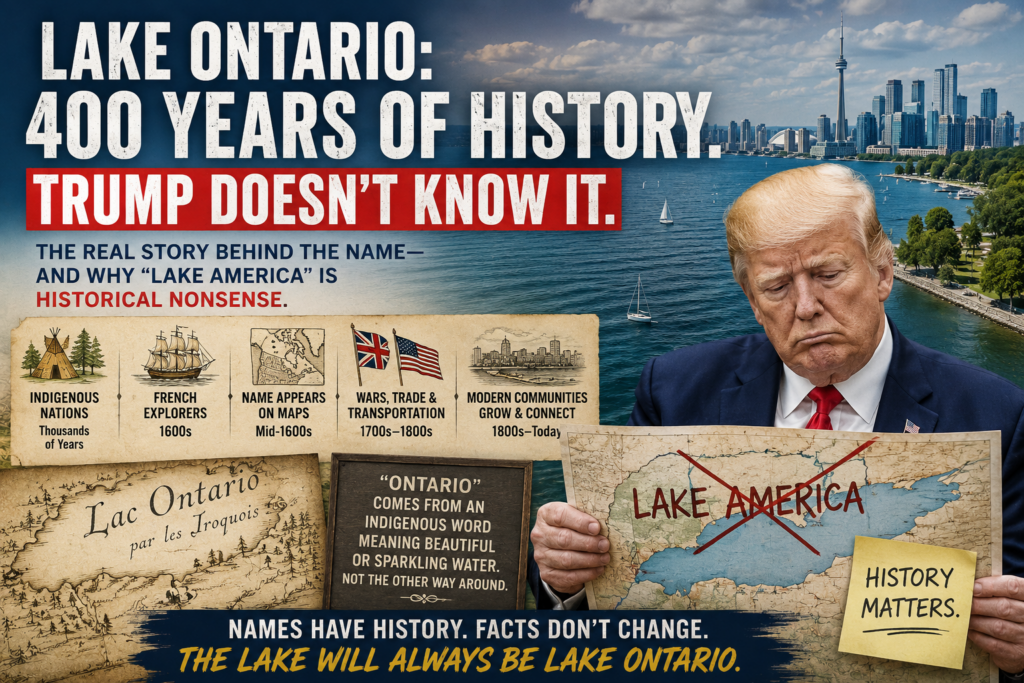
Donald Trump has apparently decided that the next front in his ongoing battle with Canada is a Great Lake.
On August 27, 2026, Trump signed an executive order directing the United States government to rename Lake Ontario as “Lake America.” The move came in the middle of another escalating dispute with Canada, making the timing about as subtle as a sledgehammer. Trump had already floated the idea days earlier, arguing that because of the deteriorating relationship with Ontario and Canada, the United States should consider giving the lake a new name.
There is just one enormous problem with that argument.
The lake wasn’t named after Ontario.
Ontario was named after the lake.
And the name existed for centuries before either the United States or Canada existed as the countries we recognize today.
That is not some obscure historical footnote. It is basic North American geography.
Trump’s attempt to turn Lake Ontario into “Lake America” isn’t merely a silly renaming exercise. It demonstrates an almost comical misunderstanding of the history of the place he is trying to rename.
The irony is that the history of Lake Ontario is actually fascinating. It is a story involving Indigenous nations, French explorers, British colonists, competing European names, the development of the Great Lakes, the creation of the United States and Canada, wars, trade, transportation and eventually the modern international border.
And almost none of that history has anything to do with Donald Trump.
The Name Came First
Let’s start with the most important fact.
The name Ontario was being used for the lake centuries before there was a Canadian province called Ontario.
The modern province of Ontario didn’t officially exist until Canadian Confederation in 1867.
The United States Declaration of Independence wasn’t issued until 1776.
The American Revolution didn’t begin until 1775.
European references to Ontario as a name for the lake go back to the 1600s.
So when Trump presents “Lake Ontario” as though it is somehow a Canadian name that can be discarded because he’s angry with the Canadian government, he’s getting the chronology completely backward.
The lake didn’t borrow its name from Ontario.
Ontario borrowed its name from the lake.
That’s the part that makes the whole episode particularly ridiculous.
Imagine deciding that a historic body of water should be renamed because you don’t like the political relationship with the modern jurisdiction that happens to share its name, without bothering to discover that the geographic feature actually supplied that jurisdiction with its name in the first place.
That’s not historical revisionism.
That’s historical illiteracy.
So What Does “Ontario” Actually Mean?
This is where things get more interesting.
There isn’t complete agreement among scholars over the precise linguistic origin and translation of the word Ontario.
Different historical and linguistic sources have connected the name to Indigenous languages of the Great Lakes region, particularly Iroquoian languages. Government sources in Canada have connected Ontario with an Iroquoian term associated with sparkling or beautiful water, while other historical scholarship identifies a Wendat/Huron form, often rendered as “Ontari’io” or “oniatarí,” with meanings along the lines of a great lake, beautiful water or shining waters.
The exact linguistic pathway is complicated because European explorers and missionaries were recording Indigenous words using French spelling conventions centuries ago.
That’s how language works when one culture writes down another culture’s words using an entirely different alphabet and pronunciation system.
What isn’t particularly controversial is the important historical point:
The name is Indigenous in origin.
It did not originate with the United States.
It did not originate with Canada.
It did not originate with Donald Trump.
And it certainly wasn’t invented to honor the Canadian province of Ontario.
The name belongs to a much older history of the Great Lakes.
Indigenous Nations Were Here Long Before European Maps
This is where Trump’s proposed renaming becomes even more historically absurd.
Lake Ontario wasn’t sitting around waiting for European colonists to arrive and give it an appropriate American name.
Indigenous peoples had lived around the Great Lakes for thousands of years.
The region surrounding Lake Ontario was home to Indigenous communities with deep cultural, economic and political relationships with the lake and the surrounding waterways.
The Haudenosaunee Confederacy became one of the most important political forces in the northeastern part of North America. Nations including the Seneca, Cayuga, Onondaga, Oneida and Mohawk developed extensive relationships across the region.
The Wendat, also known as the Huron, were another important Indigenous people whose history was deeply connected to the Great Lakes.
The Great Lakes weren’t simply large bodies of water sitting between modern political jurisdictions.
They were transportation corridors.
They were sources of food.
They were places of trade.
They were geographic landmarks.
They were part of the cultural landscape.
And they had names.
Those names existed because people lived there.
That is why the Indigenous origins of “Ontario” matter.
When Trump attempts to replace a centuries-old Indigenous-derived name with “Lake America,” he isn’t replacing a Canadian invention with an American one.
He’s attempting to replace an Indigenous historical name with a modern nationalist slogan.
That’s a very different thing. And It’s Stupid
The French Had Their Own Ideas
European explorers didn’t necessarily agree on what to call the lake.
That makes the history even more interesting.
French explorers and mapmakers used several names for Lake Ontario during the early colonial period.
Among them were names associated with French royalty and colonial officials.
The lake was known at various points as Lac des Iroquois, Lac Saint-Louis and Lac Frontenac.
Lac Frontenac was particularly important because it honored Louis de Buade, Comte de Frontenac, the governor of New France.
In other words, Europeans were perfectly capable of doing what Trump is trying to do: naming geographic features after political leaders.
The difference is that the old names existed in a very different colonial context, when European powers were mapping territory they were attempting to control.
Eventually, however, Ontario won out.
The Indigenous-derived name survived the competing French names.
That is significant.
A name that came from an Indigenous language managed to survive centuries of European colonial competition, changes in political control, wars and the eventual creation of two modern countries.
It survived because it became embedded in the geographic vocabulary of the region.
The name stuck.
The Name Was on Maps Before America Was a Country
This is the fact Trump really should have known before attempting his latest geographic rebranding project.
The name Lake Ontario appeared on European maps in the 17th century.
Historical research identifies the name appearing on maps by the middle of the 1600s, with “Lac Ontario” appearing alongside other names during the period when French cartographers were mapping the Great Lakes.
By the time English usage became widespread, Ontario was already an established geographic name.
The United States wouldn’t exist for another century.
The Province of Ontario wouldn’t exist for more than two centuries.
So the timeline looks something like this:
Indigenous peoples use names for the lake.
European explorers encounter those names.
European mapmakers record versions of those names.
“Ontario” becomes established as the lake’s name.
The United States eventually declares independence.
Canada eventually becomes a country.
Ontario eventually becomes a Canadian province.
And then, centuries later, Donald Trump looks at a map and apparently thinks the order of events was the reverse.
That is the fundamental historical problem.
Ontario Didn’t Give the Lake Its Name
Trump’s rhetoric surrounding the renaming has repeatedly suggested a connection between the name of the lake and the modern Canadian province.
But historically, that relationship runs in the opposite direction.
The territory that eventually became Ontario went through several different names and political arrangements.
After the American Revolution, the British reorganized their North American colonies.
In 1791, the Constitutional Act divided the Province of Quebec into Upper Canada and Lower Canada.
Upper Canada eventually became Ontario.
The name Ontario was adopted for the province in the 19th century.
In 1867, Ontario became one of the founding provinces of the Dominion of Canada.
So when Trump looks across the lake and sees the province of Ontario, the historically accurate conclusion isn’t “That Canadian place gave the lake its name.”
It’s:
“That Canadian place was named after the lake.”
That’s a pretty important distinction.
The United States Didn’t Own the Name Either
There is another problem with the “Lake America” idea.
Lake Ontario is an international body of water.
The United States has a shoreline.
Canada has a shoreline.
The international border runs through the lake. Neither side OWNS the lake
Trump can direct the United States government to use whatever terminology his administration wants in federal documents and databases.
He cannot simply dictate what Canada calls the lake.
And he certainly can’t erase centuries of historical usage by signing a piece of paper in the Oval Office.
The Canadian government has already made clear that it will continue calling the lake Lake Ontario.
Canadian Prime Minister Mark Carney pointed directly at the historical problem, emphasizing that the name is more than 400 years old and predates both modern Canada and the United States.
That’s the correct historical perspective.
Lake Ontario isn’t Canadian in the sense Trump seems to imagine.
It isn’t American either.
It is part of a shared geographic region whose history predates both countries.
The Lake Doesn’t Care About the Border
There is something almost wonderfully ridiculous about trying to turn Lake Ontario into a symbol of American nationalism.
The lake doesn’t recognize the border.
Water doesn’t stop at the 49th parallel.
Fish don’t check passports.
Ships don’t suddenly become American because they cross an invisible political boundary.
Weather doesn’t care.
The Great Lakes are one interconnected geographic system.
Lake Ontario is connected to Lake Erie through the Niagara River.
It connects to the St. Lawrence River and ultimately the Atlantic Ocean.
For centuries, these waterways formed one of the most important transportation networks in North America.
The history of the Great Lakes is therefore fundamentally a story of movement across borders.
Indigenous trade networks crossed them.
French explorers traveled them.
British forces used them.
American and Canadian ships still use them.
Millions of people live around them.
The lakes have always connected people more than they separated them.
That makes Trump’s attempt to turn one of them into a nationalist branding exercise particularly silly.
Lake Ontario Has Seen Actual History
The irony becomes even greater when you consider what Lake Ontario has actually witnessed.
The lake played an important role during the French and Indian War.
It was strategically important during the American Revolution.
It became a major theater during the War of 1812.
American and British forces fought for control of the lake because whoever controlled the Great Lakes had enormous strategic advantages.
Naval forces operated on its waters.
Military supplies moved across it.
Fortifications were constructed along its shores.
Communities grew around its ports.
The lake became a transportation highway long before modern highways existed.
This is real history.
Wars were fought over control of the Great Lakes.
Trade routes developed around them.
Entire communities were built because of them.
Lake Ontario isn’t an empty blue shape on a map waiting for a president to give it a more patriotic label.
It is one of the oldest geographical landmarks in the political history of North America.
Then Came Modern Commerce
By the 19th century, Lake Ontario had become an increasingly important commercial waterway.
Ports developed on both sides.
Cities grew.
Shipping expanded.
The lake became part of a larger transportation network connecting the interior of North America with the Atlantic.
Toronto grew on the lake’s northern shore. (My Actual Home #2)
Rochester grew on the southern shore. (My Actual Home #1)
** This whole argument is weird to me, since my primary residence is a house in Rochester, NY, and my secondary is an apartment in Toronto which I split time between. I was literally at home #1 this afternoon and was less than 2 miles from Ontario Beach Park, which is the actual name of the State Park, Beach Water Front, and Port in Rochester, and Tonight I am in Toronto in Ontario Canada **
Kingston became strategically and commercially important.
Hamilton and other communities developed around the Great Lakes system.
The lake helped create the economic geography that still defines the region today.
And this brings us back to the irony of Trump’s argument.
He wants to rename the lake because he’s angry about trade with Canada.
But the lake itself is one of the reasons the United States and Canada have such an interconnected economic relationship in the first place.
The geography came first.
The trade came later.
The border came later.
The politicians came later.
The name came earlier.
Much earlier.
The Province Took Its Name From the Lake
The historical sequence is worth repeating because it completely destroys the premise behind Trump’s argument.
First there was the Indigenous name.
Then European mapmakers began recording forms of that name.
The name became established as Lake Ontario.
Later, the territory eventually became known as Ontario.
Then Ontario became a province of Canada.
Therefore:
Lake Ontario did not get its name from Canada.
Ontario got its name from Lake Ontario.
That distinction is not complicated.
It’s the sort of thing you’d expect to find in a basic history book.
And that’s why Trump’s apparent ignorance of it is so embarrassing.
A president doesn’t have to be a professional historian.
But when a president decides to alter a centuries-old geographic name as part of a political dispute, he probably should know where the existing name came from.
Otherwise, the whole thing starts to look like a man changing the label on a map because he doesn’t like what the label reminds him of.
“Lake America” Is Not a Historical Name
There is also a difference between a geographic name and a political slogan.
Ontario is a geographic name with centuries of historical development behind it.
“Lake America” is a political statement.
It doesn’t describe the lake.
It doesn’t preserve Indigenous history.
It doesn’t reflect the geography.
It doesn’t acknowledge the French and British history of the region.
It doesn’t reflect the shared American and Canadian history surrounding the lake.
It exists because Donald Trump wants it to exist.
That’s the entire argument.
And that makes it profoundly different from the history of Lake Ontario.
A geographic name becomes meaningful because people use it over generations.
A president can issue an order.
He can’t force history to agree with him.
Trump’s History Problem
This isn’t the first time Trump has demonstrated a willingness to treat geography and history as though they were branding opportunities.
He previously pushed to rename the Gulf of Mexico as the Gulf of America.
He has repeatedly talked about changing historic geographic names.
He has also demonstrated a fondness for treating names as expressions of political power.
There is a legitimate discussion to be had about geographic names.
Names can reflect colonialism.
Names can erase Indigenous history.
Names can commemorate controversial figures.
Communities have every right to debate whether old names should remain.
But that debate requires historical knowledge.
You can’t intelligently discuss whether a name should change if you don’t understand where the name came from in the first place.
And that is where Trump’s Lake Ontario stunt falls apart.
He isn’t correcting a historical mistake.
He isn’t restoring an older American name.
He isn’t even reviving a name that was previously used by the United States.
He’s taking an Indigenous-derived name that predates the United States and attempting to replace it with a modern political slogan.
That’s not historical restoration.
It’s historical ignorance dressed up as presidential authority.
The Indigenous Connection Matters
There is another reason this matters.
North American history did not begin when European settlers arrived.
That’s an elementary point, yet it continues to be forgotten whenever political arguments about geographic names take place.
The Indigenous peoples of the Great Lakes region had their own names for places, their own political systems, their own trade networks and their own relationships with the land and water.
The survival of Indigenous-derived names is one of the ways that history remains visible on the modern map.
Ontario is one of those names.
Michigan is another.
Numerous rivers, towns, counties and other geographic features across North America preserve Indigenous linguistic history.
That doesn’t mean every Indigenous-derived name is perfectly preserved or that European spellings accurately represent the original languages.
They often don’t.
But the names still provide evidence of cultures and societies that existed long before modern political borders.
Replacing one of those names with “Lake America” doesn’t make American history stronger.
It makes the map historically poorer. And makes American look like an asinine child.
The Most American Thing Would Be to Know the History
There is a particularly strange irony here.
If Trump wants to make a patriotic argument, he could do it without pretending history began with the United States.
America’s history is fascinating precisely because it contains layers.
Indigenous civilizations.
European exploration.
Colonial competition.
The American Revolution.
The creation of the United States.
The War of 1812.
Westward expansion.
Immigration.
Industrialization.
The development of modern Canada and the United States.
The Great Lakes have been part of all of those stories.
That’s the real history.
You don’t make America more important by pretending everything that came before America doesn’t matter.
You make American history smaller.
The United States is an extraordinary country precisely because it has inherited and transformed an enormous landscape with a history that stretches back thousands of years.
Lake Ontario is part of that story.
Calling it Lake Ontario doesn’t make it less American.
It makes the historical record more accurate.
And What About the Name Canada?
There’s another amusing piece of historical trivia that Trump might want to investigate before declaring war on the dictionary.
Even the name Canada has Indigenous roots.
The word is generally traced to the St. Lawrence Iroquoian word “kanata,” meaning village or settlement.
So the idea that Indigenous-derived names somehow represent modern Canadian political ownership is fundamentally misguided.
North America’s map is filled with names that predate both countries.
That is normal.
That’s history.
Geography doesn’t belong to whichever government happens to control a particular piece of territory at a particular moment.
Names evolve.
Languages collide.
Cultures interact.
Some names disappear.
Others survive.
Ontario survived.
And it survived for a very long time before Donald Trump arrived with a Sharpie. And it will well after he is gone and his dumbass supporters buy into his political nonsense.
The Lake Will Still Be Lake Ontario
Trump can order American federal agencies to use “Lake America.”
That doesn’t mean Canadians will.
It doesn’t mean historians will.
It doesn’t mean Indigenous communities will.
It doesn’t mean people in Rochester, Toronto, Kingston, Hamilton or anywhere else around the lake will suddenly forget what it’s called. In Fact, Kathy Hochul (Governor), Adam Bello (Monroe County Executive), and Malik Evans (Rochester Mayor) have all laughed this off and said they will not under any circumstances recognize it.
And it certainly doesn’t erase the historical record.
The name Lake Ontario has been used for centuries.
It appears in historical maps.
It appears in books.
It appears in treaties and government documents.
It appears in the names of communities, beaches, parks, businesses and institutions. (In NY you have the town of Ontario, you have the county of Ontario, and the port of Rochester beach area is Ontario Beach Park)
It is embedded into the identity of an entire region.
A presidential order can’t erase that.
It can change a database, no one except his kool-aid drinking cultists will recognize
It can change a government document.
It can create an absurd amount of work for cartographers.
But it can’t change the fact that the name existed before the country issuing the order.
This Is Bigger Than a Silly Name
At first glance, the Lake America idea is easy to laugh at.
And frankly, there is plenty to laugh at. It’s something someone with the mindset of about a 3rd grader would do.
The image of a president sitting in the Oval Office and deciding that a lake needs a new name because he’s angry about tariffs sounds like something from a political satire. A shitty economy, wars, massive issues with health care, inflation. All the things that the average American is struggling with. But this idiot is too buys making tiktok videos literally crossing out a name and replacing it with his beloved sharpie, is honest to God embarrassing to 90% of Americans. The fact warped nonsense like this even enters the man’s brain should be a major concern for everyone.
But there is a serious historical issue underneath the comedy.
Names matter.
They tell us who was here.
They tell us what languages were spoken.
They preserve memories.
They show how cultures interacted.
They reveal which names survived and which disappeared.
When a political leader casually tries to replace an Indigenous-derived name that has existed for hundreds of years, it’s worth asking why.
In this case, the answer appears to have little to do with history and everything to do with politics.
Trump isn’t restoring an old American tradition.
He’s creating a new one.
And he is doing it because he is angry with Canada.
That’s not how historical geography works.
A President Doesn’t Get to Rewrite the Past
Donald Trump has enormous power as president of the United States.
He can sign laws.
He can issue executive orders within his authority.
He can direct federal agencies.
He can influence American policy in profound ways.
But he doesn’t have the power to rewrite the historical sequence of events.
The United States did not name Lake Ontario.
Canada did not name Lake Ontario.
Ontario did not name Lake Ontario.
The name existed before any of them.
The lake’s history belongs to Indigenous peoples, European explorers, colonial powers, Americans, Canadians and generations of people who lived around the Great Lakes.
It is a shared history.
And that’s precisely why the name has endured.
Lake Ontario Is the Better Name Because It’s the Real One
There is no compelling historical reason to call Lake Ontario “Lake America.” It actually sounds ridiculous. Even more so than Freedom Toast and Freedom Fries back in the early 2000s
There is a political reason.
There is a rhetorical reason.
There is a Trump reason.
But there isn’t a historical reason.
Lake Ontario tells us something.
It carries an Indigenous linguistic heritage.
It connects modern Ontario to its geographic past.
It reflects centuries of use.
It survived competing European names.
It survived the creation of the United States.
It survived the creation of Canada.
It survived wars.
It survived changing borders.
It survived political leaders coming and going.
It survived presidents.
It survived prime ministers.
It survived empires.
And it will survive Donald Trump’s latest attempt to put his stamp on the map.
That is the funny thing about history.
Presidents are temporary.
Political slogans are temporary.
Trade wars are temporary.
Executive orders are temporary.
Geographic names can last for centuries.
Lake Ontario has already outlived countless politicians, governments and political arguments.
There is no reason to believe Donald Trump will be any different.
The Real History Lesson
If Trump wanted to give Americans a history lesson, he could start with Lake Ontario.
He could explain that Indigenous peoples lived around the Great Lakes thousands of years before European colonization.
He could explain that the lake’s name comes from Indigenous languages.
He could explain that European mapmakers recorded the name centuries ago.
He could explain that French explorers used several different names for the lake before Ontario became dominant.
He could explain that the lake became a strategic theater during wars between European powers and later between the United States and Britain.
He could explain how the lake helped create the economic and transportation network that still connects the United States and Canada.
He could explain that Ontario the province was named after the lake, not the other way around.
He could explain that the lake’s name predates the United States and Canada as modern nations.
That would actually be presidential.
Instead, he chose “Lake America.” like a little kid who is taking his toys and going home.
That’s the difference between knowing history and using history as a prop.
Lake Ontario, Then, Now and Always
Canadian Prime Minister Mark Carney’s response to Trump’s order captured the essential point: the name is more than 400 years old and predates both Canada and the United States.
That’s the history lesson Trump apparently needed.
The lake doesn’t need a new name.
It doesn’t need a nationalist makeover.
It doesn’t need to become a symbol in a trade dispute.
It already has a name.
And that name has a history far more interesting than anything Donald Trump could invent in an Oval Office press conference.
So call it what it has been called for centuries:
Lake Ontario.
Not because Canada says so.
Not because America says so.
Not because Donald Trump says so.
Because that’s what history says.
And if a president wants to change a historical name, the very least he should do is learn the history of the name first.
Trump apparently skipped that part.
And that is why the entire “Lake America” episode is more than just another bizarre presidential stunt.
It is a remarkably clear demonstration of what happens when political ego meets a map and history loses.