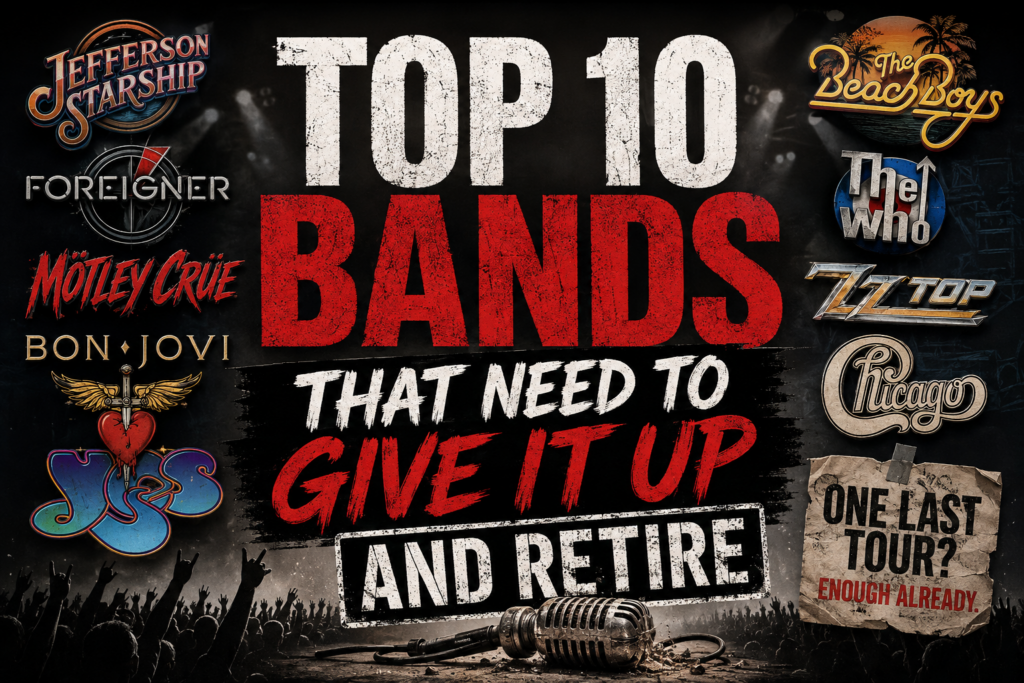
 There is something undeniably cool about seeing an old rock band walk onto a stage decades after its glory days. Sometimes the chemistry is still there. Sometimes the musicians have somehow gotten even better with age. And sometimes you walk out of the venue wondering why somebody didn’t just pull the plug before the band took the stage.
There is a difference between a legacy act and a band that simply refuses to acknowledge that its best days are behind it. Plenty of classic bands can still put on fantastic shows. Age by itself isn’t the problem. The problem is when the quality of the performance falls so far that you’re no longer celebrating the band’s history. You’re watching that history slowly fall apart in front of you.
Then there are bands that have become little more than touring brands. The name is famous, the catalog is familiar, and the audience shows up expecting to hear songs they loved decades ago. But the connection between the people onstage and the band people came to see has become increasingly tenuous.
I’ve seen a lot of these legacy acts over the years, and I’ve reached a fairly simple conclusion: some bands need to give it up.
This isn’t about age. It’s about quality. If you can still perform, go for it. If you can still bring something to the stage, fantastic. But when the vocals are painful, the lineup has become unrecognizable, or the entire thing feels like a tribute act using a famous name, maybe it’s time to call it a career.
Here are the ten that stand out the most.
** Note: Lynyrd Skynyrd absolutely 100% belongs on this list. BUT I love me some Skynyrd, and Rickey Medlocke is an original member, regardless of what the Rock and Roll Hall of Fame has to say, and Johnny Van Zant has been doing the singing for 40 years now. Plus they are still DAMN GOOD live. Saw them just a couple weeks ago and the show was dope as hell. **
1. Jefferson Starship
Jefferson Starship has always been one of those bands people either absolutely loved or absolutely hated. Personally, I’ve always enjoyed them. They have some fantastic songs, and their place in the history of American rock is unquestionable.
That’s precisely why watching the current version can be so depressing.
There is a difference between a band changing personnel and a band becoming almost completely disconnected from what it once was. Jefferson Starship has reached that point. Seeing them live today can be genuinely difficult to watch, and I’ve had to sit through them twice this year.
The biggest problem is the musical performance. It can feel messy from beginning to end. The vocals are particularly rough, with performances that can wander badly out of tune. Instead of hearing the songs that made the band interesting in the first place, you’re sometimes listening to people struggle to reproduce them.
And that’s the frustrating part: this isn’t a band I want to hate.
I actually like Jefferson Starship. I want to hear those songs performed well. I want to walk out of a show thinking, “That was awesome.” Instead, the current version can leave you feeling like you’re watching a tribute act that hasn’t quite figured out how to be a good tribute act.
At some point, loving the legacy means knowing when to stop damaging it.
2. Foreigner
Foreigner is another case where the name has become much bigger than the current band.
When you get down to essentially one original member, and that original member isn’t even the person most casual fans associate with the band, you have to start asking a very basic question: what exactly are we watching?
At some point, you’re not watching Foreigner. You’re watching a cover band called Foreigner.
And unfortunately, I don’t even think it’s a particularly great cover band.
That’s the uncomfortable reality of legacy touring. A band can own the rights to its name, have a giant catalog of hits, sell out venues and still feel completely disconnected from the group that originally created those songs.
Foreigner has plenty of material worth celebrating. “Cold as Ice,” “Hot Blooded,” “Juke Box Hero,” “Waiting for a Girl Like You” and “I Want to Know What Love Is” are all enormous songs.
But the songs aren’t enough by themselves.
There are thousands of extremely talented musicians who could play those songs. That’s not the same thing as being Foreigner.
When the original identity of a band is essentially gone, there comes a point where the respectful thing to do is stop pretending you’re still operating as that band and let the music exist on its own terms.
3. Mötley Crüe
This one hurts because Mötley Crüe used to be one of the great live rock bands.
Now?
Vince Neil has reached the point where watching him perform can be embarrassing.
You don’t have to search very hard online to find videos of Vince struggling through performances, and having seen Mötley Crüe live recently, I can confirm that the problem isn’t simply the internet exaggerating a bad night.
The singing is barely singing.
A typical performance can involve Vince holding the microphone toward the audience and letting them sing huge portions of the songs. When he does take the microphone back, you’re often left with something that sounds more like out-of-tune gibberish than the vocals people remember.
And that’s not an exaggeration for comedic effect. It’s genuinely difficult to sit through.
There is a huge difference between a singer whose voice has naturally changed with age (Elton John, Miley Cyrus, Adele, Rod Steward, Leonard Cohen) and a singer who simply cannot consistently perform the songs anymore.
Nobody expects Vince Neil to sound exactly like he did in 1985. That’s unrealistic. But you should at least be able to recognize the song.
Mötley Crüe’s legacy is enormous. They were one of the defining bands of the glam-metal explosion. Their albums, videos, excesses and live shows helped define an entire era.
That’s exactly why it feels wrong to watch the current version limp through those songs.
At some point, the audience deserves better.
And the band deserves to be remembered for what it was rather than what it’s become. I absolutely LOVE LOVE LOVE Mick Mars, and it sucks his health is so bad and he will likely be dead within a year. But he’s lucky he doesn’t have to be part of this travesty anymore.
** This video is not some sort of fake satire. I can confirm, I’ve seen it live, this is what EVERY song is like. **
4. Bon Jovi
Bon Jovi is a particularly difficult case because Jon Bon Jovi has nothing left to prove.
The man fronted one of the biggest rock bands on the planet. He has an incredible catalog and a career most musicians would kill to have.
But I’ve seen Bon Jovi live more than once in recent years, and the decline is impossible to ignore.
I saw them in Dallas a few years ago, and Jon’s voice was already rough. Then I saw them at Madison Square Garden this year, and unfortunately, things hadn’t improved.
That’s the problem with vocal decline: sometimes you can have a bad night. Sometimes you can be sick. Sometimes your voice is simply worn out after a long tour.
But when you see the same problems repeatedly over a period of years, you have to acknowledge that this may simply be where the singer is now.
The songs haven’t changed. The audience still knows every word. The band still has the ability to put together an enormous production.
But Jon Bon Jovi’s voice is the center of the whole thing.
If the singer can’t comfortably sing the songs anymore, the production, lights, screens and nostalgia can’t completely cover that up.
Bon Jovi doesn’t need another giant tour to prove anything. Their legacy is secure.
Maybe it’s time to let the records do the talking.
5. Yes
Who the hell is even in Yes anymore?
That’s not rhetorical.
Yes has gone through so many lineup changes, replacement members, replacement replacements and competing versions of the band that keeping track of the personnel has become almost an entirely separate hobby.
The last time I saw them, Steve Howe wasn’t even there.
And here’s where I draw the line.
There wasn’t a single original member.
There wasn’t even a single original replacement member.
At that point, what exactly am I watching?
Call it whatever you want, but I consider that a cover band.
And the really frustrating part is that it wasn’t even a particularly good cover band.
Yes is one of the most musically sophisticated bands in rock history. The original and classic lineups created some extraordinarily ambitious music. These songs aren’t simple three-chord rock tunes that anybody can casually reproduce.
That’s why the personnel matter.
When you remove the musicians who created the identity of the band and replace them with successive generations of replacements, eventually the name becomes little more than a logo.
There is nothing wrong with talented musicians playing Yes songs.
There is something strange about pretending that constitutes Yes when there isn’t a single person onstage who was part of the band’s actual history.
6. The Beach Boys
The Beach Boys might be one of the strangest legacy acts still operating.
Mike Love occasionally shows up, and that’s about the closest connection you’re getting to the original group.
But beyond that, the current Beach Boys experience has become increasingly difficult to justify as anything resembling the actual band.
And, frankly, they’re boring.
That’s not what anyone wants to say about the Beach Boys. We’re talking about one of the most important American bands ever.
But watching a bunch of musicians play those songs without the creative personalities that made the Beach Boys special doesn’t exactly set the world on fire.
What really bothers me, though, is where they keep getting booked.
The Beach Boys played Riot Fest.
Seriously.
Dropkick Murphys, Buzzcocks and Bad Religion were relegated to the smaller stage at a punk festival while the Beach Boys occupied the main stage.
That’s absurd.
And then there was Ocean’s Calling Festival, where the Beach Boys seemed determined to stay onstage forever.
When the stage time light is flashing and you’re still going, maybe take the hint. The fact The Offspring and The Killers had to shorten their sets due to curfew because these old farts would not get off the freaking stage and stayed on a half hour long was obnoxious. Someone should have come out and just yanked the power out.
There is something deeply strange about seeing the Beach Boys positioned as a major contemporary festival headliner when so many more relevant bands are fighting for the smaller stages.
The Beach Boys deserve enormous respect.
They don’t necessarily deserve another touring career.
7. The Who
The Who have apparently played their final tour about a dozen times since 1981.
At this point, “final tour” has become less of an announcement and more of a recurring event. Much like KISS
To be fair, the most recent version I’ve seen was musically pretty good.
Pete Townshend can still play. Roger Daltrey can still command a stage.
But then something happens halfway through the show.
They run out of gas.
That’s understandable. They’re not young men anymore, and nobody should expect a couple of musicians in their eighties to perform like they did in their twenties or thirties.
But The Who’s music is physically demanding.
When you’re playing a show built around the intensity of songs like “Baba O’Riley,” “Won’t Get Fooled Again” and “My Generation,” the performance has to have some fire behind it.
When the band is strong for half the show and visibly exhausted for the rest, the experience becomes uneven.
The Who already have one of the greatest legacies in rock history.
They don’t need another final tour.
They need a final final tour.
And then actually make it final.
8. ZZ Top
ZZ Top should have stopped when Dusty Hill died.
That might sound harsh, but Dusty wasn’t simply another employee in ZZ Top. He was one-third of the identity of the band.
Billy Gibbons, Dusty Hill and Frank Beard were ZZ Top.
When Dusty died, the decision to keep touring almost immediately afterward always bothered me.
The band barely stopped.
That was strange.
You would think the death of one of the three people who had defined the band for more than half a century would be a moment to pause and reconsider the entire operation.
Instead, they essentially kept going. Only missing 3 shows
Now the situation is even more surreal.
With the passing of Frank Beard this week, then what exactly is left?
Billy Gibbons is an excellent musician and can absolutely continue performing. There is nothing stopping him from going out with his solo band and playing ZZ Top songs. I saw Billy Gibbons and the BFGs in Niagara Falls earlier this year, and they were excellent.
In fact, that seems like the perfect solution.
Just stop calling a completely different lineup ZZ Top.
ZZ Top was one of the most recognizable trios in rock history.
The legacy doesn’t need to be stretched until there is nothing recognizable left.
9. Chicago
Chicago is one of those bands where the sheer number of musicians involved can make the current lineup look impressive on paper.
There are a million people in Chicago.
And yet, when you look at the band’s history, the connection to the original group has become remarkably thin.
Lee Loughnane, the band’s trumpet and flugelhorn player, is the one original member who remains active with the touring lineup.
That’s it.
One guy.
The flugelhorn guy.
Chicago’s history is enormous. They were one of the most ambitious bands to emerge from the late 1960s, combining rock, jazz, brass and pop in a way that became their signature.
But the more the lineup changes, the more the name becomes a representation of a catalog rather than a band.
And again, the music itself isn’t the issue.
There are talented musicians on that stage.
The question is whether you need to keep the machine running forever simply because the songs still sell tickets.
At some point, the answer has to be no.
10. The Zero-Member Hall of Fame
This final spot is really a tie, because there are too many ridiculous examples to choose just one.
We’re talking about bands that continue touring despite having zero original members.
The Guess Who.
The Temptations.
The Four Tops.
The Spinners.
The Drifters.
The Platters.
Blood, Sweat & Tears.
The Yardbirds.
Zero.
Not one.
That’s where the concept of a “band” starts getting seriously questionable.
Some of these groups have complicated histories. Vocal groups in particular have always operated differently from rock bands. Members came and went, lineups changed, and names sometimes continued across generations.
But eventually there has to be a limit.
If nobody who originally created the group is left, you’re not watching the original group.
You’re watching musicians performing songs associated with the original group.
And there’s nothing inherently wrong with that.
Tribute bands do it every night.
The problem is when the audience isn’t being given a clear distinction between the original artistic entity and the modern touring version.
The Guess Who might be the most obvious example. The name carries enormous weight because of the music created decades ago. But if none of those original musicians are onstage, what exactly is being preserved?
The same question applies to The Yardbirds. Maybe even more so. Eric Clapton, Jimmy Page, Jeff Beck. That’s a goddamn 3/4 Mount Rushmore of guitarists in one band. And now it’s made up of dudes I have never heard of, 3 out of 5 have only been with the band since 2015 or less.
The same applies to Blood, Sweat & Tears.
And it gets especially weird with groups like The Drifters and The Platters, where the names have effectively become continuing brands.
At that point, perhaps it’s better to acknowledge what they really are: professional legacy acts performing classic material.
There are plenty of bands that do that successfully. Dark Star Orchestra (Grateful Dead), The Fab Four (Beatles), Brit Floyd (Pink Floyd). That are more than just “cover bands” they are extensions of the bands they represent.
There’s nothing shameful about that.
Pretending otherwise is the problem.
Give It Up While the Memories Are Still Good
There is a natural temptation for musicians to keep going.
Who wouldn’t want to keep playing in front of thousands of people? Who wouldn’t want the paycheck? Who wouldn’t want another standing ovation?
But sometimes the most dignified thing an artist can do is stop.
Retirement doesn’t erase a career.
It doesn’t diminish the records.
It doesn’t make the fans forget.
Quite the opposite.
A great final show can become part of a band’s mythology. A graceful ending allows fans to remember the band at its best instead of watching the quality deteriorate year after year.
That’s ultimately what this list is about.
It’s not an attack on old musicians simply because they’re old. There are plenty of artists in their seventies and eighties who can still absolutely destroy a stage.
It’s about recognizing when the performance has become a shadow of what it used to be.
Jefferson Starship shouldn’t have to be painful to watch.
Foreigner shouldn’t have to function as a glorified cover band.
Mötley Crüe shouldn’t require the audience to sing every song because Vince Neil can’t.
Bon Jovi shouldn’t have to pretend Jon’s voice hasn’t deteriorated.
Yes shouldn’t be a band with no original members.
The Beach Boys shouldn’t be occupying festival main stages while genuinely relevant bands are pushed aside.
The Who should eventually have an actual final tour.
ZZ Top should have ended with Dusty Hill, or at the very least reconsidered after losing another member.
Chicago shouldn’t need an enormous lineup to disguise the fact that almost all of its founding musicians are gone.
And bands with zero original members should seriously consider whether the name they’re carrying still belongs to them.
The music will survive.
The albums will survive.
The memories will survive.
Sometimes the best way to protect a band’s legacy is simply to stop touring before the legacy becomes an embarrassment.