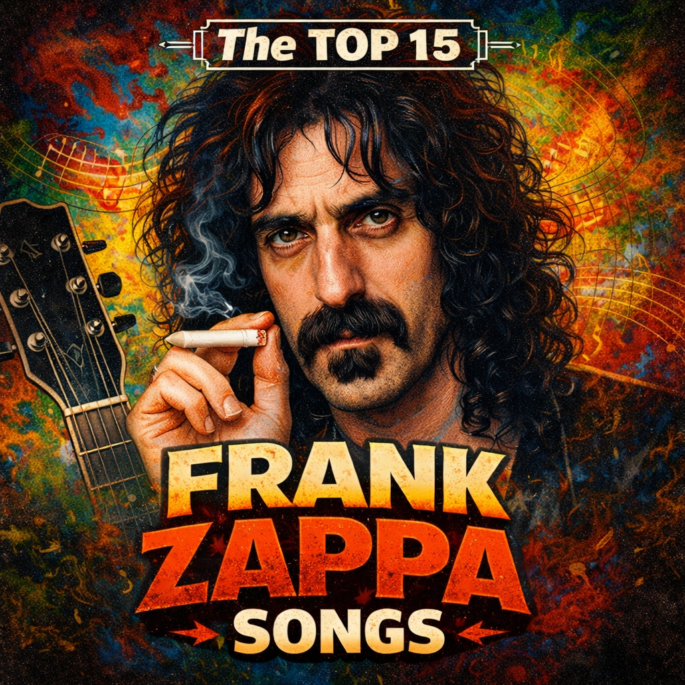
Frank Zappa is widely regarded as one of the most original, prolific, and uncompromising musical voices of the 20th century. Active from the mid-1960s until his death from prostate cancer in December 1993, Zappa released more than sixty albums that refused to be confined to any single genre. He fused rock, jazz, classical, blues, doo-wop, avant-garde experimentation, and sharp social satire into a body of work that was as intellectually demanding as it was entertaining. As a guitarist, composer, bandleader, lyricist, and producer, Zappa maintained complete creative control over his output, often funding his own projects and battling record labels, censors, and critics along the way. His songs tackled politics, religion, consumerism, sexual taboos, education, and the music industry itself with equal parts wit, outrage, and absurdity.
Zappa’s music rewards both casual listeners and serious students. Some tracks dazzle with technical complexity and instrumental beauty, while others deliver outrageous humor and pointed cultural critique. The fifteen songs selected here represent the pinnacle of his catalog. They include stunning instrumentals, commercial hits, live favorites, complex suites, and satirical masterpieces. Each one highlights a different aspect of Zappa’s extraordinary talent and continues to influence musicians across genres decades after they were recorded.
1. Peaches En Regalia Peaches En Regalia, the opening track from the groundbreaking 1969 album Hot Rats, is frequently hailed as Frank Zappa’s single greatest instrumental composition and a masterpiece of concise musical storytelling. Running just three minutes and thirty-seven seconds, this piece achieves a level of sophistication and joy that few composers have matched in such a short format. It opens with a bright, instantly hummable theme stated first by clarinet and electric piano, then passed around the ensemble with shifting dynamics and textures. The track moves through multiple distinct sections featuring complex time signature changes, unexpected modulations, tight unison lines, and lush harmonic layering that feels both playful and profoundly elegant.
Zappa recorded Hot Rats after temporarily disbanding the original Mothers of Invention, using the project to explore his jazz and orchestral interests with top-tier session musicians. Ian Underwood contributed heavily on keyboards, woodwinds, and orchestration, while the rhythm section of Max Bennett on bass and John Guerin on drums provided a supple, jazz-inflected foundation. The production was revolutionary for its time — Zappa utilized multi-track overdubbing and careful mixing to create a crystal-clear, spacious sound that still holds up remarkably well in the digital age. There are no lyrics, no vocals, and no satire; instead, the piece relies entirely on pure musical invention. Classical analysts have noted its form resembles a miniature concerto or rondo, with recurring themes that evolve and transform rather than simply repeat.
Upon release, “Peaches En Regalia” became an underground favorite and received steady airplay on progressive FM radio stations throughout the 1970s. Its influence has been far-reaching. Jam bands such as Phish have covered it dozens of times in concert, often stretching it into extended improvisational vehicles. Jazz ensembles, classical guitarists, and even electronic artists have offered their own interpretations. For many first-time listeners, this track serves as the perfect entry point into Zappa’s world precisely because it contains none of the shock value or crude humor that defines other parts of his catalog. It is simply beautiful, clever, and fun music.
Longtime fans cherish it as the purest expression of Zappa’s compositional soul — the part of him that delighted in creating intricate, rewarding structures for their own sake. Zappa himself expressed pride in the piece, noting in interviews that it represented the kind of “movie for the ears” he aimed to create. Nearly sixty years after its recording, “Peaches En Regalia” remains fresh, inventive, and full of life. It stands as undeniable proof that Zappa could produce absolute musical excellence without needing controversy or lyrics to make his point. In many “best of Zappa” polls and critic lists, it consistently ranks at or near the very top.
2. Joe’s Garage Joe’s Garage, the title track and narrative cornerstone of the 1979 three-act rock opera Joe’s Garage, is one of Zappa’s most ambitious and emotionally layered works. Spanning over six minutes in its main version, the song launches the story of a young working-class guitarist named Joe whose innocent garage-band dreams are destroyed by the combined forces of the music industry and an authoritarian government that eventually bans music altogether to control the population. Narrated by the fictional “Central Scrutinizer” (a character voiced by Zappa himself in a menacing, authoritative tone), the track masterfully blends simple doo-wop harmonies, basic I-IV-V garage-rock progressions, and increasingly polished arrangements that mirror Joe’s descent from youthful enthusiasm into disillusionment. Ike Willis provides a raw, vulnerable lead vocal that gives the character genuine humanity.
Zappa drew inspiration from his own career-long battles with record labels, censors, and moral watchdogs. The opera was partly a response to the growing push for parental advisory stickers and government interference in art. Musically, the song is brilliantly constructed: it begins loose and fun, mimicking amateur jamming in a suburban garage, then tightens and becomes more clinical as Joe signs a record deal and faces commercial pressures. This structural irony — using sophisticated playing to critique the loss of raw creativity — is classic Zappa. The lyrics are packed with sharp observations about exploitation, conformity, and the crushing of individuality.
Released at the tail end of the 1970s, Joe’s Garage achieved solid commercial success, especially in Europe, and solidified Zappa’s reputation as a rock opera composer who could stand alongside Pete Townshend and Roger Waters while remaining far more subversive and explicit. Live performances of the full opera were theatrical spectacles featuring costumes, props, and audience interaction. The themes of artistic suppression and lost creativity feel even more relevant in today’s streaming-dominated, algorithm-driven music landscape. “Joe’s Garage” is funny, tragic, catchy, and intellectually stimulating all at once. It showcases Zappa at the absolute peak of his powers as storyteller, satirist, and composer.
3. Don’t Eat the Yellow Snow (suite) The Don’t Eat the Yellow Snow suite from the 1974 album Apostrophe (‘) remains one of Zappa’s most popular and enduring comedic achievements. This nearly nine-minute four-part sequence — “Don’t Eat the Yellow Snow,” “Nanook Rubs It,” “St. Alfonzo’s Pancake Breakfast,” and “Father O’Blivion” — weaves a completely surreal dream narrative involving an Eskimo revenge fantasy, a fight over yellow snow, pancakes, and a lecherous priest. The storytelling flows with remarkable seamlessness thanks to clever thematic transitions and the exceptional chemistry of Zappa’s mid-1970s touring band. George Duke and Napoleon Murphy Brock deliver cartoonish, highly expressive vocals while the music shifts between funky grooves, wild instrumental interludes, and abrupt tempo changes.
Zappa fills every section with witty wordplay, sound effects, and musical in-jokes that reveal new layers upon repeated listens. The humor is deliberately juvenile and absurd, yet the underlying musical craftsmanship is highly advanced, featuring sophisticated rhythms, rich horn and keyboard textures, and tight ensemble playing. This combination of lowbrow comedy and high-level execution is what makes the suite so special and re-listenable. It became an instant fan favorite upon release and has stayed in heavy rotation for Zappa tribute bands and cover acts for fifty years.
Beyond the laughs, the piece highlights Zappa’s gift for extended-form storytelling and his willingness to push the boundaries of good taste. It also captures the playful spirit of one of his strongest live bands. For casual fans, it is pure entertainment. For dedicated listeners, it is a masterclass in transforming nonsense into musically compelling art. The Yellow Snow suite perfectly encapsulates why Zappa’s work continues to resonate: he could be uproariously funny without ever sacrificing quality or intelligence.
4. Inca Roads Inca Roads from the 1975 masterpiece One Size Fits All is a seven-minute prog-rock epic that fuses cosmic speculation with dazzling technical brilliance. The lyrics, sung with soulful intensity by Napoleon Murphy Brock, playfully question whether ancient astronauts visited Earth and assisted in building the Inca empire, drawing inspiration from Erich von Däniken’s popular pseudo-archaeology books. The arrangement is a tour de force of shifting time signatures, dynamic contrasts, and intricate interplay between George Duke’s groundbreaking synthesizer work, Ruth Underwood’s virtuosic percussion and marimba, and Zappa’s soaring, emotionally charged guitar solo. This track represents the absolute zenith of Zappa’s mid-1970s jazz-rock fusion period. Live versions frequently stretched well beyond ten minutes, showcasing the band’s near-telepathic communication.
5. Bobby Brown Goes Down Bobby Brown Goes Down from the 1979 album Sheik Yerbouti is one of Zappa’s biggest international hit singles. This upbeat, deceptively cheerful track tells the satirical story of a clean-cut, privileged college boy whose life takes a bizarre turn into sadomasochism and celebrity perversion. The tight band performance and catchy melody deliberately contrast with the explicit lyrics, creating classic Zappa irony. It reached the Top 10 in several European countries and became a concert staple.
6. Valley Girl Valley Girl, a collaboration with his daughter Moon Unit Zappa on the 1982 album Ship Arriving Too Late to Save a Drowning Witch, gave Frank his only major U.S. Top 40 hit. Moon’s improvised stream-of-consciousness monologue over a funky new-wave groove skewers 1980s San Fernando Valley teenage slang, materialism, and mall culture. The song became a nationwide cultural phenomenon.
7. Catholic Girls Catholic Girls from Joe’s Garage delivers a bouncy, high-energy satire on sexual repression and religious hypocrisy. Zappa contrasts bright rock arrangements with explicit lyrics about Catholic schoolgirls’ secret fantasies, making it one of his most provocative and energetically performed pieces.
8. Titties & Beer Titties & Beer, a highlight of the 1978 live album Zappa in New York, is a wild theatrical rock narrative in which Zappa acts out a deal with the devil involving a biker, his girlfriend, and the eternal choice between “titties & beer” or damnation. The driving groove, role-playing vocals, and audience energy make it a legendary concert number that perfectly captures Zappa’s outrageous live persona.
9. Watermelon in Easter Hay Watermelon in Easter Hay is widely considered Zappa’s most beautiful and emotionally devastating guitar instrumental. From Joe’s Garage, this melancholic solo represents Joe’s final dream of musical glory before accepting a soul-crushing factory job. Zappa’s phrasing, tone, and note choice convey profound longing and resignation with stunning clarity. Many fans and critics rank it as the single most moving piece in his entire discography.
10. The Black Page (#1 & #2) The Black Page is a legendary rhythmic masterpiece originally written as a drum solo for Terry Bozzio. Version one is a dense thicket of odd time signatures; version two adds memorable melody and swing. It stands as a testament to Zappa’s love for extreme technical challenge.
11. Sofa (#1 & #2) Sofa #1 is a gorgeous, floating wordless lullaby, while Sofa #2 transforms the same melody into an absurd German-language hymn declaring a sofa to be divine. The contrast between sublime beauty and ridiculous humor is pure Zappa genius.
12. Village of the Sun > Echidna’s Arf (Of You) > Don’t You Ever Wash That Thing? This spectacular live medley from Roxy & Elsewhere (1974) showcases the extraordinary precision and creativity of Zappa’s 1974 band. It flows from dreamy utopian lyrics into complex instrumental fireworks and heavy funk grooves, featuring standout work by Ruth Underwood on marimba and George Duke on keyboards.
13. Strictly Genteel (London Symphony Orchestra version) The 1980s London Symphony Orchestra recording of Strictly Genteel elevates this piece into a stunning orchestral work that blends elegant classical themes with sudden modernist eruptions. It demonstrates Zappa’s serious ambitions as a concert composer.
14. Zomby Woof Zomby Woof from Over-Nite Sensation (1973) is a funky, horror-themed rocker featuring Ricky Lancelotti’s wildly over-the-top vocals and inventive horn charts. It masterfully blends silliness with tight musical precision.
15. Cosmik Debris Cosmik Debris is a laid-back, groovy satire targeting fake spiritual gurus and cosmic nonsense. The memorable chorus, tight funk rhythm section, and sharp lyrics make it one of Zappa’s most consistently enjoyable mid-1970s tracks.
In conclusion, these fifteen songs capture the full spectrum of Frank Zappa’s genius — technical brilliance, emotional depth, satirical bite, and pure entertainment. More than thirty years after his passing, his music remains as fresh, challenging, and relevant as ever. Whether you are new to Zappa or a longtime fan, these tracks provide an ideal entryway into one of the most fascinating catalogs in musical history.