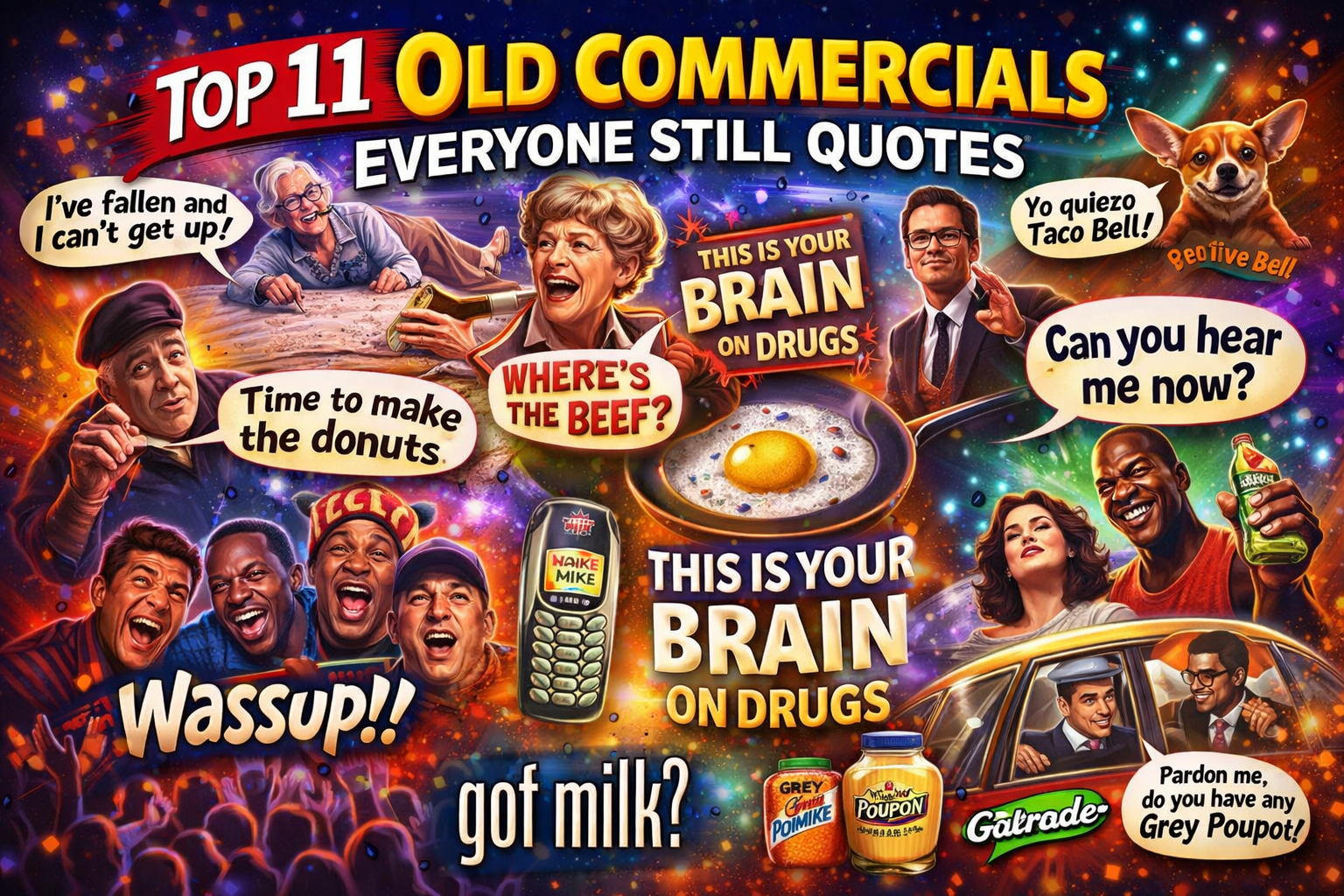
 There’s something uniquely powerful about a great commercial. In just 30 or 60 seconds, it has to grab your attention, tell a story, and leave behind something memorable enough that you carry it with you long after it’s over. The best ones don’t just sell a product—they become part of the culture. They give us catchphrases, jingles, and moments that outlive the brands themselves.
Long before streaming and ad-skipping became the norm, commercials were unavoidable—and because of that, the great ones reached everyone. They became shared experiences. You’d hear a line in school, at work, or at a party, and instantly recognize it. Over time, those phrases detached from their original purpose and became shorthand for humor, nostalgia, or just plain fun.
These are the commercials that broke through the noise—the ones people still quote decades later, sometimes without even remembering what they were advertising.
11. “Pardon Me, Do You Have Any Grey Poupon?” – Grey Poupon
Why It Endured: A simple line that turned sophistication into a punchline.
Few commercials managed to blend humor and class quite like Grey Poupon’s iconic campaign from the 1980s. Set in an exaggerated world of luxury, the ads typically featured two wealthy men riding in limousines who pull up alongside each other. One rolls down his window and politely asks, “Pardon me, do you have any Grey Poupon?” The other obliges, passing the mustard between cars as if it were the most natural thing in the world.
The humor came from the absurdity. The setting was so over-the-top—formal attire, chauffeured rides, exaggerated politeness—that it made the simple act of asking for mustard feel hilariously pretentious. And that’s exactly why it worked.
The phrase quickly entered everyday conversation as a tongue-in-cheek way to mock sophistication or poke fun at anything perceived as fancy. People would use it jokingly in completely ordinary situations, instantly getting a laugh.
What made the campaign so effective was its confidence. It didn’t try to be relatable—it leaned fully into luxury, and in doing so, became universally recognizable.
Even decades later, the line still pops up in pop culture, proving that sometimes the most memorable commercials are the ones that embrace their own ridiculousness.
10. “I’ve Fallen and I Can’t Get Up” – LifeCall
Why It Endured: Unintentionally funny, endlessly repeatable.
Originally intended as a serious message about the importance of emergency response systems for seniors, the LifeCall commercial featuring the now-infamous line “I’ve fallen and I can’t get up” took on a life of its own.
The ad shows an elderly woman stranded on the floor, unable to reach help—until she uses her LifeCall device. It’s meant to be a sobering reminder of vulnerability and the value of preparedness. But something about the delivery of that line—earnest, direct, and a little awkward—turned it into an instant cultural catchphrase.
Almost immediately, it was parodied across TV shows, stand-up comedy routines, and everyday conversation. People would quote it jokingly whenever they tripped, sat down too hard, or even just wanted to exaggerate minor inconvenience.
What makes this commercial so memorable is that it wasn’t trying to be funny. Its sincerity is exactly what made it stick. It crossed over from advertisement to pop culture reference almost by accident.
9. “Where’s the Beef?” – Wendy’s
Why It Endured: A simple question that became a national punchline.
In 1984, Wendy’s launched a commercial featuring three elderly women inspecting a competitor’s burger, only to discover a tiny patty hidden inside an oversized bun. One of them, Clara Peller, delivers the now-iconic line: “Where’s the beef?”
The brilliance of the ad lies in its simplicity. It cuts straight to the point—Wendy’s burgers have more meat—and does so in a way that’s instantly memorable.
The phrase quickly transcended advertising. It was used in political campaigns, late-night jokes, and everyday conversations as a way of calling out something lacking substance. It became shorthand for skepticism and critique.
Clara Peller herself became a minor celebrity, proving just how deeply the line resonated. Decades later, people still use the phrase without necessarily remembering its origin.
That’s the mark of a truly successful commercial—it becomes part of the language.
8. “Time to Make the Donuts” – Dunkin’ Donuts
Why It Endured: Relatable exhaustion turned into a ritual phrase.
Before Dunkin’ was a global coffee powerhouse, it built its brand around fresh donuts—and one sleepy, dedicated worker named Fred the Baker.
In a series of commercials, Fred wakes up at absurd hours muttering, “Time to make the donuts,” as he trudges through his daily routine. The repetition of the line, combined with the character’s weary determination, made it instantly relatable.
The phrase became a go-to expression for anyone facing early mornings or monotonous tasks. Whether heading to work, school, or any obligation that required dragging yourself out of bed, people would echo Fred’s resigned tone.
What made it stick was its authenticity. It captured a universal feeling—the grind—without overcomplicating it.
Even as Dunkin’ evolved, that simple line remains one of the most enduring slogans in advertising history.
7. “This Is Your Brain on Drugs” – Partnership for a Drug-Free America
Why It Endured: A stark visual that burned into memory.
Few commercials hit as hard—or as simply—as the “This is your brain on drugs” campaign. The ad shows a man holding up an egg: “This is your brain.” He then cracks it into a frying pan: “This is your brain on drugs. Any questions?”
That’s it. No flashy effects, no humor—just a blunt, almost confrontational message.
The imagery was so effective that it became impossible to forget. It was quoted, parodied, and referenced endlessly, often in comedic contexts that contrasted sharply with the original intent.
Despite its simplicity, the commercial achieved what many more elaborate campaigns could not: instant recognition. The phrase became shorthand for warning against bad decisions of all kinds—not just drug use.
Its staying power proves that sometimes, the most direct message is the most powerful.
6. “Can You Hear Me Now?” – Verizon
Why It Endured: A catchphrase built on repetition and frustration.
In the early 2000s, Verizon introduced a campaign featuring a bespectacled test man walking through various environments, asking, “Can you hear me now?” as he tested network coverage.
The phrase quickly became part of everyday conversation. Dropped calls, poor reception, or even simple miscommunication would prompt someone to repeat the line.
What made it effective was its relatability. Everyone had experienced bad cell service, and the commercial tapped into that frustration with humor and consistency.
The campaign ran for years, reinforcing the phrase until it became inseparable from the brand—and from the broader experience of early mobile technology.
Even today, long after the ads stopped airing, the line still pops up whenever communication breaks down.
5. “Yo Quiero Taco Bell” – Taco Bell
Why It Endured: A quirky mascot with unexpected charm.
In the late 1990s, Taco Bell introduced a small Chihuahua with a big personality—and an even bigger catchphrase: “Yo quiero Taco Bell.”
The ads were playful, slightly absurd, and instantly memorable. The dog’s confident delivery, combined with the unexpected use of Spanish, gave the campaign a unique flavor.
The phrase spread rapidly, becoming a cultural phenomenon. People repeated it in schools, offices, and social settings, often without fully understanding the language.
While the campaign eventually faced criticism and was retired, its impact was undeniable. The Chihuahua became one of the most recognizable advertising mascots of its era.
The line itself remains a nostalgic callback to a time when commercials could dominate conversation in a way that feels almost impossible today.
4. “Got Milk?” – California Milk Processor Board
Why It Endured: A question that became a universal slogan.
“Got Milk?” is one of the most iconic advertising slogans ever created. Debuting in the 1990s, the campaign featured celebrities and everyday people sporting milk mustaches, paired with the simple, two-word question.
Its brilliance lies in its flexibility. The phrase could be applied to almost anything, making it endlessly adaptable and easy to parody.
It quickly became a cultural staple, referenced in TV shows, movies, and everyday speech. The simplicity of the message made it unforgettable.
Unlike many campaigns, “Got Milk?” wasn’t tied to a specific product variation—it promoted an entire category. And it did so with remarkable success.
Even decades later, the phrase still resonates, proving that sometimes, less really is more.
3. “Wassup?!” – Budweiser
Why It Endured: A moment of pure, infectious energy.
Few commercials captured the spirit of a moment quite like Budweiser’s “Wassup?!” campaign. Featuring a group of friends greeting each other over the phone with an exaggerated “Wassup?!,” the ad became an instant hit.
Its appeal was rooted in authenticity. It felt like something real people might actually do—just dialed up for comedic effect.
The phrase spread like wildfire, becoming a staple of early 2000s pop culture. It was shouted across rooms, repeated in conversations, and referenced in countless parodies.
What made it endure was its simplicity and energy. It didn’t try to be clever—it just captured a vibe.
Even now, hearing someone say “Wassup?!” in that distinctive tone immediately brings back memories of the era.
2. “Calgon, Take Me Away!” – Calgon
Why It Endured: A dramatic escape line everyone wished they could use.
Few commercials captured the feeling of everyday stress quite like the classic Calgon ads. Debuting in the 1970s and running for years after, these commercials typically featured a frazzled woman overwhelmed by chaos—ringing phones, demanding family members, endless responsibilities. At her breaking point, she’d cry out, “Calgon, take me away!” and suddenly be transported to a peaceful bath, far removed from the madness.
The brilliance of the campaign was how relatable it felt. Everyone has moments where they want to escape—whether from work, family, or just the noise of daily life. Calgon turned that universal feeling into a simple, repeatable phrase that instantly resonated.
The line quickly became part of everyday language. People would jokingly shout it during stressful situations, often without even thinking about the product itself. It became shorthand for needing a break, a reset, or just a moment of peace.
What made it stick wasn’t just the humor or the dramatics—it was the fantasy. The idea that you could instantly disappear from your problems, even for a moment, struck a chord.
Decades later, “Calgon, take me away!” still gets quoted, proving that sometimes the most powerful ads are the ones that tap directly into how people feel.
1. “Be Like Mike” – Gatorade
Why It Endured: A jingle that turned an athlete into a universal aspiration.
Before social media turned athletes into daily fixtures in our lives, there was Michael Jordan—larger than life, seemingly untouchable, and everywhere. Gatorade tapped into that aura perfectly with its “Be Like Mike” campaign in the early 1990s, creating one of the most iconic commercials of all time.
The ad featured everyday kids and adults mimicking Jordan’s moves, set to a catchy, feel-good jingle: “Sometimes I dream that he is me… I wanna be, I wanna be like Mike.” It wasn’t just about basketball—it was about aspiration. The commercial sold the idea that greatness, or at least a piece of it, was within reach.
What made it stick was the music. The jingle became instantly recognizable, replayed endlessly on TV, radio, and even playgrounds. Kids sang it. Adults remembered it. It transcended advertising and became part of the cultural fabric of the ’90s.
Unlike many slogans that feel tied to a brand, “Be Like Mike” felt bigger than Gatorade. It became shorthand for chasing excellence, idolizing greatness, and believing you could rise above your limits.
Decades later, people still reference it—not just as a commercial, but as a moment when sports, music, and marketing aligned perfectly.
Final Thoughts
These commercials prove that great advertising isn’t just about selling—it’s about sticking. The lines, images, and moments that resonate most deeply are the ones that tap into something universal, whether it’s humor, frustration, ambition, or just the rhythm of everyday life.
In an era where ads are easier than ever to skip, it’s worth remembering a time when commercials could become part of the culture—when a single line could echo for decades.
And if you’ve ever caught yourself quoting one of these without even thinking about it, you’ve experienced exactly what made them so powerful.