 In a musical landscape dominated by lyrics, storytelling, and vocal charisma, instrumental songs occupy a special and often overlooked corner of pop and rock history. Without a singer guiding the narrative, the instruments themselves must carry the emotional weight, the hooks, and the atmosphere. When it works, the result can be electrifying. A great instrumental song proves that melody, tone, rhythm, and arrangement alone can communicate feelings just as powerfully as words.
Instrumentals have existed since the earliest days of rock and roll. Surf rock bands in the early 1960s rode waves of reverb-drenched guitar instrumentals, while jazz-influenced rock musicians expanded the form into complex compositions. Later decades saw funk, progressive rock, and even electronic artists embrace the instrumental format.
Yet only a select handful of instrumental tracks managed to cross over into mainstream pop success while remaining essential parts of rock history. These songs didn’t just chart—they became cultural touchstones. Some dominated radio airplay. Others became staples in film, television, and sports arenas. And a few are simply so memorable that almost everyone recognizes them within the first few notes.
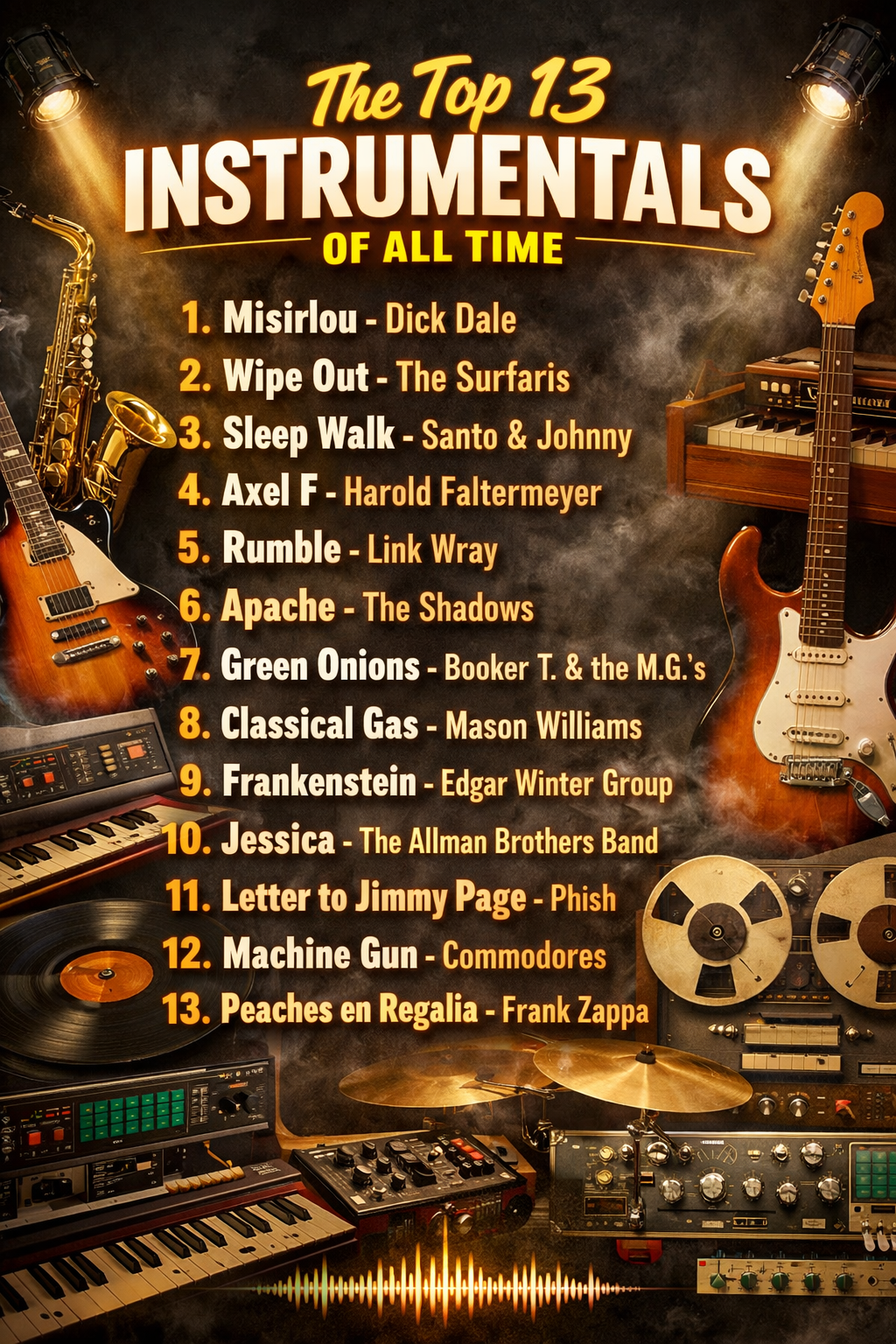
Here are the 13 greatest instrumental songs in pop and rock history—tracks that proved you don’t need lyrics to create something unforgettable.
13. “Peaches en Regalia” – Frank Zappa (1969)
Few instrumental songs in rock history manage to balance complexity and accessibility the way “Peaches en Regalia” does. Released on Frank Zappa’s 1969 album Hot Rats, the track stands as one of the most beloved compositions in Zappa’s vast and wildly eclectic catalog.
“Peaches en Regalia” blends elements of jazz, progressive rock, orchestral music, and psychedelic experimentation into a piece that somehow remains instantly catchy. The opening melody is bright, playful, and unmistakable, weaving through a lush arrangement of guitars, keyboards, horns, and percussion.
Unlike many progressive rock instrumentals that can feel overly technical, this track never loses its sense of fun. The song moves through multiple musical sections while maintaining a strong melodic core, demonstrating Zappa’s remarkable gift for composition.
The recording also highlights the musicianship of the players involved. Guitar lines glide effortlessly over tight rhythm work, while keyboards and brass instruments add color and unexpected twists.
Over the years, “Peaches en Regalia” has become one of Zappa’s most frequently celebrated works. It’s often cited by musicians as a perfect example of how instrumental music can be sophisticated without losing its sense of groove and accessibility.
For many listeners, it also serves as the perfect gateway into the wonderfully strange world of Frank Zappa’s music.
12. “Machine Gun” – Commodores (1974)
Before Lionel Richie transformed the Commodores into one of the biggest soul-pop acts of the late 1970s and 1980s, the band built its reputation as a tight, groove-heavy funk ensemble. Their 1974 instrumental hit “Machine Gun” perfectly captures that early era.
Released on the group’s debut album Machine Gun, the track quickly became a club favorite and an essential funk anthem.
The song’s title comes from its distinctive synthesizer sound effect that mimics rapid gunfire. This futuristic keyboard riff drives the entire composition, giving the track a unique sonic identity that still feels bold and inventive decades later.
But the real power of “Machine Gun” lies in its rhythm section. The bass line is deep and elastic, the drums lock into a relentless funk groove, and the layered keyboards create a thick wall of sound that makes the song impossible not to move to.
At a time when funk instrumentals were thriving in dance clubs, “Machine Gun” stood out for its energy and its memorable central hook.
The track also showcased the Commodores’ musicianship long before they became radio superstars with ballads like “Easy” and “Three Times a Lady.”
Today, “Machine Gun” remains one of the defining instrumental funk tracks of the 1970s and an essential example of groove-driven instrumental pop.
11. “The Ladyland” – Phish (1988)
Phish’s “The Landlady” stands as one of the band’s most captivating instrumental compositions, a compact yet dynamic showcase of their early compositional flair. Penned by Trey Anastasio, this brief Latin-infused, mambo-esque gem originated as the composed middle section of “Punch You in the Eye,” but it quickly earned its own spotlight as a standalone piece.
Debuting in the late 1980s, “The Landlady” bursts forth with a bright, syncopated horn-like melody (often delivered via Trey’s guitar or with actual horns in special arrangements), layered over a lively rhythmic foundation. Mike Gordon’s bass locks in with crisp, walking lines, while Jon Fishman and Page McConnell provide the percussive and harmonic glue that gives it such infectious bounce. The track shifts between two main themes: a punchy, upbeat motif and a slightly more lyrical counter-melody, creating a conversational interplay that feels both structured and freewheeling—classic Phish.
Live versions, especially those augmented by the Giant Country Horns (like memorable 1990s renditions), amplify its festive energy, turning it into a dance-floor igniter amid longer jams. Clocking in around 2-3 minutes in its composed form, it never overstays its welcome, serving as a perfect burst of precision and joy in setlists.
“The Landlady” highlights Phish’s love for weaving diverse influences—here, a nod to Afro-Cuban rhythms—into their improvisational world. It’s a reminder that even their tightest instrumentals carry the spirit of exploration. For fans, it’s an enduring earworm: upbeat, sophisticated, and endlessly replayable.
10. “Jessica” – The Allman Brothers Band (1973)
Few instrumental rock songs feel as joyful and open-road ready as “Jessica.” Released on the Allman Brothers Band’s 1973 album Brothers and Sisters, the song quickly became one of the group’s most beloved compositions.
Written primarily by guitarist Dickey Betts, “Jessica” is a perfect blend of Southern rock, country swing, and melodic guitar interplay. The track is famous for its bright, flowing dual guitar lines that dance around each other while piano adds rhythmic energy beneath the surface.
Interestingly, Betts reportedly composed the melody while playing with his young daughter Jessica, who was fascinated with the guitar but too small to form chords. As a result, the melody was built around single-note phrases rather than chord structures, giving the song its distinctive flowing feel.
Over time, “Jessica” has become a staple of classic rock radio. It also gained new life in the 2000s when it became widely known as the theme music for the long-running automotive TV show Top Gear.
9. “Frankenstein” – Edgar Winter Group (1973)
“Frankenstein” is one of the most innovative instrumental rock hits of the 1970s. Released in 1973 by the Edgar Winter Group, the song climbed all the way to No. 1 on the Billboard Hot 100, a rare achievement for an instrumental.
The song’s title reflects how it was assembled—much like the famous monster—from numerous tape edits and musical fragments stitched together in the studio. The final product is a thrilling blend of rock, funk, and experimental synthesizer work.
What truly makes “Frankenstein” unforgettable is its sound palette. The track features:
-
Blazing saxophone riffs
-
Thick synthesizer textures
-
Driving rock guitar
-
A thunderous rhythm section
The synthesizer solo in the middle of the track was groundbreaking at the time and helped push electronic instruments further into mainstream rock music.
Even today, “Frankenstein” sounds futuristic and explosive, proving that instrumental rock can be just as adventurous and experimental as any vocal-driven track.
8. “Classical Gas” – Mason Williams (1968)
“Classical Gas” is a rare example of an instrumental song that feels both timeless and completely unique. Written and performed by guitarist Mason Williams, the piece blends classical guitar techniques with pop accessibility.
Released in 1968, the song quickly became a massive hit, reaching the Top 5 on the Billboard charts and winning three Grammy Awards.
The composition itself is deceptively complex. It combines intricate fingerpicked guitar passages with sweeping orchestral arrangements. The result is a piece that moves through multiple moods—from delicate acoustic sections to dramatic, cinematic crescendos.
Unlike many rock instrumentals built around electric guitar, “Classical Gas” draws heavily from classical and folk traditions. Yet its melodic clarity and rhythmic drive helped it cross over into mainstream pop success.
More than fifty years later, it remains one of the most recognizable instrumental guitar pieces ever recorded.
7. “Green Onions” – Booker T. & the M.G.’s (1962)
Few songs can establish a mood within the first three seconds like “Green Onions.” The iconic Hammond organ riff that opens the track is instantly recognizable and has become one of the most famous instrumental hooks in music history.
Recorded in 1962 by Booker T. & the M.G.’s, the house band for Stax Records, the track became an unexpected hit and reached No. 3 on the Billboard Hot 100.
The song’s magic lies in its simplicity. The groove is slow, cool, and deeply rooted in blues and R&B. Booker T. Jones’ organ carries the melody while guitarist Steve Cropper provides subtle rhythmic accents.
“Green Onions” has been used in countless films, television shows, and commercials, often to evoke a sense of swagger or retro cool. Despite being more than six decades old, the song still sounds fresh and timeless.
It stands as one of the greatest examples of how a simple riff and a perfect groove can create musical history.
6. “Apache” – The Shadows (1960)
“Apache” may be the most influential instrumental guitar song of all time. Originally written by Jerry Lordan and performed by the British group The Shadows, the track became an international sensation in 1960.
Built around Hank Marvin’s distinctive echo-laden Fender Stratocaster tone, “Apache” helped define the sound of early rock guitar. The haunting melody, combined with galloping rhythms and atmospheric percussion, creates a cinematic Western-like atmosphere.
The song’s influence extends far beyond rock. Decades later, hip-hop artists sampled the drum break from the Incredible Bongo Band’s cover version, making it one of the most sampled beats in rap history.
For generations of guitarists, “Apache” served as an introduction to the expressive possibilities of the electric guitar.
5. “Rumble” – Link Wray (1958)
“Rumble” is one of the most rebellious instrumental songs ever recorded. Released in 1958 by guitarist Link Wray, the track shocked audiences with its raw, distorted guitar sound.
At a time when rock and roll was still relatively clean and polished, Wray deliberately poked holes in his amplifier speakers to create a gritty, aggressive tone. The result was one of the earliest examples of distorted electric guitar in rock music.
Despite having no lyrics, the song was controversial enough to be banned by some radio stations, which feared it might incite juvenile delinquency.
That reputation only added to the song’s legend.
“Rumble” would go on to influence countless rock icons, including Jimmy Page, Pete Townshend, and Neil Young. Its dark swagger and heavy guitar tone helped lay the groundwork for everything from garage rock to heavy metal.
Few instrumental tracks have had such a lasting impact on the sound of rock music.
4. “Axel F” – Harold Faltermeyer (1984)
Synthesizers dominated the sound of the 1980s, and no instrumental track captured that era better than “Axel F.”
Written by German composer Harold Faltermeyer for the film Beverly Hills Cop, the track became an international hit in 1984. Built around a catchy electronic melody and pulsing drum machines, the song perfectly captured the sleek, neon-lit aesthetic of the decade.
Unlike many movie themes that fade into obscurity, “Axel F” became a pop culture staple. It has been remixed, covered, and sampled countless times over the decades.
The track also demonstrated how electronic instruments could carry a song entirely on their own without the need for vocals.
Today, “Axel F” remains one of the most recognizable instrumental themes in film and pop music history.
3. “Sleep Walk” – Santo & Johnny (1959)
Few instrumental songs are as hauntingly beautiful as “Sleep Walk.” Released in 1959 by the steel guitar duo Santo & Johnny, the track became a massive hit and reached No. 1 on the Billboard charts.
The song’s dreamy atmosphere is created by Santo Farina’s steel guitar, which glides through the melody with an almost vocal-like quality. The instrument seems to sigh and weep as the notes bend and linger in the air.
“Sleep Walk” perfectly captures the late-night mood of early rock and roll—romantic, mysterious, and slightly melancholic.
The track has appeared in numerous films and television shows, including David Lynch’s La Bamba, further cementing its place in pop culture.
Even decades later, “Sleep Walk” remains one of the most emotionally powerful instrumental recordings ever made.
2. “Wipe Out” – The Surfaris (1963)
If there is one drum intro that every aspiring drummer learns at some point, it’s the legendary opening of “Wipe Out.”
Released in 1963 by the surf rock band The Surfaris, the track became one of the defining songs of the surf music movement. Its explosive drum solo and fast-paced guitar riffs perfectly captured the energy of California’s early 1960s beach culture.
The song famously begins with a maniacal laugh followed by the words: “Wipe Out!”
Then the drums explode.
Drummer Ron Wilson’s relentless beat drives the entire track, making it one of the most famous drum performances in rock history.
Even today, “Wipe Out” is a staple at sporting events, surf documentaries, and classic rock playlists.
Few instrumental songs deliver pure adrenaline the way this one does.
1. “Misirlou” – Dick Dale (1962)
No instrumental song in rock history is more electrifying than “Misirlou.”
Originally a traditional Middle Eastern folk song, it was transformed into a blistering surf rock masterpiece by guitarist Dick Dale in 1962. Played at an astonishing speed with rapid-fire picking, the song pushed the limits of what electric guitar could do.
Dale’s aggressive playing style and heavy use of reverb created a sound that defined surf rock and influenced generations of guitarists.
For many modern listeners, “Misirlou” became famous again after being used in the opening scene of Quentin Tarantino’s film Pulp Fiction in 1994.
The moment those rapid guitar notes burst from the speakers, the song instantly grabs your attention.
More than sixty years after its release, “Misirlou” remains one of the most thrilling instrumental performances ever recorded.
Why Instrumental Songs Still Matter
Instrumental tracks occupy a unique place in pop and rock history. Without lyrics, the listener is free to interpret the music in a personal way. A guitar melody can feel triumphant to one listener and nostalgic to another.
These songs also highlight the artistry of musicianship. Guitar tone, keyboard texture, rhythmic precision, and dynamic arrangement become the stars of the show.
Many of the greatest instrumental tracks also pushed musical boundaries. “Rumble” introduced distortion. “Frankenstein” experimented with synthesizers. “Misirlou” redefined speed and intensity in guitar playing.
In a way, instrumental songs often function like musical laboratories—places where artists experiment with sound in ways that traditional vocal songs sometimes cannot.
The Power of Melody Without Words
The best instrumental songs share one key trait: an unforgettable melody.
Even without lyrics, listeners can hum the opening riff of “Green Onions,” recognize the shimmering guitar of “Apache,” or instantly identify the electronic hook of “Axel F.”
These melodies prove that music can communicate emotion directly, bypassing language entirely.
Instrumental songs also have a universal quality. Because there are no lyrics, they cross cultural and linguistic boundaries effortlessly.
A great instrumental track can be enjoyed by anyone, anywhere in the world.
Final Thoughts
While vocalists often dominate the spotlight in pop and rock music, instrumental songs have quietly shaped the genre’s history in profound ways. They have launched new sounds, showcased revolutionary playing styles, and created melodies that remain embedded in our cultural memory.
From the gritty distortion of “Rumble” to the surf rock fury of “Misirlou,” these ten tracks represent the very best of what instrumental music can achieve.
They remind us that sometimes the most powerful musical statement isn’t made with words at all—it’s made with a guitar riff, a keyboard melody, or a drumbeat that refuses to be forgotten.